Joe Jefferson Players stage ‘Young Frankenstein’ in Mobile
The Joe Jefferson Players stage Mel Brooks' musical comedy Young Frankenstein at their historic Mobile playhouse, with performances through early February.
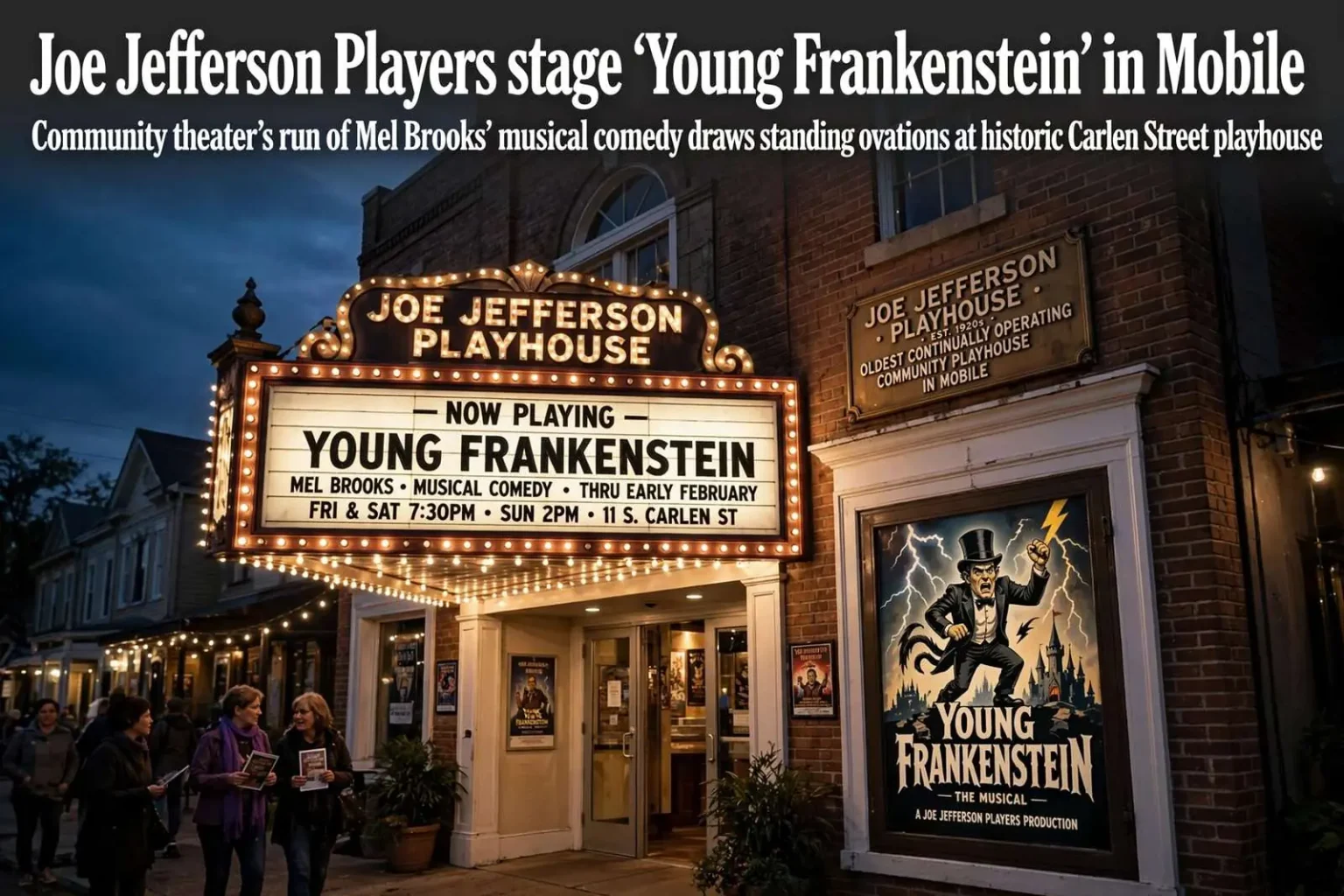
The Joe Jefferson Players are bringing Mel Brooks’ musical comedy Young Frankenstein to the stage at the oldest continually operating community playhouse in Mobile. The production runs through early February at the theater at 11 S. Carlen St. Performances are scheduled Fridays and Saturdays at 7:30 p.m., with a Sunday matinee at 2 p.m. The opening weekend drew a standing ovation from audience members mid-show, and remaining performances are selling quickly — a sign that word of mouth is doing exactly what community theater hopes it will.
The show itself needs little introduction to anyone who knows the source material. Young Frankenstein began as Mel Brooks’ 1974 film, a black-and-white parody of the classic Universal horror pictures, and it went on to be ranked among the greatest comedies ever made before Brooks adapted it for Broadway in 2007 with a full musical score. The stage version keeps the story: Frederick Frankenstein, the respectable American grandson of the infamous Baron, inherits the family castle in Transylvania, insists on distancing himself from his grandfather’s infamous experiments, and inevitably finds himself hunched over the slab with a lightning-charged creation of his own. Songs like “Putting on the Ritz” — in which the monster performs the Irving Berlin standard in top hat and tails — anchor a score built entirely for laughs, and the show’s humor runs from broad slapstick to rapid-fire parody.
Mounting that kind of show is a deliberate choice for a community theater. The musical demands a large cast, quick scene changes, elaborate sets that shift from a train station to a castle laboratory, and effects that have to land night after night. For the Joe Jefferson Players, taking it on is a statement of ambition, and the mid-show standing ovation on opening weekend suggested the gamble paid off with the audience that matters most — the one in the seats.
The House on Carlen Street
The Joe Jefferson Playhouse has operated at its Midtown Mobile home on Carlen Street for generations, and its claim as the oldest continually operating community playhouse in the city carries real history. Community theater in Mobile reaches back to the early twentieth century, when the company that bore the name of Mobile-born actor Joe Jefferson — the performer whose Rip Van Winkle made him one of the most famous American stage actors of his era — began mounting productions for local audiences. Through wars, hurricanes and changing entertainment habits, the playhouse has kept producing, sustained by volunteers who build sets, sew costumes, run lights and fill the stage season after season.
The theater’s place in Midtown gives it a neighborhood character that larger venues cannot replicate. The house is intimate enough that a mid-show ovation becomes a shared experience between cast and audience, and the lobby on a performance night doubles as a gathering place for the city’s theater-going community. Productions there rely on the same formula as the one behind Young Frankenstein: local performers with day jobs and classes rehearsing evenings and weekends for the love of the craft, backed by seasoned directors and volunteers who have mounted hundreds of shows between them.
The run is directed by Gene Murrell of local radio station 92.1 Zew, with music direction by Daniel Driskell and choreography by Rebekah Howard. Murrell’s day job on the radio gives him a natural ear for comic timing and musical performance, and pairing him with a music director and choreographer spreads the show’s three main disciplines — staging, singing and dancing — across specialists. In a musical as physically demanding as this one, where the ensemble dances through number after number while executing comedy bits, that division of leadership is essential.
A Cast Assembled From Across the Community
The cast blends high school students, college theater majors, adult character actors, professional musicians and regional dancers. That mix is the defining feature of community theater casting, and in a show like Young Frankenstein it becomes part of the performance itself. High school students bring energy and fearlessness to ensemble numbers; college theater majors arrive with training and technique; veteran character actors carry the comic weight of roles that demand split-second timing; and dancers and musicians raise the overall polish of the production. An audience watching the show sees those layers working together, often within the same scene.
Assistant director Kirk Corley said the gathering of local talent makes this version of the show one that will not be repeated. The observation is literal as much as sentimental: casts change, students graduate, and the specific combination of performers assembled for this run will never appear on that stage together again in quite the same way. Community theater productions are ephemeral by nature — there is no touring cast, no recording, no revival — which gives each run the quality of a local event that exists only for the weeks it plays.
Ensemble member Finn Jasgur noted that some of the funniest moments were invented by the cast rather than borrowed from the original Broadway production. That kind of invention is how Mel Brooks’ material rewards performers: the script and score set the framework, but comic beats — a double take, a stumble, an added visual gag — are the cast’s to discover in rehearsal. For audiences who know the film or the Broadway staging, those original touches are part of the draw, since they make the show something more than a reproduction of familiar material.
Special effects, a full live band, creative costumes and original routines add to the experience. The laboratory scenes at the center of the story demand the kind of stagecraft that stretches a community theater’s technical volunteers — lightning effects, apparatus that must convincingly suggest a reanimation experiment, and a monster whose movements and makeup define the production’s centerpiece. A live band, rather than recorded tracks, gives the musical numbers their punch and the performers flexibility in timing, while costume work carries much of the comedy, from Transylvanian village dress to the show’s most famous musical number. Routines staged specifically for this cast add choreography that exists nowhere else in any production of the show.
Volunteer crews spend weeks before opening night building the castle interiors and laboratory set pieces that the story moves between, and the quick transitions the script demands become a point of pride for the stagehands executing them in the dark. Audiences rarely see that work directly, but a musical of this scale depends on it, and the smoothness of the opening weekend performances reflected the same volunteer dedication that has kept the playhouse running for generations.
The production’s success so far reflects the playhouse’s ongoing season strategy of alternating dependable favorites with shows that challenge its volunteers and cast. A big musical comedy does both: it fills seats, and it gives the theater’s technical crews and younger performers experience with material they would otherwise only see professionally. The standing ovation that arrived mid-show during opening weekend — before the finale, when ovations usually come — is the kind of audience reaction that spreads through a community quickly, and the pace of ticket sales for the remaining dates indicates it has.
Why the Remaining Performances Matter
Only a handful of performances remain, and organizers encourage audiences to catch the show while it is in town. The schedule leaves Friday and Saturday evenings at 7:30 p.m. and a Sunday matinee at 2 p.m. as the remaining chances to see the production, and community theater does not extend runs the way commercial tours do. When the last curtain falls, the set comes down, the costumes go into storage, and the cast scatters back to classrooms and day jobs until the next production begins.
For Mobile audiences, the run is also a chance to see the breadth of local performing talent in one place. The same stage that hosts the show’s professional-caliber musicians and trained dancers also fields high school students making their first appearances before a paying crowd, and part of the pleasure of community theater is watching that pipeline in action — the ensemble member this season who carries a leading role three seasons from now. Supporters of the playhouse often describe that continuity as the real product: a theater education and a performance tradition that has continued on Carlen Street longer than nearly any cultural institution in the city.
Practical notes for attendees are simple. The theater sits at 11 S. Carlen St. in Midtown, with performances on the Friday-Saturday-Sunday schedule through early February, and patrons are advised to secure tickets in advance given the pace of sales. Mel Brooks’ comedy rewards an audience that arrives ready to laugh at material that is deliberately, cheerfully absurd, and the cast’s original touches give even those who know the film by heart something new.
As the run moves through its final performances, the production stands as a strong entry in the playhouse’s long history: a demanding Broadway musical, staged with a live band and full effects by a cast drawn from every corner of the community, directed by a local radio personality and cheered by an audience that could not wait for intermission to get on its feet. For the Joe Jefferson Players, that is the tradition continuing exactly as intended.