Judge Denies Marco Perez Youthful Offender Status; Accused Cop Killer Pleads Not Guilty
A Mobile judge denied Marco Perez youthful offender status and he pleaded not guilty in the capital murder case of Officer Sean Tuder.
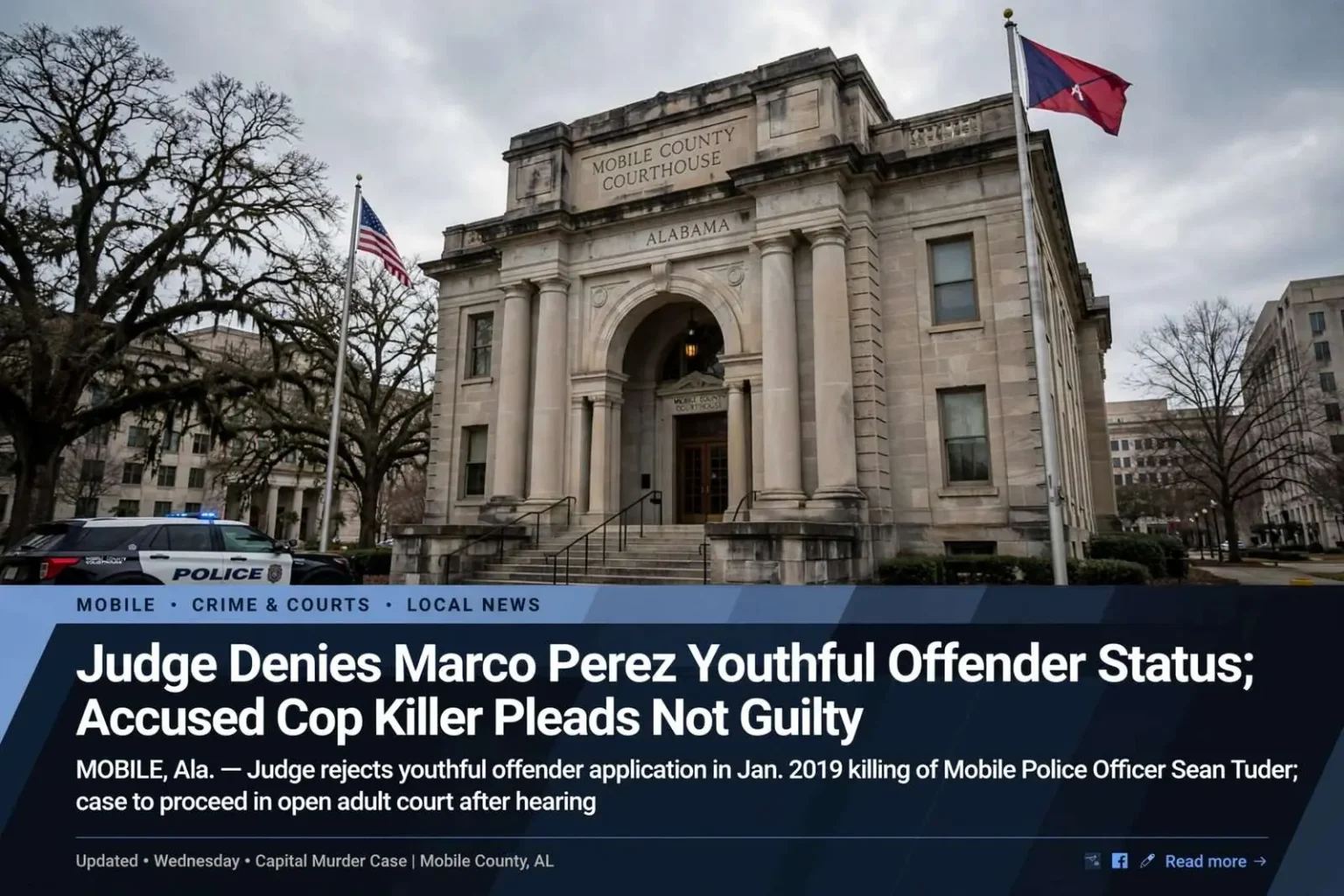
MOBILE, Ala. — A Mobile judge has denied accused cop killer Marco Perez’s application for youthful offender status, and Perez pleaded not guilty to all charges. The ruling means the case arising from the January 2019 killing of Mobile Police Officer Sean Tuder will proceed in open adult court rather than in the confidential, sealed process Alabama law provides for qualifying young defendants. The decision came after a hearing in which prosecutors and defense lawyers disputed not just the law but the accuracy of the factual record itself.
During the Wednesday hearing, the judge asked the state whether it opposed anything in the youthful offender application. Prosecutors pointed to a passage in the report they said was inaccurate — a line stating Perez raised his hands and backed away when Officer Tuder got out of his car. The state asked that the sentence be stricken from the record; the judge said he would note the state’s objection but that the passage would remain. The exchange previewed what both sides expect to be a central fight at trial: what happened in the seconds before the shooting, and what Perez could have known about the man getting out of the vehicle.
The state also cited Perez’s prior record in opposing youthful offender treatment, including previous charges of breaking and entering into vehicles and third-degree burglary. Under Alabama law, youthful offender status is available to defendants under a certain age at the time of their offense, and a grant carries major consequences: any sentence is limited, and the court file is kept confidential. Prosecutors argued the prior charges weighed against extending that protection in a case of this magnitude.
The defense raised Alabama’s stand-your-ground law in connection with the shooting that killed Tuder, arguing Perez had been granted youthful offender status before and could receive it again, and that this was not the typical case of a uniformed officer being shot and killed. The argument sought to frame the encounter as a confrontation with an unidentified driver rather than a police ambush — a framing the state flatly contests.
The dispute over what the video shows
Defense lawyers argued there was no way Perez knew Tuder was a police officer, while the state said it believes the two had interacted before the shooting. That prior-contact allegation, if proven, would undermine the claim that the encounter was a random, mistaken confrontation, and prosecutors signaled it will be part of their case when the matter reaches a jury.
The defense laid out its account in detail: that on the day of the shooting, Tuder pulled up in an unmarked Volkswagen with no identification except a badge on his side, and that Perez raised his hands and backed up before the altercation. Lawyers for Perez pointed to video and witness testimony they said supported that sequence, arguing the physical evidence shows a retreat, not an ambush, and that the burden of disproving self-defense rests with the state once the claim is properly raised.
Prosecutors, for their part, have treated the shooting of Tuder as a capital case. The officer was killed in January 2019 while investigating at a west Mobile apartment complex, a death that shook the police department and prompted an outpouring of public support across the city. The Mobile County District Attorney’s Office has said the evidence, including the alleged prior contact between the two men, shows Perez knew or should have known he was dealing with an officer.
What youthful offender status means in Alabama
The stakes of the status question are hard to overstate. Alabama’s youthful offender law, passed in the 1970s, allows defendants who were under 21 at the time of an alleged offense to apply for treatment as minors in the eyes of the court. If a judge grants the status, the maximum exposure shrinks dramatically — sentences are capped far below what adult court allows — and the proceedings, records and identity of the defendant are shielded from public view. A denial, like the one issued this week, sends the case into the ordinary adult docket, where the most serious charges can carry the heaviest penalties the law permits.
Judges considering these applications weigh the nature of the offense, the defendant’s prior record, the interests of justice and the prospect of rehabilitation. Prosecutors argued that a prior history including breaking and entering into vehicles and third-degree burglary cut against rehabilitation claims, while the defense emphasized Perez’s age and his earlier grant of youthful offender status in a previous case. The judge’s ruling means those arguments will not be revisited in this case, and the defense’s remedy lies in the trial itself and any later appeal.
The not-guilty pleas entered at the hearing formally set the case for the trial process. Courts in Mobile County handle capital-murder dockets on a slower track than ordinary felonies, given the volume of evidence, the number of witnesses and the penalty questions such cases raise. The parties now face a schedule of pretrial hearings, motion practice on the self-defense claim and discovery that will include the video the defense says supports its account.
The road ahead in the case
Perez is to have a status hearing Jan. 30, and the state said a trial was set for August 2020. Status hearings in the local system are checkpoints where the judge confirms that discovery is proceeding, motions are on track and the trial date remains realistic; they also give the defense and prosecution a public occasion to raise scheduling conflicts. Whether the August 2020 trial date holds will depend on how those intermediate steps go, particularly any rulings on the stand-your-ground argument.
A stand-your-ground defense in Alabama permits a defendant to claim immunity from prosecution if a judge finds the use of force was justified under the statute, which removes the duty to retreat before using deadly force in places a person lawfully occupies. Successful immunity claims end cases before trial; unsuccessful ones leave the same evidence to be argued again before a jury. The defense’s description of an unmarked car, a hidden badge and a retreating suspect is built for that framework, and the state’s response — prior contact, and a claim that the account contradicts the video — is built to defeat it.
For the Tuder family and the Mobile Police Department, the hearing was another step in a case that has moved through the courts since the January morning the officer was shot. Officers across the city wore mourning bands in the days after the killing, and the department has followed the prosecution closely. For Perez, the denial of youthful offender status forecloses the confidential path and puts every remaining question — what the video shows, whether the men met before, and what happened in the final moments — before a public trial and, ultimately, a jury.
How the case has moved since January
The case began in the days after Officer Tuder was shot while working at an apartment complex off Cottage Hill Road in west Mobile, an area the department had been focusing on during an initiative to combat vehicle break-ins and thefts in the corridor. Investigators made an arrest within days, and prosecutors moved quickly to secure capital charges, citing the killing of a law enforcement officer acting in the line of duty. Since then the file has grown through grand jury indictment, arraignment and a series of preliminary hearings.
Along the way, the youthful offender application became the first major strategic battle. For the defense, the application was both a long-shot effort to cap exposure and a chance to preview evidence — including the video and witness accounts — in a setting where the state had to respond. For prosecutors, opposing it preserved the full sentencing range a capital case carries and locked in their position on the record early. Wednesday’s ruling resolved that battle in the state’s favor, and the record built during the application fight now travels with the case into trial preparation.
Legal observers in the community expect the stand-your-ground immunity question to be the next inflection point. An immunity hearing, if the defense formally requests one, would put officers, witnesses and the video at the center of a contested evidentiary proceeding months before trial, and its outcome would shape plea discussions if any occur. The state’s belief that Perez and Tuder had interacted before the shooting will likely be a centerpiece of that hearing, because prior familiarity with an officer undercuts a claim of mistaken identity about who was in the car.
In the meantime, the January 30 status hearing will set the near-term calendar, and the August 2020 trial window stands as the date both sides are building toward. What will not be part of the case, as of this week, is any possibility of confidential juvenile-style proceedings: the denial of youthful offender status means the trial, whenever it happens, will be public, the records open, and the verdict rendered in the plain light of an adult courtroom in Mobile County.