
Judge Michelle Thomason joins University of Mobile Foundation board
Presiding District Judge Michelle Thomason has joined the University of Mobile Foundation board and is running for the Alabama Court of Civil Appeals.
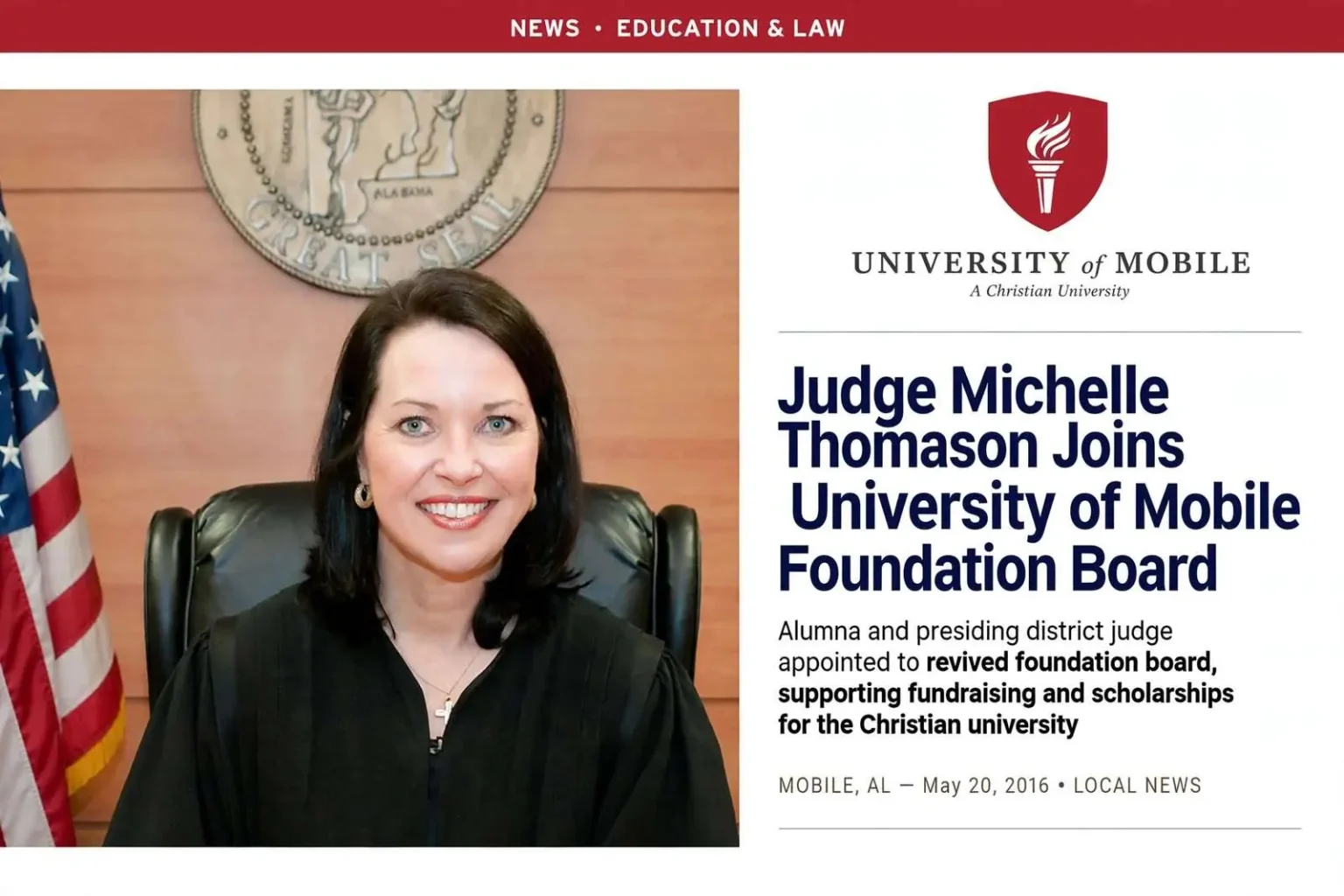
A local judge has been asked to join the board of directors of the University of Mobile Foundation, according to an announcement from the school. Presiding District Judge Michelle Thomason said in a press release that she has been invited to serve on the foundation’s board, adding a sitting judge and university alumna to the body that supports the private Baptist university’s fundraising and endowment efforts.
The foundation had been dormant for many years but has been revived, according to the announcement, and its reactivation marks a renewed effort by the university to organize its charitable giving and long-term financial support. The University of Mobile, a private institution affiliated with the Alabama Baptist State Convention, sits in the Kayowee area of west Mobile, and like most small private colleges it depends heavily on donor support, scholarships, and endowment income to keep tuition within reach of its student body.
A graduate of Mobile College’s last class
Thomason is a graduate of the University of Mobile, part of the last class to graduate when the school was still called Mobile College. The name change — from Mobile College to University of Mobile — came as the institution expanded its graduate offerings and sought a designation that reflected its broader academic scope, and Thomason’s class thus occupies a particular place in the school’s history: the final group to carry the founding name before the university era began.
“The University of Mobile provided me and other members of my family with a tremendous Christian education, and laid a rock-solid foundation for me to further my education in law,” she said in the announcement. The statement ties her judicial career directly to her undergraduate years, and it reflects the university’s emphasis on pre-law preparation among its programs. For the revived foundation, a board member who can speak to that journey from Mobile College classrooms to the district bench offers a ready-made story for donor outreach.
The foundation’s role at a small university
A university foundation is the institution’s principal fundraising arm, holding and managing donated assets, soliciting major gifts, and connecting alumni and community leaders to the school’s financial needs. Foundations at small private universities typically steward endowed scholarships — the lifeblood of schools whose students often rely on substantial aid packages — along with funds for facilities, academic programs, and faculty support. A dormant foundation, as the University of Mobile’s had been for many years, leaves that work to the institution’s general administration; a revived one rebuilds the structured donor pipeline that peer institutions maintain as a matter of course.
Boards of such foundations are usually stocked with alumni, business leaders, and professionals whose community standing helps attract gifts. Thomason’s professional profile — a presiding district judge — fits that pattern, bringing legal-world credibility and visibility in Mobile County’s civic life. Her service on the board also links the university to the county’s court system in a visible way, the kind of community connection that schools of the university’s size cultivate deliberately.
The 2016 appeals court campaign
At the time of the announcement, Thomason was running for a seat on the Alabama Court of Civil Appeals, a statewide judicial race that put her name in front of Republican primary voters across Alabama. She faced Alabama Tax Court Judge Christy Olinger Edwards in the runoff election for the Republican nomination, with the two vying for a seat now held by Civil Appeals Judge Craig Pittman, who was retiring. In Alabama, where Republican primaries frequently decide statewide offices, the runoff represented the decisive stage of the contest.
The Alabama Court of Civil Appeals sits in Montgomery and hears appeals in civil matters — domestic relations cases, including divorce and child custody; workers’ compensation; and appeals from administrative agencies — alongside the criminal appeals and other matters handled by its sister court. Five judges sit on the court, and its docket makes it one of the most consequential appellate bodies for Alabama families, since custody, support, and benefits disputes pass through it in volume. Pittman’s retirement opened one of those five seats, drawing the field of candidates that produced the Thomason-Edwards runoff.
Thomason’s own bench experience positioned her for the race. As a presiding district judge, she held the administrative leadership post at the trial-court level, overseeing the district court’s operations in addition to her docket. District judges in Alabama handle misdemeanor criminal cases, small claims, preliminary hearings in felonies, and civil matters up to the district threshold — a volume docket that gives presiding judges wide exposure to the kinds of civil disputes, particularly domestic relations matters at the district level, that the Court of Civil Appeals reviews.
Campaign season on the foundation board
The timing of the foundation announcement, during an active statewide campaign, illustrates how Alabama judicial candidates build coalitions across the state’s civic institutions. Service on a university foundation board signals roots and community standing to voters, while the university gains a board member whose statewide profile raises the school’s own visibility. Neither the university’s announcement nor the campaign statement suggested any conflict between the two roles; foundation boards are civic positions, and Alabama judicial candidates commonly hold them.
For the University of Mobile, the announcement doubled as evidence that the revived foundation intended to recruit board members of genuine prominence rather than treat the reactivation as a formality. An alumna on the appeals-court campaign trail, crediting the school — in her words — with laying a “rock-solid foundation” for her legal education, is precisely the kind of ambassador a small university’s fundraising arm wants on its letterhead.
The University of Mobile in the local landscape
The University of Mobile occupies a distinctive niche among Alabama’s private colleges. Founded in 1961 through the leadership of Mobile’s Baptist community, the school grew from a junior-college-style start into a four-year institution offering programs in nursing, business, education, music, Christian ministry, and the liberal arts. Its campus in west Mobile serves a student body drawn from the Gulf Coast region and beyond, and its Christian identity shapes both its curriculum and its community life — the “tremendous Christian education” Thomason cited in her statement.
The school’s alumni network across Mobile County’s professions — law, medicine, education, ministry, and business — represents exactly the donor and leadership pool a foundation board draws from. The Mobile College era, which ended with the name change, produced a cohort of graduates who remember the school under its founding name, and alumni of that era often carry particular loyalty to the institution’s founding mission. Thomason’s place in the last Mobile College class makes her a bridge figure between the founding generation of alumni and the university’s present identity.
What the civil appeals seat means for the region
The seat Thomason sought matters to Gulf Coast residents in practical terms. The Court of Civil Appeals reviews the trial courts of southwest Alabama — including Mobile County’s circuit and district courts — in the civil and domestic matters that fill its docket, and its rulings shape how custody standards, workers’ compensation claims, and agency appeals are resolved across the state. A judge from Mobile joining the court would give the region’s perspective a voice on a bench whose members historically come from communities across Alabama.
The runoff against Christy Olinger Edwards, a judge on the Alabama Tax Court, paired two sitting judges with appellate ambitions, a common dynamic in Alabama’s down-ballot judicial races where bench experience is the currency of credibility. Craig Pittman’s retirement created the opening, and the Republican runoff would determine which of the two candidates advanced toward the seat. Whatever the outcome, the campaign itself advertised the University of Mobile connection, since Thomason’s biography — and her foundation board service — featured her alma mater prominently.
The announcement of her foundation role thus landed at the intersection of the university’s institutional revival and the judge’s statewide campaign: an alumna invited onto the board of a newly reactivated foundation, crediting the school with her legal foundation, while asking Alabama’s voters for a promotion to the appellate bench. Both stories, the foundation’s and the campaign’s, were versions of the same theme — a Mobile institution’s graduate giving back to the community that formed her.
For university supporters watching the foundation’s relaunch, the recruitment of a sitting presiding judge offered a template for the board’s future composition: alumni with standing in the professions, willing to lend their names and networks to the school’s giving operation. Foundation boards succeed or fail on the engagement of exactly such members, and the university’s decision to announce Thomason’s appointment publicly signaled that the revived body intends to operate in the open, with named community leaders rather than anonymous stewardship. The approach mirrors foundations at larger institutions across the state.