Jurassic Quest Brings Life-Size Dinosaurs to the Mobile Convention Center
Jurassic Quest brought more than eighty life-size animatronic dinosaurs, real fossils and family rides to the Mobile Convention Center for a three-day run.
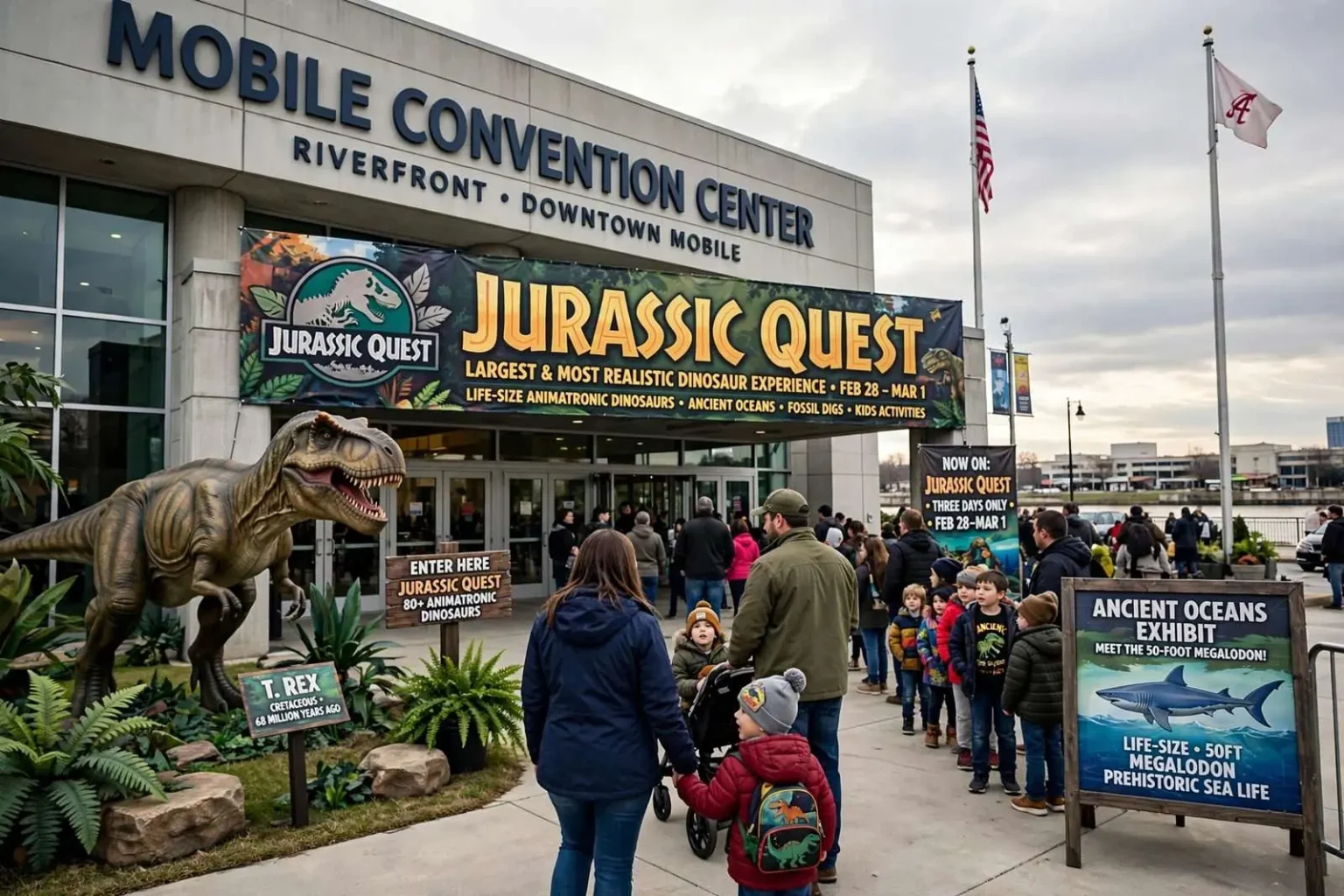
Dinosaur lovers along the Gulf Coast had a rare chance this winter to come face-to-face with creatures from tens of millions of years ago. Jurassic Quest, a touring exhibition billed as the largest and most realistic dinosaur experience in North America, set up shop at the Mobile Convention Center for a three-day run from February 28 through March 1. The event transformed the downtown riverfront venue into a prehistoric landscape, drawing families from Mobile, Baldwin County and the Mississippi Gulf Coast for a weekend built around life-size dinosaurs.
The exhibit walked visitors through the Cretaceous, Jurassic and Triassic periods, with a single ticket also covering an “Ancient Oceans” section built around prehistoric sea life. Its centerpiece was a moving, life-size, 50-foot-long Megalodon — the largest apex predator known to have existed — alongside giant prehistoric sea turtles and early dolphins. The ocean gallery gave visitors a look at a side of prehistoric life that land-based dinosaur exhibits rarely touch, reproducing the seas that once covered much of what is now the Southeast.
More Than Eighty True-to-Life Replicas
According to organizers, Jurassic Quest is the only dinosaur event featuring more than eighty true-to-life animatronic dinosaur replicas, ranging from tiny species to towering giants that move, roar and roam the hall. The replicas were created in collaboration with leading paleontologists, and visitors could get close to baby dinosaurs as well as walking adolescent ones. The scale of the exhibition required the full floor of the convention center, with the hall’s riverfront views temporarily replaced by Cretaceous scenery.
The animatronics are the event’s signature. Built on steel frames and driven by programmed motion systems, the dinosaurs blink, breathe, swing their tails and announce themselves with recorded roars calibrated to startle without terrifying the youngest guests. Tall-necked sauropods tower over the crowd paths, while predators like the Tyrannosaurus rex anchor the exhibition’s most crowded viewing areas. Handlers and signage throughout the hall orient visitors to each species and its era.
The walk through geological time gives the exhibition an educational spine. The Triassic period, which began more than 200 million years ago, saw the first dinosaurs emerge on a supercontinent whose eventual breakup shaped the continents of today. The Jurassic brought the giants — the long-necked plant eaters and the earliest great predators — while the Cretaceous, ending 66 million years ago with the asteroid impact that ended the age of dinosaurs, produced many of the most famous species, from Triceratops to T. rex.
For many Gulf Coast families, the three-day run was a first opportunity to see creatures of that scale without a long drive to a major city museum. Touring exhibitions fill that gap in mid-sized markets like Mobile, and the convention center’s downtown location put the event within walking distance of restaurants and hotels, letting visiting families make a weekend of it.
Hands-On Paleontology for Kids
Beyond the roaring animatronics, the event packed in activities for every age group. A paleontology station let children dig for fossils themselves, while a dinosaur museum displayed real fossils dating back more than 60 million years, including bones originally unearthed in North America. The fossil dig — a staple of the touring show — gives young visitors the experience of brushing sand away from embedded replicas, teaching them how paleontologists actually work: slowly, with brushes, patience and careful notes of where each piece was found.
The museum section grounds the spectacle in real science. Actual fossils — teeth, bones, imprints — let children see the physical evidence behind the animatronic displays, and docents walk families through what each specimen shows about the animal it came from. Organizers have long positioned the educational components as the event’s core, aiming to turn a weekend outing into the start of a lasting interest in science.
Dinosaur-themed rides, bounce houses, science stations, a dino cinema, baby and walking dinosaur shows, face painting and craft stations rounded out the lineup, making it a full family outing for Mobile-area parents looking to occupy school-age kids over a weekend. The walking dinosaur shows, in which costumed and puppeteered creatures parade through the hall, reliably produce the loudest reactions from the crowd, while the rides and inflatables give toddlers and younger siblings their own attractions away from the more intense animatronic displays.
A Big Weekend for Downtown Mobile
The Mobile Convention Center, on the city’s riverfront downtown, regularly hosts a calendar of trade shows, banquets and consumer events, and family-oriented exhibitions like Jurassic Quest fill a distinctive niche. Such events draw from a wide radius — families drive in from Baldwin County, Mississippi and the Florida Panhandle — and the spending follows: downtown restaurants, parking garages and hotels all see the bump over a three-day run. Convention officials have worked to broaden the venue’s mix beyond business conferences, and a high-profile family exhibition supports that effort.
The February 28 through March 1 dates also positioned the event in a seasonally quiet stretch, after Mardi Gras season winds down and before spring events begin, giving downtown an attraction during what can otherwise be a slower stretch of the calendar. For parents, the timing landed neatly in late winter, when options for keeping school-age children entertained indoors grow thin.
The popularity of dinosaur exhibitions shows no sign of fading. Jurassic Quest and similar tours routinely post strong attendance across mid-sized American cities, and the format has evolved with each generation of animatronics — the current replicas move more smoothly and look more lifelike than earlier versions, and the addition of marine prehistoric life has widened the appeal. Organizers say the combination of scale, science and rides is what sets the show apart from smaller traveling exhibits.
For the children who spent the weekend face-to-face with a roaring T. rex or digging their first fossil, the experience is designed to stick. Organizers note that many of today’s paleontologists describe childhood dinosaur obsession as the spark that started their careers — and if Mobile’s young visitors took home that spark along with their face paintings and craft projects, the exhibition’s three days on the Gulf Coast will have done more than entertain.
The Megalodon and Alabama’s Prehistoric Past
The Ancient Oceans centerpiece — the 50-foot Megalodon — connects to a history Alabamians can find in their own backyards. Fossilized Megalodon teeth are found along Gulf Coast waterways and beaches, and Alabama’s Cretaceous-era chalk deposits in the Black Belt region have produced some of the most important marine fossils in North America, including mosasaurs and ancient sea turtles. The state even claims one of the most complete mosasaur skeletons ever discovered, and the Alabama State Fossil is a prehistoric whale — Basilosaurus cetoides — whose remains dot the same ancient seafloor deposits.
That context makes the exhibition’s marine section especially resonant for local visitors. Much of what is now the southeastern United States lay under shallow seas during the age of dinosaurs, and the fossil record across Alabama and Mississippi documents the giant sharks, reptiles and early whales that swam above it. A child who digs for a fossil replica at the exhibition can hunt for the real thing along Alabama creeks, where shark teeth weather out of the same formations.
The Megalodon itself, an extinct species of giant shark that lived from roughly 23 million to 3.6 million years ago, dwarfs any shark alive today, with adults estimated to reach lengths approaching 50 feet or more. The animatronic reproduction at the convention center gave visitors a visceral sense of that scale — a creature whose jaws could dwarf an adult standing inside them, prowling seas that also held the giant turtles and early dolphins represented in the gallery.
Organizers built the three periods of the dinosaur era into the layout so families experience the chronology as a journey. Interpretive panels explain what separated the Triassic world from the Jurassic and the Cretaceous — different continents, different climates, different plant life — and the animatronic casts reflect those eras rather than mixing all the famous species into one anachronistic scene. The approach has earned the exhibition praise from teachers and museum professionals who value accuracy alongside entertainment.
The Economics of a Touring Exhibition
Bringing a show of this scale to Mobile represents a substantial logistical undertaking. Animatronic dinosaurs, inflatables, rides and fossil displays travel on multiple tractor-trailers, with a crew that loads in, assembles, operates and strikes the exhibition over the course of a few days. Convention centers compete for such tours because they generate ticket revenue for the promoter and measurable visitor spending for the host city, and mid-sized venues like Mobile’s offer the kind of open floor space the largest displays require.
The three-day Mobile run fit the pattern of the tour’s other Southeast stops, with sessions timed across the weekend to manage crowds. Families moved through at their own pace, and the show’s design — wide aisles around the big animatronics, activity stations spaced around the perimeter — kept traffic flowing even during peak hours. Organizers also offered timed considerations for younger children sensitive to the louder elements of the exhibition.
For downtown Mobile, the weekend added to a run of family tourism growth that the city has cultivated alongside its convention business. Visitors who came for dinosaurs found a walkable downtown with restaurants, the riverfront and attractions nearby, and tourism officials count such first visits as investments in return trips. The exhibition’s departure left the hall ready for its next event, but for the families who attended, the roar of a life-size Megalodon on the Mobile waterfront was the kind of weekend memory that lasts well past checkout.