
‘Just Recognized’: Downtown Mobile to Paint Black Lives Matter Mural for Juneteenth
Rainbow Mobile and arts groups painted a temporary Black Lives Matter mural on Conti Street near Cathedral Square for Juneteenth.
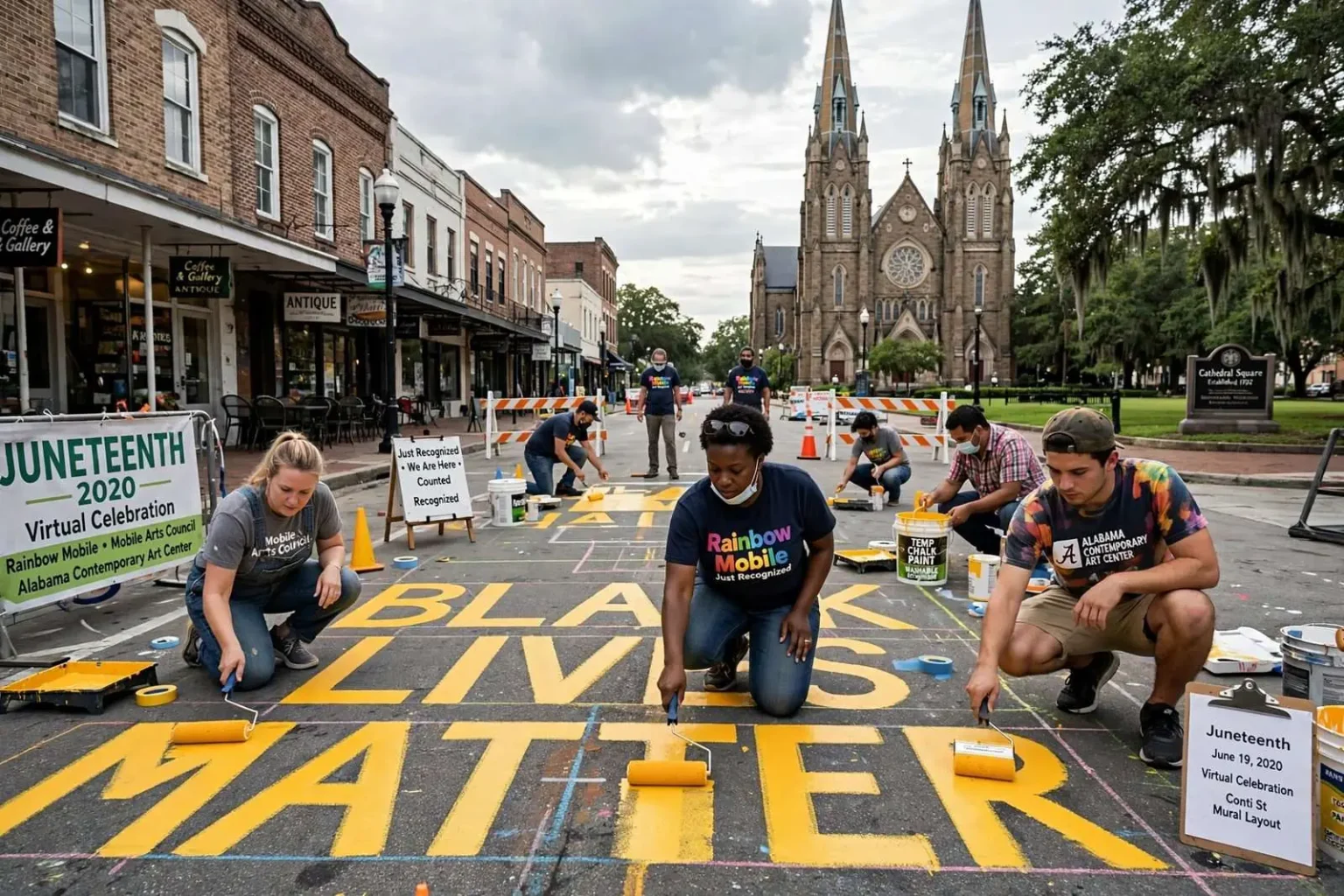
Mobile was set to join a growing list of American cities putting the Black Lives Matter message directly on their streets, with organizers planning to paint the words on Conti Street near Cathedral Square as part of a virtual Juneteenth celebration. The project would place Mobile among the municipalities that answered a summer of national protest with a physical statement of their own — twelve letters and a demand, painted on the pavement of one of downtown’s most visited blocks.
The location was chosen with care. Conti Street runs through the heart of downtown Mobile beside Cathedral Square, the grassy square fronted by the Cathedral-Basilica of the Immaculate Conception and framed by some of the oldest commercial blocks in the city. It is ground tourists cross on the way to restaurants and galleries, ground office workers cross every weekday, and ground steeped in the layered history of a city whose port once ranked among the South’s most consequential. Painting a message into that pavement puts it where Mobile cannot avoid seeing it — in front of the church spires, the historic markers, and the daily commerce of downtown.
The project brought together Rainbow Mobile, the Mobile Arts Council, the Alabama Contemporary Art Center, and other community groups, a coalition spanning advocacy, established arts institutions, and the city’s contemporary art community. Rainbow Mobile, an organization serving and advocating for the Gulf Coast’s LGBTQ community, anchored the organizing effort — an alliance reflecting how the summer’s racial justice protests drew support from across the spectrum of Mobile’s civic groups. The Mobile Arts Council and the Alabama Contemporary Art Center contributed the artistic infrastructure: lead artists, supplies, and the institutional weight of two organizations that anchor downtown’s cultural life.
Dozens of volunteers planned to gather Sunday afternoon to paint the mural using temporary chalk paint — a detail that shaped both the execution and the meaning of the project. Temporary paint makes the statement deliberately perishable: it will fade with traffic and rain, lasting weeks rather than years, and must be renewed to persist. Organizers in other cities made the same choice, trading permanence for the freedom to paint without permanently altering a public right-of-way, and in Mobile the format let the project proceed on city streets while the question of a permanent installation remained open.
From Momentum to Message
Organizers said they were inspired by similar murals in Washington, D.C., and Charlotte, and wanted to bring that energy home in the wake of protests over unarmed Black people being killed by police. The nation’s capital had painted the phrase in enormous yellow letters down the length of a street leading to the White House, renaming the block Black Lives Matter Plaza; Charlotte painted its own version uptown in front of government buildings. Those murals became landmarks — destinations for visitors, backdrops for photographs, and unavoidable statements to the cities that housed them. For Mobile’s organizers, the model demonstrated that a street painting could be more than decoration: it could reframe the ground itself.
“We want to take advantage of the momentum now to focus on racial justice,” said Bryan Fuenmayor of Rainbow Mobile, describing the window organizers felt open after weeks of protest. The phrase captured the project’s theory of change: movements have moments, and the work is to convert the moment’s attention into something the community continues to see, discuss, and act on after the news cycle moves on.
Lead artist Soynika Edwards-Bush said the mural was about visibility for Mobile’s Black community. “We want to be represented in the city in a positive way. Saying that we’re here. Just counted, just recognized,” she said. Her framing located the project in the Juneteenth context that gave it its occasion — the holiday marking June 19, 1865, when word of emancipation finally reached the last enslaved Americans in Texas, more than two years after the Emancipation Proclamation. Juneteenth celebrations in Mobile, as across the country, have always carried that theme of delayed recognition: a freedom announced but long withheld from common knowledge.
The “virtual” Juneteenth format distinguished Mobile’s celebration from the large gatherings other cities held that summer. With public health precautions reshaping community events during the pandemic era, organizers moved the commemorative programming — speeches, performances, reflections — online and concentrated the physical, distanced expression into the mural itself. The result inverted the usual structure: instead of a rally with a banner, it was a banner with a broadcast, the street painting serving as the gathering point while the crowd remained digital.
The mechanics of painting a street mural are more demanding than they appear from the finished product. Municipal-scale lettering is engineered from a template: the letters are measured and laid out with string and chalk lines to fit the street’s width, then filled block by block by volunteers working on their knees with rollers and brushes. Dozens of volunteers, as planned for Sunday afternoon, is about what a letter set the length of a city block requires — each participant assigned a section, the paint applied fast enough to finish before the traffic lanes must be restored. The collaborative painting process is itself part of the point, turning the mural’s creation into a public event visible to anyone passing the square that afternoon.
Conti Street’s proximity to Cathedral Square also places the mural inside the footprint of downtown’s arts economy. The square hosts the city’s regular art walks and market days; the Alabama Contemporary Art Center sits nearby, and the galleries and venues that participate in Mobile’s cultural calendar cluster within a few blocks. Painting the statement there ensures it is seen not only by commuters and diners but by the audiences — and the visiting press — that downtown’s cultural events draw, embedding the message in the very spaces where the city presents itself to visitors.
Fuenmayor said he hoped the physical statement would spark lasting dialogue. “I feel like the community really wants this project to happen,” he said. “I’m hoping this starts conversations with people.” That hope — dialogue rather than monument — matches the mural’s temporary medium. A fading painting invites the question of what comes next: whether the city will permit a permanent installation, whether the coalition that organized this one will carry the conversation into policy forums, school programs, and next year’s Juneteenth. The chalk paint sets a clock on the message, and organizers were explicit that the clock is the point.
Mobile’s project also joined a wider pattern playing out across the Gulf South that summer, as cities from New Orleans to Huntsville saw variations on the street-mural idea — some sanctioned and city-supported, others painted by volunteers overnight, each becoming a local referendum on the same message. In Mobile, the sanctioned route carried the project forward with institutional partners and a defined site, giving the statement the legitimacy of process along with its visibility.
What residents would find on Conti Street by Sunday evening was thus several things at once: a Juneteenth observance adapted to a summer of distance, a coalition of the city’s advocacy and arts organizations acting together, a piece of public art painted by dozens of local hands, and a demand spelled out in the pavement beside the city’s oldest square — visible to everyone who passes, counted and recognized, scheduled to fade unless the community decides it shouldn’t.
Juneteenth itself carries particular weight in the Gulf Coast region, and Mobile’s observance sits within a longer local history. The holiday’s origin in June 1865 came barely five months after the last major engagements of the Civil War had unfolded within reach of Mobile Bay, where Union forces had taken the city’s defenses at Spanish Fort and Blakeley in the spring campaign. For Black Mobilians, the Emancipation commemoration has been marked by generations of church services, parades, and family gatherings, and the city’s modern celebrations layer education, music, and civic recognition onto that foundation. Painting the mural as part of the Juneteenth observance placed a contemporary justice message inside one of the community’s oldest annual traditions — the newest expression of a commemoration that has always been about freedom promised and freedom delayed.
The involvement of Rainbow Mobile as lead organizer also illustrates how the summer’s protest wave built coalitions across causes. LGBTQ advocacy organizations in Southern cities have historically understood the mechanics of visibility campaigns — the marches, the storefront displays, the hard conversations with local government — and that experience translated directly into the mural project’s organizing. For the Mobile Arts Council and the Alabama Contemporary Art Center, participation represented public institutions lending their standing to a message that a municipal government had not yet acted on itself, a form of support that carried its own quiet statement about where the city’s cultural leadership stood.
For the volunteers who would kneel on Conti Street with rollers on Sunday afternoon, the project offered a physical form of participation that protest marches could not. Painting a mural is constructive rather than oppositional — building something in public, with neighbors, on the city’s own ground — and the finished letters then do their work silently for weeks, addressed to every driver and pedestrian who crosses them. Organizers in the cities that pioneered the format reported the same effect: the murals became stops on walking routes, subjects of school conversations, and daily encounters with a message that a visitor could not avoid and a resident could not claim never to have seen.
Whether Mobile’s mural outlasts its chalk paint depends, as organizers framed it, on the conversations Fuenmayor hoped to start. The project’s coalition — Rainbow Mobile, the Mobile Arts Council, the Alabama Contemporary Art Center, and the community groups beside them — laid out its theory plainly: take the momentum, put the message where the city lives, and let the community decide what should remain when the paint fades. On Conti Street beside Cathedral Square, that message was about to be twelve letters wide, temporary by design, and aimed directly at the future.