Kenny Scharf Returns to Mobile to Finish MOBLOBZ Mural at Free CLA Community Day
Artist Kenny Scharf returned to Mobile to complete his MOBLOBZ mural during a free Community Day at the Centre for the Living Arts on Conti Street.
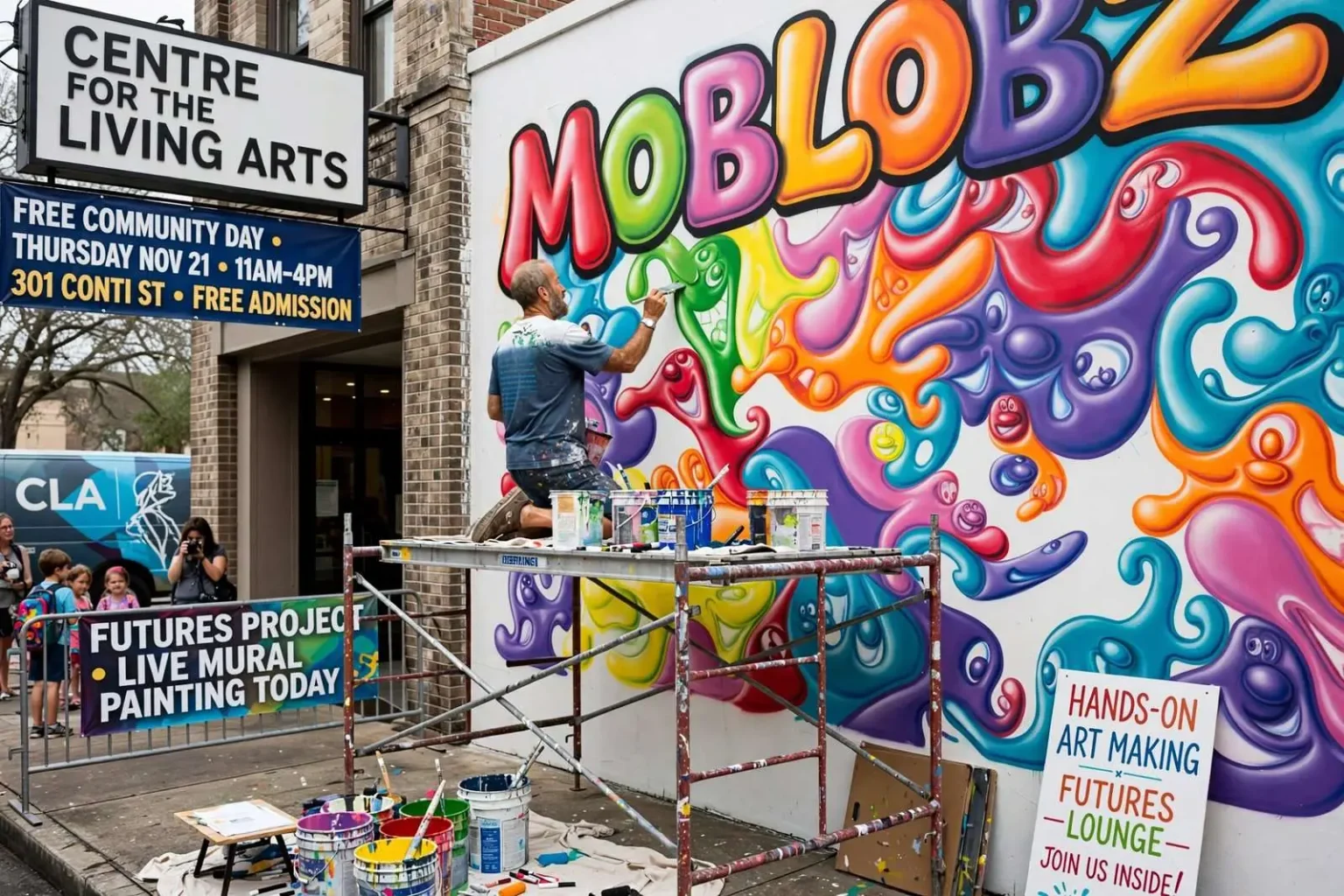
Pop-art favorite Kenny Scharf headed back to Mobile in November 2013 to put the finishing touches on “MOBLOBZ,” his vibrant mural gift to the city, and the Centre for the Living Arts threw open its doors for the occasion with a free Community Day.
The event ran Thursday, November 21, from 11 a.m. to 4 p.m. at the CLA, 301 Conti Street downtown, with admission free all day.
A working artist, up close
The draw wasn’t just free entry. Visitors could watch Scharf at work completing the mural in real time, a rare chance to see an internationally known artist mid-creation rather than admiring the finished piece after the scaffolding comes down.
Watching a muralist work is different from viewing a finished wall. The gestures, the color decisions, the moments when a shape gets rethought mid-stroke, all of it happens in front of an audience that can ask questions between coats of paint. For school groups, art students and curious passersby off Dauphin Street, the Community Day turned a gallery visit into a studio visit, with the artist answering questions while he worked rather than through a catalog essay afterward.
Scharf’s connection to Mobile had been building through the CLA’s Futures Project, his exhibition inside the gallery that anchored the season’s contemporary art programming.
His playful, candy-colored aesthetic, born of the 1980s East Village street scene alongside Keith Haring, made “MOBLOBZ” one of the most visible public art gestures downtown Mobile had seen.
Scharf emerged in that same downtown New York moment that produced Haring and Jean-Michel Basquiat, when young artists took spray paint, markers and borrowed walls and turned the Lower East Side into a gallery without doors. Trained at the School of Visual Arts and steeped in cartoon imagery, television kitsch and outer-space fantasy, he built a career on the conviction that art belongs to everybody, a philosophy that shows up everywhere from his joyous public murals to the immersive, black-lit “cosmic caverns” he has constructed in cities around the world. His work hangs in major museum collections, but his reputation rests just as much on the walls anyone can walk past.
“MOBLOBZ” carried that street-bred spirit into downtown Mobile. The mural’s tumbling, melting forms and saturated color scheme, rendered at a scale that dominates its wall, gave the city a permanent example of the energy that made the East Village scene famous, and it put Mobile in the company of the other cities, from New York to Miami to São Paulo, that have claimed Scharf walls as public landmarks. The title itself telegraphs the style: blobby, friendly, deliberately silly shapes that turn a blank facade into something between a cartoon and a dreamscape.
Hands-on for everyone
Alongside the live painting, the CLA set up Scharf-inspired art-making in its Futures Lounge, letting visitors try their own hand at the style. Families could also enter a drawing for a free family membership, extending the day’s giveaway spirit beyond the front door.
The hands-on component mattered as much as the headliner. Museums and arts centers have learned that the visitors who pick up a marker in the gallery are far more likely to come back than the ones who only look, and a Scharf-inspired project is an easy invitation: his forms are approachable, forgiving and fun to imitate, which is precisely why they work as a teaching tool. Children who met the artist’s shapes on the wall could walk a few steps and make their own versions, and parents who came for free admission left with a membership drawing entry and, the CLA hoped, a reason to return.
Family memberships carried the day’s logic forward. A free visit is a single afternoon, but a membership is a habit, and arts organizations trying to build an audience from scratch think in exactly those terms. The drawing turned a giveaway into a pipeline, one more way the CLA converted a one-day event into long-term attendance.
The CLA’s bet on public art
For a museum still working to cement downtown Mobile as an arts destination, the free Community Day doubled as an open invitation: world-class art, made in public, at no cost, a template for how the CLA hoped to keep Mobilians coming back to Conti Street.
The Centre for the Living Arts operated in the former Space 301 building on Conti Street, a downtown block that civic leaders had targeted for revival through the arts. Its programming strategy leaned on ambitious, accessible shows, the Futures Project exhibitions among them, that could pull in audiences who might not otherwise set foot in a gallery. A mural by an artist of Scharf’s standing served that strategy on every level: it put a recognizable name on the building, left a permanent artwork on the streetscape and gave the city a photograph-worthy landmark that advertises itself every day.
Why the moment mattered for Mobile
Downtown Mobile in 2013 was a city working deliberately to remake itself around culture. The renovation of Dauphin Street, the growth of loft conversions in the historic core and the steady addition of galleries, restaurants and music venues had given the city a downtown constituency that hadn’t existed a decade earlier, and institutions like the CLA were the anchors that strategy depended on. A free day built around a famous artist at work was designed for exactly that audience, and for the families across the city who might make their first trip downtown because admission was not a barrier.
Public art played its own role in the revival. Cities across the country had learned in the preceding years that murals do quiet economic work: they photograph well, they mark neighborhoods as destinations, and they signal that a place takes its streetscape seriously. Scharf’s wall, with its unmistakable blobs and colors, gave Mobile a piece of art that could stand beside the murals of Wynwood or the East Village as a reason to stop, look and take a picture, and its presence on Conti Street tied the museum’s mission to the sidewalk in front of it.
Scharf’s ethos and the day it visited Mobile
Everything about the Community Day matched Scharf’s career-long argument that art should not be guarded. An artist who began by painting abandoned cars and empty walls in 1980s New York, who built playable, glowing installations for children and who has consistently brought his work out of museums and onto streets, was the right figure for a museum trying to drop its guard entirely for a day.
For the visitors who came on November 21, the experience compressed that ethos into a few hours: watch a famous muralist finish a wall, make something of their own in the lounge, enter to win a year of gallery visits, all without spending a dollar. For the CLA, it was a demonstration of the model it believed in, world-class art delivered without friction to the people of Mobile, and for the city it was one more marker of downtown’s transformation, painted in candy colors on a wall that anyone could visit long after the scaffolding came down.
The Futures Project connection
The exhibition that anchored Scharf’s Mobile relationship was part of the CLA’s Futures Project, a programming initiative built around contemporary artists whose work speaks to where art is heading rather than where it has been. The idea behind the series was to give the Gulf Coast an early look at artists of consequence while they are still working, and Scharf, three decades into a career that began on New York’s streets, fit the series’ premise in an unusual way: historic enough to be collected by major museums, current enough to be painting new walls in new cities.
Hosting him for an extended project, an exhibition inside the gallery and a mural outside it, let the CLA present the full range of his practice. Gallery visitors saw the paintings and installations; the neighborhood got the wall. The two halves reinforced each other, and the Community Day sat at the junction, inviting everyone to see the connection between the two for themselves.
What visitors took home
A day like this leaves its mark in layers. The most visible is the mural itself, which stays on Conti Street as a landmark and a backdrop for countless photographs in the years that follow. Less visible is the audience effect: the students who watched a professional work at scale, the families who discovered that a downtown arts center is a manageable outing with children, and the adults who learned that contemporary art can be welcoming rather than intimidating.
The CLA’s staff built the day around those outcomes deliberately. Free admission removed the first barrier, the live painting supplied a reason to come at all, the lounge projects kept families engaged once they arrived, and the membership drawing offered a mechanism for staying connected. Each piece of the design answered a specific question about how to convert curiosity into attendance, which is the operational core of any arts organization trying to grow in a mid-sized Southern city.
By the time Scharf painted his final strokes on “MOBLOBZ,” Mobile had gained more than a mural. It had hosted an artist of international standing at work in public, given its residents a day of art without cost and demonstrated the accessibility model the Centre for the Living Arts hoped would define its future on Conti Street.