
Lending Tree Bowl still without city contract; venue uncertain
The 2021 Lending Tree Bowl lacks a finalized city contract and venue, with Mobile Mayor Sandy Stimpson's administration still in negotiations.
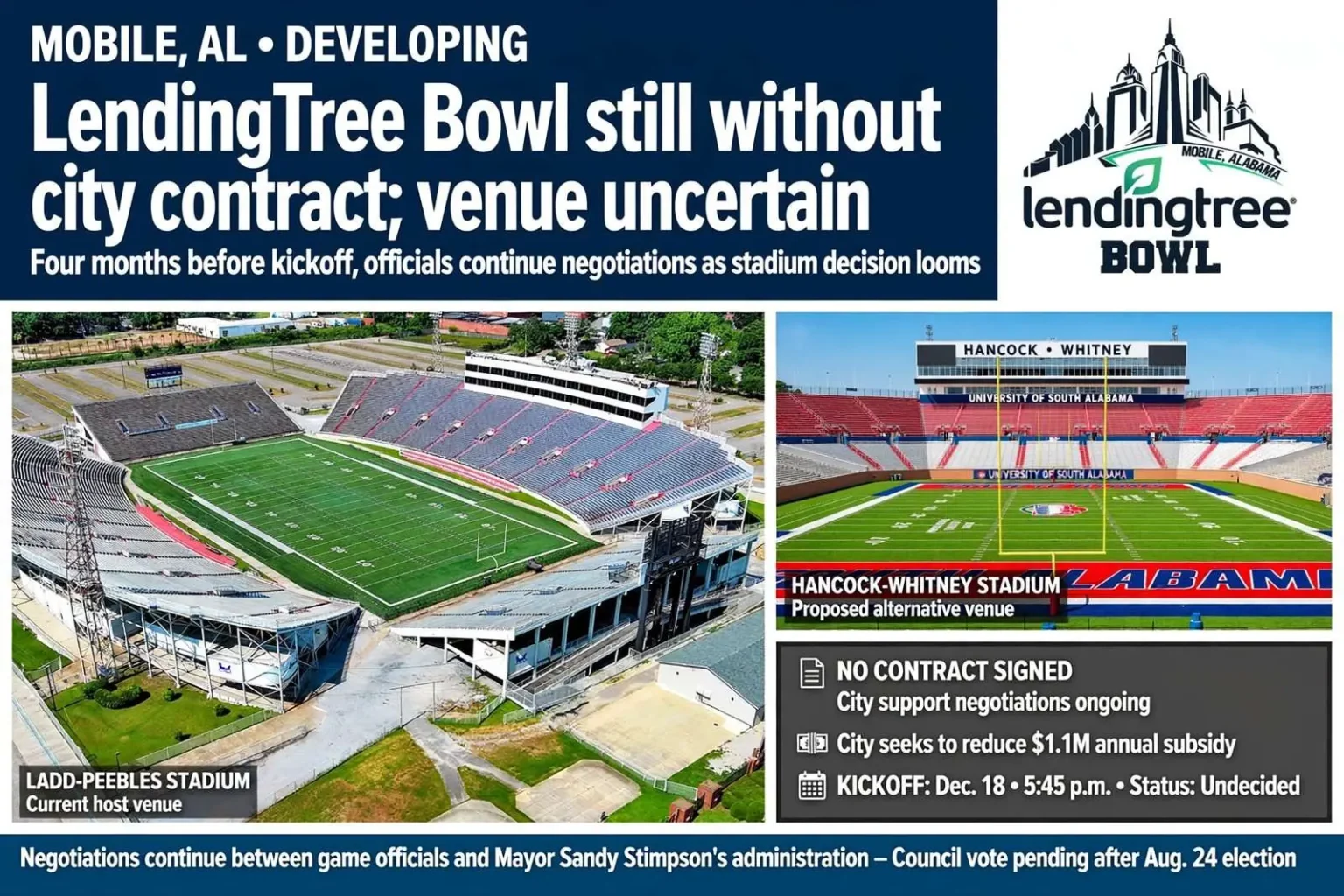
With the 2021 LendingTree Bowl about four months away, there is still no contract between game officials and the City of Mobile — and it remains genuinely unclear where the game will be played. Mayor Sandy Stimpson’s administration says it is “currently in negotiations with game officials,” but the absence of a signed agreement this close to kickoff leaves the December bowl’s status in Mobile in a state of limbo that neither side is attempting to hide.
The central sticking point is the city’s financial support. The previous contract, which expired after last December’s game, required the city to provide up to $1.1 million in support, minus whatever the title sponsor contributed. Stimpson has sharply criticized that arrangement, and the negotiating position his administration brings to the table reflects that criticism. For a mayor who has made fiscal discipline a defining theme of his tenure, a seven-figure annual subsidy for a bowl game has been a recurring target, and the renegotiation is the occasion to press that point.
The Sponsorship Math That Got Here
The subsidy’s escalation tells the story. Past title sponsors paid varying amounts toward the game’s support — GMAC up to $900,000 a year at the high point, GoDaddy $600,000, and Dollar General $200,000 — shifting more of the cost onto the city each time the naming rights changed hands. Last year, lender LendingTree paid $250,000, meaning Mobile taxpayers effectively covered about $850,000 of the gap. Each sponsorship transition moved the burden further from private industry and onto the city budget, a drift that Stimpson’s administration has argued is unsustainable for a game the city hosts but does not own.
The bowl’s value to Mobile is real, but so is the debate over who should pay for it. The game fills hotels and restaurants during a slow early-December week, puts the city on national television, and supports the hospitality economy that downtown has spent years building. Game supporters argue that spending is an investment that returns in lodging and sales taxes, while critics — the mayor’s office chief among them — counter that the subsidy has grown faster than the measurable benefit, and that a healthy bowl event should attract sponsorship capable of carrying its own weight. The contract negotiation is essentially that argument, conducted in term sheets rather than press releases.
Jerry Silverstein, president of the game, said he was unsure when a contract would be finalized and presented to the City Council. The council’s role matters: even a negotiated agreement has to win approval from a body that will look different by the time it votes, with at least three new members arriving after the Aug. 24 municipal election. New members bring fresh constituencies and no accumulated history with the bowl’s subsidy arrangements, so the pitch game officials make this fall has to work on an audience that is still introducing itself.
The Stadium Question
Layered over the money is the venue question. The game could still follow the Senior Bowl’s lead in moving from Ladd-Peebles Stadium to South Alabama’s Hancock-Whitney Stadium, a shift that would relocate the bowl from the city’s aging west-Mobile stadium to the newer on-campus facility at the university. The Senior Bowl’s move set the precedent: when the region’s most established football event decided Ladd-Peebles no longer served its needs, it crossed town, and the bowl now weighing the same decision is doing so against that example.
Silverstein, asked directly about the venue, offered only “to be determined.” That non-answer keeps both options alive through the negotiating period, and it gives the city one more source of leverage in the contract talks — and the bowl one more source of leverage in return. A game that can credibly threaten to leave has negotiating power; a city that can credibly refuse to fund it has its own. The four-month runway to the Saturday, Dec. 18 game — set for a 5:45 p.m. kickoff — is when that negotiation gets resolved, one way or the other.
The venue decision carries real consequences either way. Ladd-Peebles has hosted college football in Mobile for decades, but the stadium’s age and maintenance needs have been the subject of recurring public debate, and both the Senior Bowl and the University of South Alabama have already moved their events to Hancock-Whitney. If the bowl follows, Ladd-Peebles loses its last major annual tenant and the city faces hard questions about what to do with the property. If it stays, the city is underwriting a game at a facility whose future remains unresolved — and paying for the privilege under terms the mayor has publicly opposed.
The ESPN Rumor
One rumor Silverstein was eager to kill: reports that ESPN is trying to buy the game. There is “absolutely no truth” to the rumor, Silverstein said, closing the door on speculation that a broadcast partner might step in as an owner and change the game’s economics overnight. The rumor’s persistence says something about the bowl’s position, though — when a game’s future looks shaky, acquisition theories follow, because ownership changes are how struggling bowl properties have often been stabilized elsewhere in the sport.
For now, the game’s fate rests on the negotiation between Silverstein’s operation and the Stimpson administration. The outline of a deal exists in the expired contract: city support in exchange for an event that delivers economic activity and television exposure. The question is the number. A smaller city contribution would represent a win for the administration’s fiscal argument and could force the bowl to find new sponsorship revenue or cut costs. A contribution near the old level would preserve the event as-is but hand the mayor’s critics a talking point about continuity with an arrangement he campaigned against. Either outcome changes the template for every future negotiation.
The timing pressure is not evenly distributed. The city can wait longer than the bowl can — a game scheduled for a specific December date needs hotels, venues, broadcasting arrangements and team commitments locked in months ahead, and every week without a contract complicates that work. Bowl officials elsewhere have seen games relocate or fold when logistical certainty dissolved too close to kickoff, which is why Silverstein’s uncertainty about the contract timeline reads as more than a negotiating posture. Four months is workable. Two would not be.
The Senior Bowl’s own experience is the most instructive precedent. That game spent decades at Ladd-Peebles before deciding that the university stadium offered a better product and a more manageable operation, and its departure reset expectations for every football event in the city. What the move demonstrated is that Mobile’s football calendar is not fixed in place — events will follow the facility that serves them best, and the city’s leverage depends on remaining the most sensible host. The LendingTree Bowl’s deliberation over the same move is a direct test of that principle, with a smaller event but the same underlying calculation.
What Mobile Stands to Lose or Gain
Mobile has hosted college football bowl games since the first Senior Bowl era and has built its December calendar around them, but hosting is not an entitlement — it is a competition among cities that offer venues, subsidies and hospitality. If the LendingTree Bowl leaves Mobile, another city with a newer stadium and a larger check would be the beneficiary, and the loss would be felt most visibly in the hotels and restaurants that fill during bowl week. If it stays on renegotiated terms, the city will have redefined what it pays for an event it has long hosted at a discount.
The Aug. 24 election adds a wrinkle to both timelines. With at least three new council members coming in, the composition of the body that approves any contract is in flux, and neither negotiating side can be certain how the new council will weigh the trade-off between fiscal restraint and event retention. A deal presented to the old council would face a different audience than one presented to the new one, and the election outcome could shift the negotiating leverage on both sides. Game officials and city negotiators are, in effect, negotiating against a moving target.
Bowl economics elsewhere in the country offer context for what Mobile is being asked to fund. Most bowl games rely on a mix of ticket revenue, conference reimbursements, title sponsorship and municipal support, and the balance among those sources varies widely from game to game. Where title sponsorship is strong, the host city’s contribution shrinks; where sponsorship lapses, the public subsidy grows or the game disappears. Mobile’s experience — from GMAC’s $900,000 down through Dollar General’s $200,000 and LendingTree’s $250,000 — is a case study in how quickly that balance can tip against a host city when naming rights change hands.
What remains certain is the date: Saturday, Dec. 18, 5:45 p.m. kickoff, somewhere. Whether that somewhere is Ladd-Peebles Stadium or Hancock-Whitney Stadium, and whether the city’s check is closer to $1.1 million or something substantially smaller, depends on the negotiation now underway — one that four months from now will have produced a contract, a relocation, or a very public problem for both sides.