
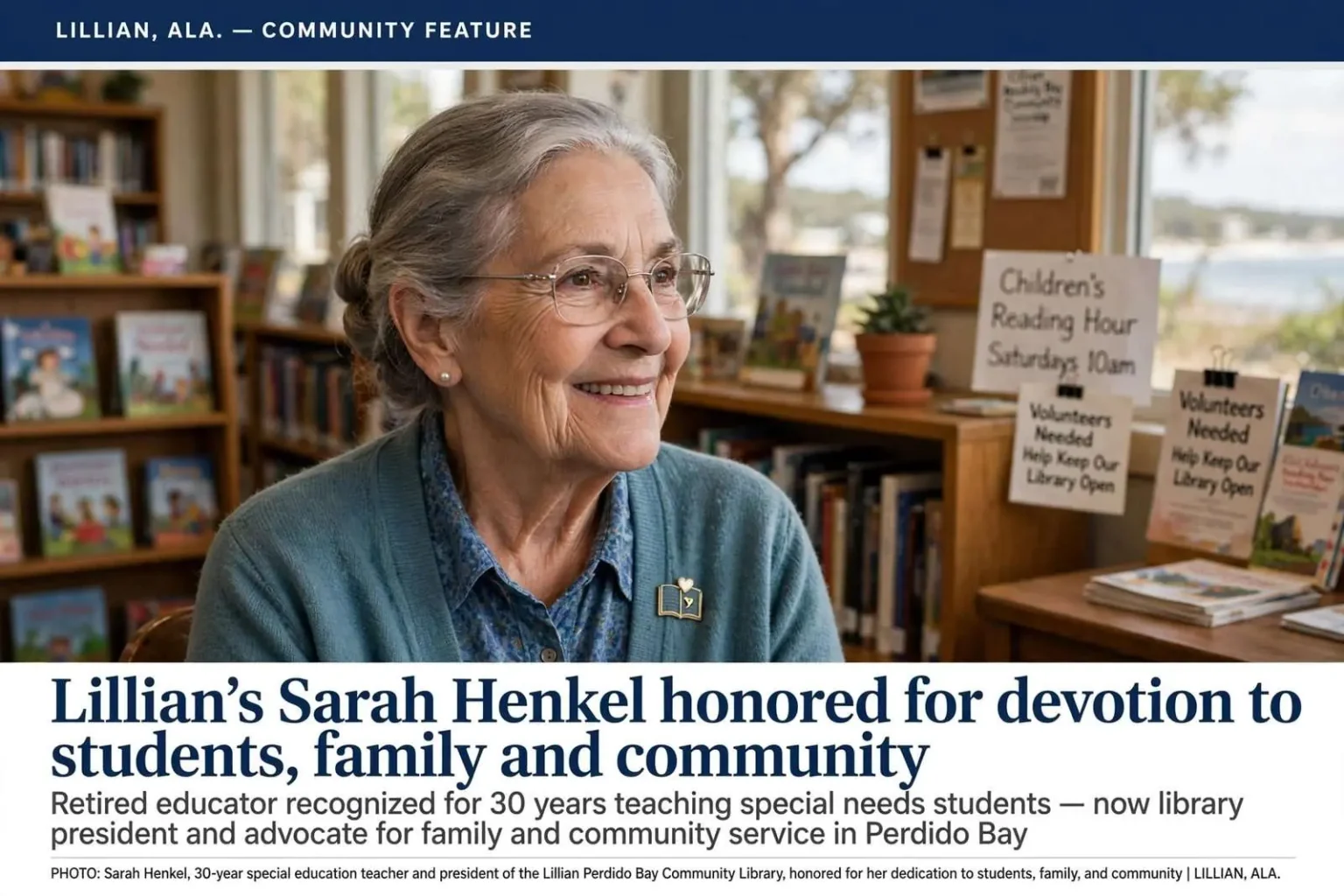
LILLIAN, Ala. — Sarah Henkel spent 30 years in the classroom, much of it teaching special needs students and challenging them to succeed despite their disabilities. Now retired, the longtime educator is being recognized for a lifetime of service to her community and family — a recognition that spans a teaching career, an unpaid leadership role at a small rural library, and a personal story of loss and perseverance that her neighbors in this Perdido Bay community know well.
Lillian sits in the southeastern corner of Baldwin County, hard against the Florida line on the west shore of Perdido Bay, one of those small Alabama communities where a schoolteacher’s influence carries for decades and a library president can be one of the most consequential people in town. It is the kind of place where careers like Henkel’s leave marks that outlast retirement — in the students who came back to say so, and in the institutions she helped build after the classroom.
Thirty Years of Teaching Students to Succeed Anyway
Henkel’s teaching career was built around a demanding and often underappreciated specialty: working with special needs students and holding them to high expectations rather than lowered ones. The approach reflects a conviction that has driven special education philosophy for decades — that a disability defines a limitation, not a ceiling, and that the teacher’s job is to find the route around the limitation rather than to excuse the student from the journey. Thirty years of that work, much of it in this region’s schools, produced exactly the kind of quiet legacy that rarely makes headlines but reshapes lives one student at a time.
One former student at Pensacola Catholic High School said Henkel taught him the skills to thrive in college. “I admire her dedication and passion. She taught learning strategies, how to effectively take notes, how to listen. She really prepared me how to study in college, how to be a good student,” he said. The testimony captures what skilled special education teachers actually provide: not lowered standards but explicit instruction in the hidden curriculum — note-taking, listening, study habits — that other students absorb by osmosis and that students with learning differences must be taught directly, skill by skill.
That kind of instruction is what separates a surviving student from a succeeding one. A young person can be admitted to college and still fail within a semester without the organizational and study skills that college assumes, and students who have spent their school years with adults scaffolding every step are especially vulnerable to that gap. Henkel’s former student’s account — prepared for college, prepared to be a good student — is the outcome her approach was designed to produce, and the fact that he returned to say so publicly is part of why her community’s recognition of her carries weight.
An Unpaid Job at the Heart of the Community
Henkel serves as president of the Lillian Perdido Bay Community Library, a role she takes on without pay. Small community libraries across rural Baldwin County run on exactly this kind of volunteer leadership — boards and officers who write grants, organize volunteers, keep the lights on and treat the library as the town’s civic center rather than a room with books. In communities without the tax base for elaborate facilities, the library is often the only public gathering place, the free internet connection, the children’s program and the meeting room all at once, and it survives because someone like Henkel treats its success as a personal responsibility.
“I’m only as successful as I am because of what they do. Same thing like in the classroom when I taught. My success as a teacher was only as good as what the children could give me back as students,” she said. The philosophy is consistent across both of her careers: leadership as a partnership, whether the partners are library volunteers or schoolchildren. It is an unusually humble framing from someone being honored for a lifetime of achievement, and it is also an accurate description of how both classrooms and volunteer organizations actually work — the leader’s success is the collective’s success or it is nothing.
The Lillian Perdido Bay Community Library occupies a particular place in its community. Perdido Bay’s Alabama shore is scattered with small settlements — Lillian, Perdido, the communities along Highway 98 and the county roads that run toward Elberta and Robertsdale — far enough from the branch libraries of Foley and the Baldwin County system’s larger facilities that a local library fills a genuine gap. Residents who cannot easily drive to a larger town depend on the local library for everything from reading material to internet access to the social contact that rural communities can lack, and a strong volunteer president determines whether that institution merely survives or actually serves.
A Life Marked by Loss
Henkel has faced deep personal loss. She lost her father to a heart attack as a child, and two brothers — one to a bicycle accident and another to ALS. Few families absorb that pattern of grief — a parent in childhood, a sibling in accident, a sibling to a slow and merciless disease — and come through it with the outward energy Henkel has poured into classrooms and community work. ALS, the degenerative disease often called Lou Gehrig’s disease, takes its victims over years while families watch, a burden different in kind from sudden loss and one that reshapes the survivors’ understanding of what patience and care require.
The losses did not end with her siblings. Her son James, a former rock climber, became a quadriplegic after a fall, and Henkel and her husband underwent months of medical training so he could live as independently as possible. That decision — to train themselves rather than accept dependence as the permanent arrangement — is the kind of choice that defines a family. Caregivers of quadriplegic family members must learn transfers, emergency response, medication management and the daily mechanics of care that hospitals perform with teams and equipment, and doing it well is the difference between a life organized around an institution and a life organized around a home.
The investment paid off in the outcome every caregiving family hopes for. Today James drives to a full-time job, lives alone and enjoys fishing. For a former rock climber who lost the use of his body below the neck, that life — employment, independence, time on the water — represents an achievement built on his own determination and on parents who spent months in medical training so his independence could be real rather than aspirational. Adaptive driving programs, accessible housing and employers willing to hire quadriplegic workers all play a part, but none of it functions without the family foundation the Henkels built.
Henkel’s story with her son also loops back to her teaching philosophy. The same conviction that shaped her classroom — that a disability sets the challenge but not the ceiling — governed how she and her husband approached their son’s injury. Students with learning differences and adults with spinal cord injuries face different obstacles, but the family’s approach was the same in both: learn everything, expect everything, and build the path around the limitation instead of surrendering to it.
What She Would Tell Other Parents
She encourages parents to spend time with their children and read to them. Coming from a career special educator, the advice carries the weight of professional observation — thirty years of watching which children arrived ready and which ones spent years catching up, with the difference usually traceable to what happened at home before school ever started. Reading aloud to children builds vocabulary, attention and the association between books and comfort that formal instruction later depends on, and no program or intervention matches what a parent’s daily reading does in the earliest years.
“You don’t have to do great, grand, glorious things to be remarkable,” Henkel said. “You can just be a little old library president in Lillian, Ala.” It is a fitting summary from someone whose own life makes the argument. No single line on her record — the classroom years, the library presidency, the caregiving, the survival of so much loss — is the kind of achievement that makes national news. Taken together, they describe the kind of person a community is actually built out of: the teacher whose students come back to say thank you, the volunteer who keeps the library’s doors open, the mother who learned the medicine so her son could drive himself to work.
The Recognition She Earned
The honor being paid to Henkel now, in retirement, is the community’s answer to a question her career kept asking: what does service look like when it is done without an audience? The answer in Lillian has been a working life of exactly that — thirty years with special needs students, years of unpaid leadership at the community library, and a family story told here as an example rather than a complaint. Her neighbors know the whole of it, which is why the recognition comes not from an institution far away but from the community she served, in the town where her students, her fellow volunteers and her family all live with the results.
Communities across Baldwin County and the rest of the Gulf Coast are full of people carrying comparable loads quietly — retired teachers staffing volunteer organizations, families managing care for injured or disabled relatives, longtime residents holding small institutions together without pay or recognition. Most of them will never be written up. Sarah Henkel’s story stands for all of them, and her own words supply its lesson: remarkable does not require great, grand and glorious. Sometimes it looks like a classroom of students taught to believe in themselves, or a small library on Perdido Bay, or a son driving himself to a job he earned the ability to keep.