
Locally Produced Horror-Comedy The Night Shift Set for Alabama Premiere at Crescent Theater
Fighting Owl Films brings its debut supernatural comedy The Night Shift to the Crescent Theater in downtown Mobile for the Alabama premiere.
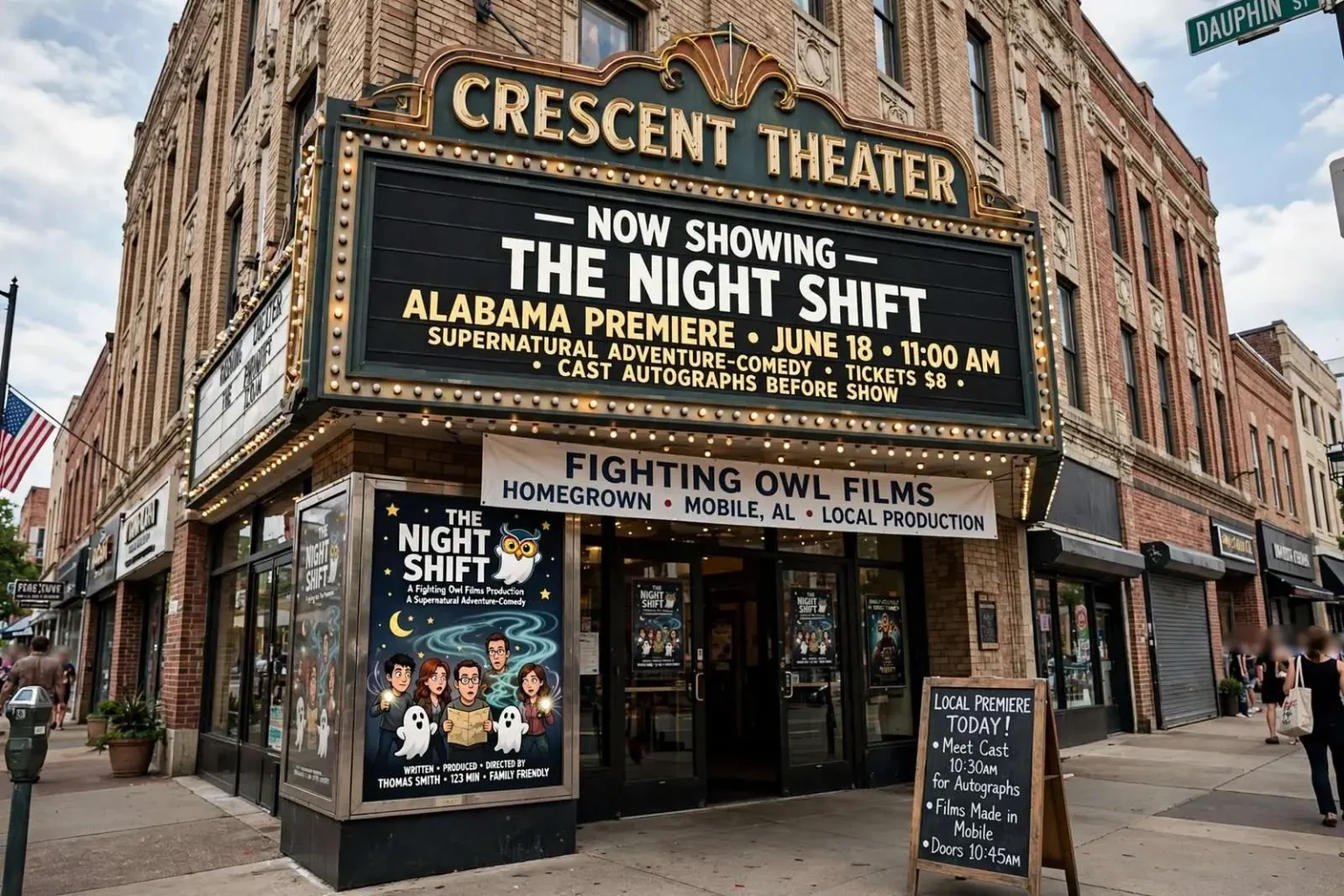
A Mobile-based filmmaking group is bringing its debut feature film home for an Alabama premiere later this month. Fighting Owl Films will screen its supernatural adventure-comedy, The Night Shift, at 11 a.m. on June 18, 2011, at the Crescent Theater in downtown Mobile, giving local audiences the first chance to see a project that was developed, shot, and finished almost entirely in the Mobile area.
The Crescent Theater, an intimate independent cinema tucked into the heart of downtown Mobile, has built a reputation as a home for offbeat and locally minded programming, and the morning slot for the premiere reflects the film’s family-friendly appeal. Tickets are priced at $8 and will be available at the door, and members of the principal cast are expected to be on hand before the screening to sign autographs for moviegoers. For a debut feature from a homegrown company, the chance to meet the cast in person adds a small-town warmth that bigger premieres rarely offer.
Written, produced, and directed by Thomas Smith, The Night Shift marks Fighting Owl Films’ first feature-length production. The company has been a familiar presence in the regional film scene, building its project from the ground up in the Mobile area with local talent and local locations rather than relying on the far-flung resources of a studio production. That do-it-yourself approach is common among Gulf Coast filmmaking groups, where crews often wear multiple hats and productions are financed and completed through persistence as much as through budget.
The film stars Khristian Fulmer, Erin Lilley, Soren Odom, Jonathan Pruitt, and Jordan Woodall in a story that blends supernatural elements with comedy. Rather than playing its ghostly material for straightforward scares, the movie leans into the adventure-comedy side of the genre, positioning itself as something audiences of different ages can watch together. The unrated but family-friendly film runs 123 minutes, a substantial length for an independent debut and a sign that the filmmakers had a full story to tell rather than a short subject stretched thin.
A Homegrown Production
Fighting Owl Films’ decision to premiere in Mobile rather than in a larger market speaks to the growing confidence of the city’s independent film community. Over the past several years, Mobile has hosted a widening range of locally produced shorts and features, supported by venues willing to screen non-studio work and by a base of actors, crew members, and musicians who live and work along the Gulf Coast. A homegrown premiere also gives the production’s many local contributors a chance to see the finished work surrounded by the neighbors, friends, and family members who helped make it possible.
Independent genre filmmaking occupies a distinctive place in Alabama’s creative economy. Without the infrastructure of a major production hub, companies like Fighting Owl Films depend on resourcefulness: repurposing locations, working with compact shooting schedules, and cultivating casts who can commit to a project over months of evenings and weekends. The Night Shift’s journey from concept to completed 123-minute feature is a product of that method, and its premiere offers a concrete example of what local crews can accomplish with limited means.
Festival Buzz Building
The Mobile premiere comes as the film gains traction on the independent festival circuit. The Night Shift has already been selected to screen at Kentucky’s Fright Night Film Festival in July 2011, one of the regional gatherings where independent horror, science fiction, and fantasy titles find their audiences and, occasionally, their distributors.
The movie also recently screened as part of the Paranormal Pop Culture Film Festival at Colorado’s historic Stanley Hotel, the property famously known for inspiring Stephen King’s novel The Shining. That booking carried a certain symbolic weight for a supernatural comedy: showing a ghost story at one of America’s most famous haunted hotels places the film in direct conversation with the tradition it draws from, and festival programmers there have a keen eye for material that fits the venue’s lore.
The growing festival interest signals a promising start for the local production company. Festival selections function as independent film’s review system, offering outside validation that a small production can hold its own against entries from across the country. For a first feature, earning slots at multiple festivals in a single season is no small feat, and it suggests the film’s blend of humor and the supernatural is finding a receptive audience beyond the Gulf Coast.
What the Premiere Means for Local Film Fans
For local film enthusiasts, the June 18 screening offers a chance to see a homegrown production on the big screen before it continues its festival run. Audiences in cities with major studios rarely get to watch a film arrive in the same community where it was made, and the Crescent Theater screening closes that loop: the crew members, extras, locations, and businesses that supported the production can finally see the results of their collective effort projected at full size with an audience.
The premiere also comes at a moment of momentum for genre filmmaking in the Southeast. Regional horror conventions and festivals have multiplied across the Gulf Coast and the wider South, and audiences have shown a steady appetite for films that trade big-budget spectacle for wit, character, and regional flavor. A 123-minute supernatural adventure-comedy made in Mobile fits squarely within that wave, and its family-friendly rating broadens the potential crowd considerably.
The morning showtime makes the event accessible in a way evening premieres often are not, opening the door for younger viewers as well as adults who prefer to avoid late-night crowds. With autographs from the principal cast before the screening and an $8 ticket price, the event is designed to feel less like a formal industry affair and more like a community celebration of a project the city can claim as its own.
The Road Ahead for Fighting Owl Films
Whatever happens after June 18, the premiere secures the most important milestone for any independent company: a completed first feature, screened for the public, with a festival calendar already filling in behind it. Companies that clear that first hurdle rarely stop there. The experience of writing, producing, and directing a full-length film teaches lessons in budgeting, scheduling, and collaboration that no short film can, and the relationships built during a first production often carry forward into the second and third.
The Night Shift’s cast — Khristian Fulmer, Erin Lilley, Soren Odom, Jonathan Pruitt, and Jordan Woodall — also gain a showcase that festival programmers and other filmmakers can study. Regional casts that prove themselves on a completed feature frequently become the backbone of a local production community, appearing in one another’s projects and raising the overall quality of the area’s output.
For Mobile, the screening is another entry in a longer story of the city’s creative growth, one that includes its theaters, its musicians, its galleries, and now its filmmakers. A supernatural adventure-comedy with festival selections in Kentucky and Colorado may have been born on the Gulf Coast, but on June 18 it comes home — and Mobile audiences will be the first in Alabama to decide what they think of it. The Crescent Theater screening begins at 11 a.m. on June 18, 2011, with the cast on hand before the show and tickets available at the door for $8.
Inside the World of the Film
Supernatural adventure-comedies occupy a narrow but beloved shelf in independent cinema. The genre asks filmmakers to hold three tones at once: the eerie atmosphere of a ghost story, the momentum of an adventure, and the timing of a comedy that knows when to undercut its own chills. Getting that balance wrong produces a movie that feels scattered; getting it right produces the kind of film that audiences describe to their friends with a grin. The Night Shift’s festival bookings suggest Thomas Smith and his collaborators managed the trick, programmers at two separate genre festivals judging the result worthy of their lineups.
The choice to keep the film family-friendly despite its unrated status is itself a strategic one. Horror content is often the easiest genre in which to drift into material that narrows an audience, and a small production that resists that drift gains access to school-age viewers, church groups, and multi-generational audiences that a harder-edged film would exclude. In a community-sized market like Mobile, where word of mouth between neighbors and coworkers drives attendance more than any advertising campaign, a wide audience is a real asset.
The 123-minute running time also sets the film apart from the leaner projects typical of a first feature. Many debuts land in the 80-to-95-minute range, trimming ambition to keep production manageable. A longer film signals confidence in the story and in the audience’s patience, and it gives the ensemble cast — Fulmer, Lilley, Odom, Pruitt, and Woodall — room to develop characters rather than merely hit marks between scares and jokes.
Mobile’s Growing Screen Culture
The premiere lands in a city whose screen culture has quietly thickened over the past decade. Mobile has long had the raw ingredients of a film town: distinctive architecture, coastal landscapes, historic neighborhoods that photograph as though they were built for a camera, and a population of performers and technicians with theater and commercial experience. What has often been missing is the connective tissue — screening venues, festival circuits, and production companies willing to commit to features. Fighting Owl Films’ debut adds to that connective tissue, and the Crescent Theater’s willingness to host the premiere shows the venue side of the equation doing its part.
Local premieres also matter economically. Money spent on a hometown production — location fees, catering, lumber, costumes, props — circulates locally, and a successful premiere encourages other area businesses to treat film crews as customers worth courting. Every independent feature shot in the region functions as a small demonstration project for the idea that Mobile can host creative production without the expense of importing it.
The festival circuit reinforces that case from the outside. When a Mobile-made film screens at a Kentucky festival or a Colorado hotel-turned-cultural-landmark, it carries the city’s name to audiences and programmers who might otherwise never associate the region with film production. That visibility is cumulative: each selection makes the next production easier to fund, easier to cast, and easier to screen.
Why Debut Features Matter
A first feature is the steepest test in filmmaking. Short films reward intensity and can be improvised; features demand sustained organization across months of pre-production, shooting, and editing. The scripts alone run past a hundred pages, the shot lists run into the hundreds, and every day of production costs money that a self-financed company must find on its own. Companies that emerge with a finished, coherent, festival-ready film have demonstrated something rare, regardless of how the movie ultimately performs.
Fighting Owl Films cleared that bar with The Night Shift, and the film’s details show deliberate choices. The supernatural elements provide the premise, but the comedy carries the tone. The family-friendly rating keeps the door open to the widest possible audience. The ensemble structure spreads the story across five principal performers, lightening the burden on any single actor and creating the interplay on which comedy depends. These are the decisions of filmmakers thinking about who will actually sit in the seats.
The timing of the premiere — 11 a.m. on a Saturday morning in mid-June — also reflects an understanding of the local audience. Summer Saturdays in Mobile are built around family schedules, and a morning show allows fans to attend the screening, meet the cast, and still have the rest of their day. It is a small logistical choice, but it captures the film’s whole approach: accessible, unpretentious, and aimed squarely at the community that made it.
Eight dollars buys a 123-minute supernatural adventure-comedy made down the road, a chance to meet the people who made it, and a front-row seat to the moment a hometown production company steps onto the festival stage. That meeting — between a Mobile crew and a Mobile crowd, in a downtown theater that champions independent work — is exactly what the local film scene exists to produce, and on June 18, 2011, it arrives on schedule.