
Long-Lost Siblings Meet for First Time in Daphne After DNA Match
A New York man adopted in 1964 met his biological half-siblings in person for the first time Friday in Daphne, after a DNA test on Ancestry.com revealed the family connection.
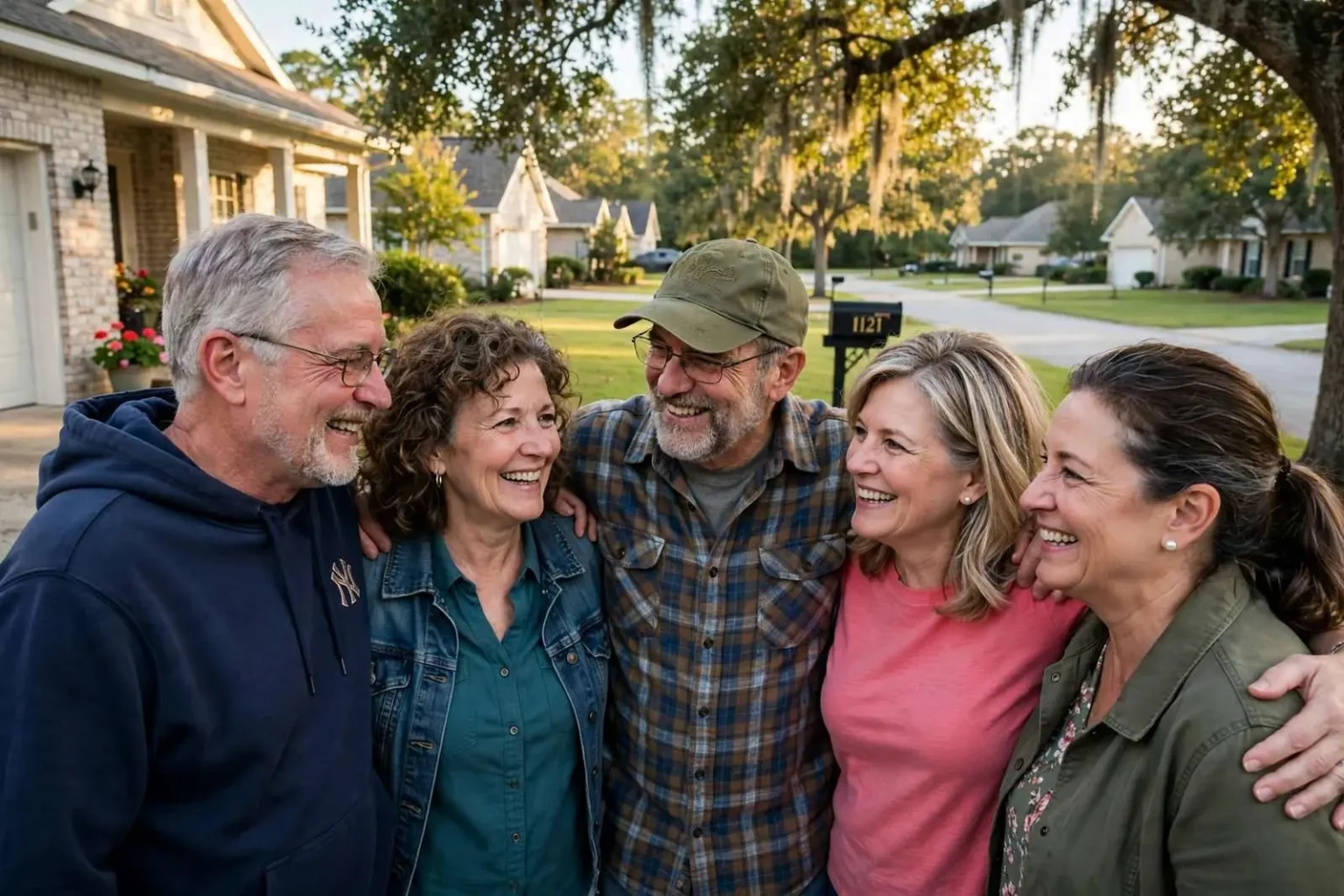
A New York man who was adopted in 1964 met his biological half-siblings in person for the first time Friday afternoon at a home in Daphne, capping a search that began with a DNA test and an online genealogy match. For an adoptee who had spent decades with nothing but questions, the driveway of a Baldwin County house became the endpoint of a paper trail that had crossed half the country.
Joe Zubin’s search for his biological family led him to Ancestry.com, where he discovered a probable family match. He reached out to the matched family, setting off a chain of events that eventually brought together five half-siblings who had not previously known each other existed. The first messages between strangers who shared a biological family gave way to phone calls, photographs and genealogy work, and finally to the meeting on the Eastern Shore that none of them had imagined possible a few months earlier.
Adoption searches like Zubin’s were once exercises in locked courthouses and sealed records. Alabama, like most states for most of the twentieth century, sealed original birth certificates upon adoption, and adoptees who wanted their origins had to petition courts or rely on intermediaries. Consumer DNA testing changed the equation almost overnight. For roughly the price of a family dinner, a person could compare their genetic code against databases containing millions of other testers, and half-siblings, first cousins and biological parents began surfacing as “close family” matches on commercial websites.
The result has been a quiet revolution in American family life. Genealogists who once specialized in tracing colonial lines now spend much of their time on what the field calls “genetic genealogy” — building family trees backward from a shared centimorgans report. For adoptees of Zubin’s generation, born into an era when closed adoptions were standard practice, the databases have offered something no record office would: a way in that required no one’s permission.
Five siblings, one discovery
What distinguished the Daphne reunion was its scale. A DNA match frequently produces a single discovery — a cousin, a father, a grandmother’s maiden name. Zubin’s match instead opened a door onto an entire family branch: five half-siblings, raised without knowledge of one another, now comparing childhoods, faces and family resemblances across the distance between New York and Mobile Bay.
Half-sibling discoveries carry particular complications. They can be joyous — new family, new stories, new holidays — but they also arrive unannounced, landing in households that never chose the disclosure. The fact that this group moved from an online match to an in-person reunion at a Daphne home suggests the family navigated those conversations well, something search experts encourage: allowing time for questions, being considerate of older relatives who may not have known, and letting each sibling set their own pace.
Reunions of this kind have become common enough that support networks now exist for every step of the process. Online groups for adoptees and for newly discovered relatives share advice on first messages, on managing expectations and on handling the emotional weight of a match. Professional genealogists offer to trace the connection when the database returns only distant cousins, working backward through shared matches until the common ancestor appears.
Why Daphne
The meeting place was a home in Daphne, on the eastern shore of Mobile Bay just south of Spanish Fort. It is a setting that says a great deal about how the region has grown. Daphne expanded rapidly in the 1990s and 2000s as a suburban community serving commuters working in Mobile and at the industrial sites along the bay’s eastern edge — a city of neighborhoods and schools where family gatherings happen in living rooms and backyards rather than banquet halls. For a first meeting between long-lost siblings, a family home carries the right kind of intimacy: no reservations, no audience, just the people involved.
Getting there is its own small lesson in Eastern Shore geography. Travelers from the Mobile side cross the bay over the Jubilee Parkway — the twin-span bridge locals call the Bayway — which connects the city of Mobile to the Eastern Shore high above the waters where jubilees, the bay’s famous mass movements of sea life onto the shoreline, occasionally occur. The parkway is one anchor of a road network that also includes Interstates 10 and 65, the Bankhead Tunnel under the Mobile River downtown, and the Cochran-Africatown USA Bridge to the north.
Transportation planning remains a long-running topic in the Mobile area, where the bay, the river, the port and the interstate system together define how the region moves. Discussions over a potential additional Mobile River crossing and a renewed push for downtown rail service are part of the region’s ongoing conversation, and they matter to families like the one gathering in Daphne in practical ways: a reunion depends on someone being able to get across the bay, across the county or across the country without the trip becoming an expedition.
Public transit in the city of Mobile is operated by the Wave Transit System, which provides fixed-route bus service across the city, while Baldwin County is served by a mix of commuter and demand-response services. The gap between the two systems reflects the region’s development patterns — a dense urban core on one side of the bay, spread-out suburbs on the other — and for most Eastern Shore households, the automobile is the way everything happens, including reunions.
The region around the reunion
Community life along the upper Gulf Coast is shaped by civic groups, faith communities, school events and the long tradition of public gatherings that have defined the area for generations. From springtime events such as the Festival of Flowers in Fairhope and the Azalea Trail Maids in Mobile to coastal celebrations in Gulf Shores and Orange Beach, the community calendar across south Alabama is full of recurring events that draw residents and visitors alike. Into that calendar, a family reunion — even an improvised one on a Friday afternoon — fits naturally; the Eastern Shore has always been a place where people gather in each other’s homes.
Mobile and Baldwin County together form a single regional economy, with commuters, students and shoppers moving daily across the bay, and with shared concerns about transportation, schools, public safety and growth that play out in both counties’ public meetings and local news coverage. A family straddling that bay — new siblings discovering one another between New York and Daphne — is the personal-scale version of the same connection.
News from across south Alabama frequently highlights the ways in which local decisions in city halls, county commissions, school board meetings and state offices in Montgomery interact with daily life for residents from Saraland to the Eastern Shore and from downtown Mobile to the Gulf beaches. A story like the Zubin reunion lives on the human side of that ledger — not a policy fight but the kind of family news that flows through the same channels: the daily local newspaper, regional television stations and a growing number of digital outlets focused specifically on the cities and towns of south Alabama.
Long-running coverage of the Port of Mobile, the Brookley aeronautics complex and the industrial corridor along the Mobile River connects stories about steel, shipbuilding, aerospace and shipping into a single regional narrative. That narrative explains why families end up where they do: the region’s jobs draw people in from elsewhere and send its own residents out to New York and beyond, scattering siblings across states and generations — and occasionally, as in Daphne, drawing them back together.
Schools and community anchors
Local school systems, including Mobile County Public Schools and the Baldwin County Public Schools system, are among the largest employers in the region and a focus of ongoing community attention, particularly around school construction, teacher staffing and student performance. Schools double as community anchors in towns like Daphne, Spanish Fort and Fairhope — the gyms and auditoriums where reunions, recitals and town meetings happen, and the institutions through which newcomers meet neighbors. A family suddenly expanded by five is likely to run into itself at school open houses and Friday games soon enough.
Hurricane and severe-weather preparedness is a recurring topic for residents across the coast, with annual public drills, sandbag distributions and updates from local emergency management agencies as the Atlantic hurricane season progresses each year. Everyone who lives along Mobile Bay learns the drills; families with roots in the region carry memories of named storms that reshaped neighborhoods. It is the shared experience that ties coastal residents together — and one more subject for five siblings getting to know each other’s worlds, one of them raised amid Gulf weather and the other amid New York winters.
What the search leaves behind
For the five half-siblings, the Friday-afternoon meeting in Daphne ended the search but not the relationship; in most families formed this way, the first reunion is followed by group texts, holiday planning and the slow accumulation of shared history. Genealogy researchers note that the databases keep working long after the initial match: cousins surface, photos are exchanged, and the family tree grows branches that paperwork had hidden for half a century.
For adoptees still searching, the story offered the standard encouragement of the era — that a test kit and a message to a stranger can end a decades-long question. And for Daphne, the visit added one more entry to the region’s long ledger of family gatherings on the Eastern Shore: five adults who had not known of one another’s existence standing in a driveway above Mobile Bay, filling in what a sealed record from 1964 had kept quiet.