
Longtime Mobile broadcaster Mel Showers enters Bishop State Hall of Fame
Longtime Mobile broadcaster Mel Showers will be inducted into the Bishop State Wildcat Sports Hall of Fame in January.
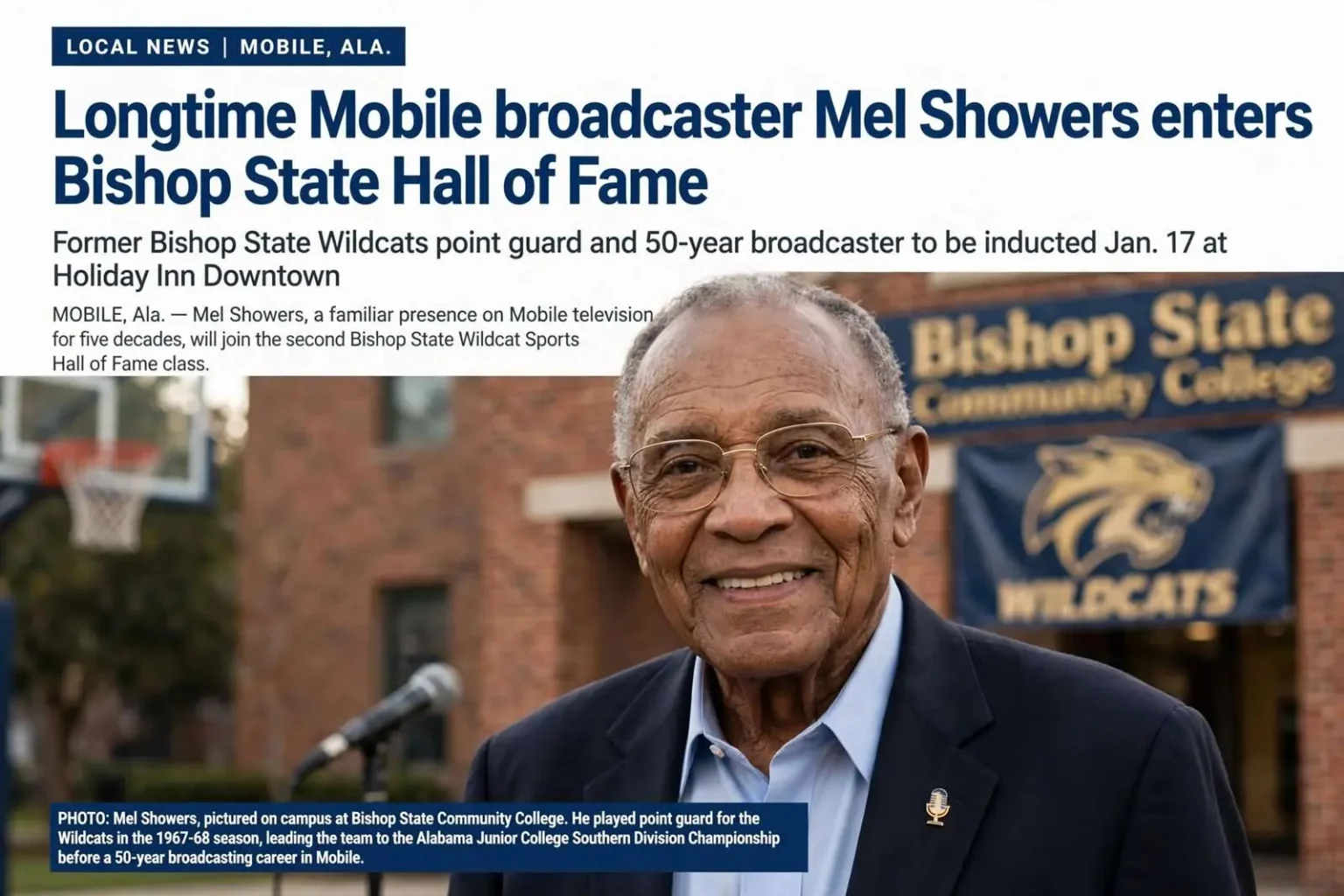
MOBILE, Ala. – Mel Showers, a familiar face to generations of Mobile television viewers, is being inducted into another hall of fame. Showers is already a member of the Alabama Broadcast Association Hall of Fame. Now he is set to enter the Bishop State Wildcat Sports Hall of Fame on Jan. 17, adding a second honor that reaches back to the start of his story long before the television cameras found him.
“I’m humbled and appreciative,” Showers said. “I had some great teammates!” The two short sentences capture the path that carried him from the basketball floor at Bishop State to one of the longest careers in Mobile broadcasting, and his immediate turn from recognition to teammates fits the way colleagues describe him. The honor places him among the athletes whose early careers at the college set the standard for those who followed.
Showers played point guard for the Wildcats during the 1967-68 season and captained the basketball team to an Alabama Junior College Southern Division Championship. The role of point guard — the position that directs the offense, sets the tempo and makes decisions under pressure — has an obvious parallel to the anchor chair Showers would occupy decades later. Captaining a team to a division championship as a sophomore-era player marked him early as a leader whose teams responded to him.
He also played basketball in the U.S. Air Force and at the old Central High School in Mobile. Central High School holds a singular place in Mobile’s history as the city’s first high school for Black students, an institution that produced generations of educators, doctors, athletes and civic leaders during the segregation era and after. Playing there meant competing at one of the city’s most storied athletic programs, and his Air Force service placed his game on military courts during a period when many young men’s paths ran through the armed forces.
Other members of Bishop State’s second Hall of Fame class include Ronald Crimes, Oly Johnson, Robert Parker, Charles Smith, Louise Thrower, Elston Turner and Darryl Walton. The class spans multiple eras and sports, bringing together athletes whose careers helped define Wildcat athletics across decades. Induction classes at community college halls of fame serve a purpose beyond honoring individuals: they preserve institutional memory at schools whose earliest records and champions are often known only through the people who lived those seasons.
A Ceremony for the Whole Community
The induction ceremony and dinner will be held at 6 p.m. on Jan. 17 at the Holiday Inn Downtown. The downtown venue puts the event in the middle of Mobile, accessible to former teammates, family members and fans traveling from across the Gulf Coast. Dinner ceremonies of this kind typically blend formal induction with the kind of storytelling that happens when old teammates share a room, and this class — spread across so many eras — should generate plenty of it.
The guest speaker will be former NFL quarterback and Mobile and Alabama Sports Hall of Fame member Scott Hunter, who worked alongside Showers for a decade on Morning Newscenter 5. The pairing gives the evening a professional as well as athletic through-line: two men who shared a broadcast desk for ten years, with one now saluting the other. Hunter’s own path through Mobile sports — from local stardom to an NFL career and induction into two halls of fame — mirrors the arc this ceremony celebrates.
Showers retired in May after 50 years in broadcasting. Half a century in one profession is rare; half a century as the face of local news in a single market is nearly unheard of. Generations of Mobile viewers grew up with his presence on their screens, and his retirement closed a chapter in the city’s broadcast history that stretched from the era of black-and-white television into the age of streaming and social media.
Bishop State Community College, where his athletic career is being honored, has deep roots in Mobile. The institution traces its origins to the era of segregation, when it served Black students excluded from other colleges, and it grew through mergers and expansions into a comprehensive community college serving thousands of students across multiple campuses in the city. Its athletic teams, the Wildcats, compete in the Alabama Community College Conference, and its gyms and fields have launched countless Mobile athletes toward four-year programs and professional careers.
From Point Guard to Anchor Desk
The connection between athletics and broadcasting in Showers’ career is more than chronological. Point guards see the whole floor, read situations quickly and communicate constantly — the same skills that anchor a live newscast. His teammates’ championship season taught habits of preparation and composure that translated directly to a business where the broadcast happens once, live, with no second take. Colleagues over the years often pointed to that same steadiness as the quality that defined his work.
The Alabama Junior College system that Showers competed in during the late 1960s gave thousands of Alabama athletes their first opportunity beyond high school. Schools like Bishop State offered rigorous competition at a moment when opportunities for Black athletes in the state were limited, and the Southern Division championship his team captured stood as proof of the program’s strength. Hall of fame classes like this one are how those teams stay part of the college’s living story.
For Mobile viewers, the honor reframes a familiar figure. Most people knew Showers only from the desk — the measured delivery, the steady presence through hurricanes, elections and everyday news cycles. The Hall of Fame recognition pulls back to the athlete underneath: a captain at 19 years old, leading a championship team, in a city that was still years away from the professional recognition his broadcasting career would later earn.
Why Community College Halls of Fame Matter
Halls of fame at community colleges occupy a particular place in American sports culture. Four-year universities have prominent halls and elaborate archives, but two-year schools — where so many athletes played only a season or two before moving on — often lose their history unless someone deliberately preserves it. Bishop State’s decision to build its Wildcat Sports Hall of Fame across multiple classes reflects an effort to gather those stories while the people who lived them can still tell them firsthand.
The second induction class carries extra weight in that process. First classes tend to be obvious choices, the names everyone knows; second and later classes require deeper digging through records, newspaper archives and memory. The inclusion of Louise Thrower among the eight inductees also highlights that the honor reaches beyond men’s basketball, recognizing the full range of Wildcat athletics.
For the honorees, the evening represents a reunion as much as a ceremony. Athletes who played at Bishop State in different decades rarely cross paths once their playing days end, and an induction dinner brings them together with the coaches, classmates and family members who watched those careers begin. In a city like Mobile, where high school and community college sports remain central to civic life, those rooms fill with decades of shared history.
A Career That Shaped How Mobile Sees Itself
Showers’ 50 years in broadcasting spanned the transformation of Mobile from a port city learning to tell its own stories to a metropolitan area with a crowded local news market. His decade alongside Scott Hunter on Morning Newscenter 5 gave viewers a pairing that blended hard news with the easy rhythm of two professionals who knew each other well. Mornings are the hardest shift in local news — live television, day after day, before most of the city is awake — and sustaining that work for years built the trust that made his retirement in May such a significant local event.
His path also tells a broader story about opportunity in the South. A young man who came of age playing at Central High School and Bishop State during the 1960s entered a profession that was itself changing, and he stayed long enough to become one of the region’s most recognizable broadcasters. The two halls of fame he now belongs to — one for broadcasting, one for athletics — mark the two halves of a life that connected Mobile’s athletic fields to its living rooms.
The Jan. 17 dinner at the Holiday Inn Downtown will honor seven other inductees alongside him, each with their own chapter of Wildcat history. But for many in the room, the evening’s emotional center will be the sight of a beloved anchor accepting a place among the athletes who came before the anchor existed. Showers said it himself, in the way that has made his voice part of Mobile’s daily life for 50 years: he is humbled, appreciative, and quick to credit the teammates who got him there.