Lowman Energy Center in Leroy to Add Second Gas Turbine in Major Expansion
PowerSouth Energy Cooperative is expanding its Lowman Energy Center in Leroy with a second gas turbine, a project expected to bring in more than 300 construction workers and boost winter generating capacity enough to serve about 694,000 homes.
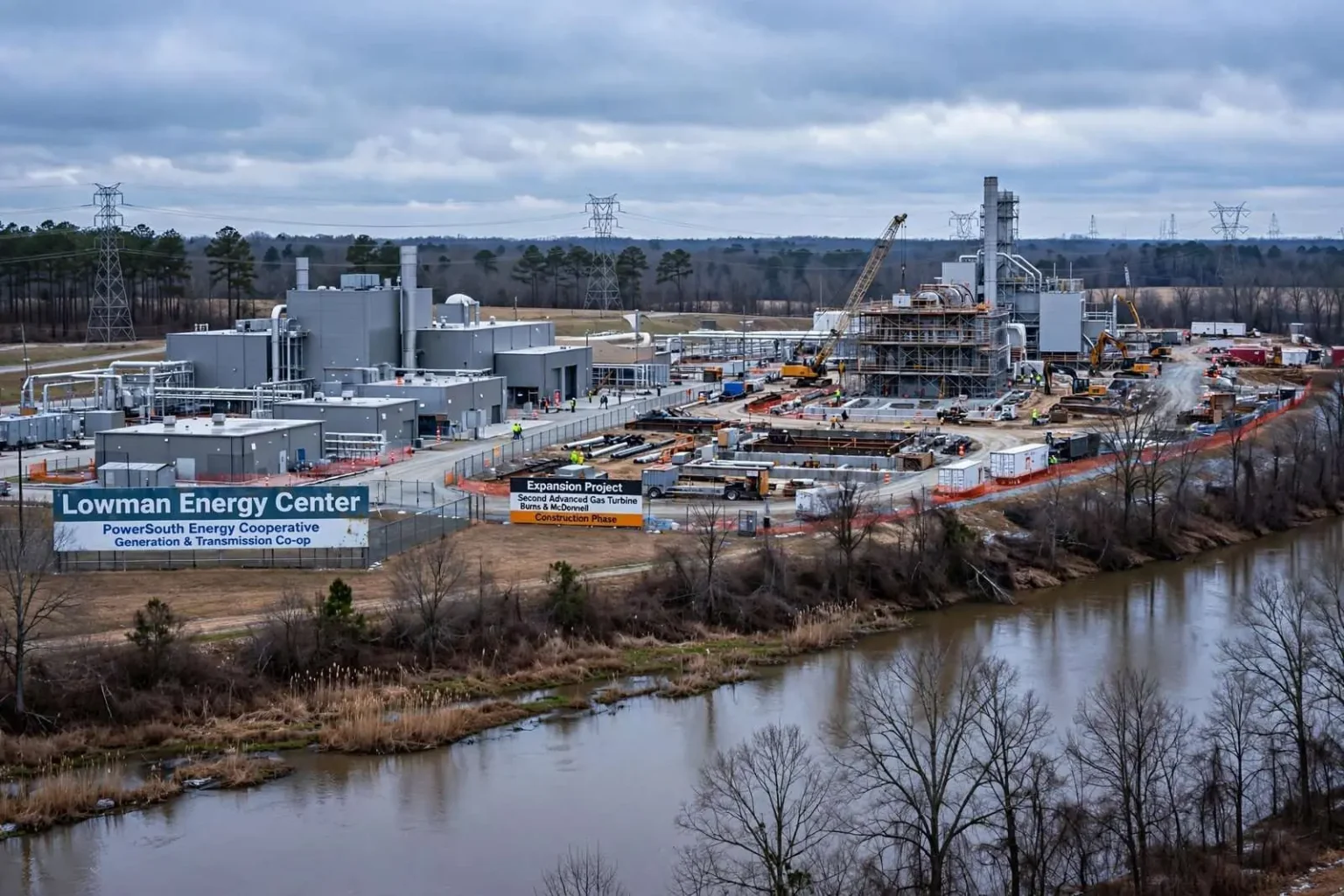
PowerSouth Energy Cooperative is moving ahead with a major expansion of its Lowman Energy Center in Leroy, a project expected to bring more than 300 construction workers into the Washington County community once work gets underway. The expansion marks one of the larger power-plant investments in southwest Alabama in recent years, and it will turn a rural site along the Tombigbee River basin into an even bigger anchor of the region’s electrical supply.
The cooperative has selected Mitsubishi Power Americas Inc. to supply a second advanced gas turbine for the plant, joining the unit that has been running at the site since 2023. Burns & McDonnell will provide engineering, procurement and construction services for the project. The pairing brings together one of the world’s major turbine manufacturers with one of the country’s largest engineering firms, a combination utilities typically choose when they want a project delivered on a predictable schedule with proven technology rather than experimental design.
PowerSouth officials say demand for electricity is rising across the region as manufacturing returns to the area, more homes and businesses rely on electric power, and growth in artificial intelligence technology adds new strain to the grid. The demand curve utilities are watching has shifted faster than anyone projected: industrial customers that once drew modest loads now build data-intensive operations that run around the clock, households add electric vehicles and heat pumps to their consumption, and the computing infrastructure behind artificial intelligence has become one of the largest new sources of electrical demand in the country.
Capacity built for winter
Because PowerSouth’s system typically sees its heaviest use in winter, the new turbine is expected to add enough winter generating capacity to serve roughly 694,000 homes in the region. Winter peaking is a defining feature of the cooperative’s service territory, where cold mornings drive heating loads far above summer’s air-conditioning demands. Building generation that can deliver on the coldest days of the year — when every heat pump in the territory runs at once — is the central planning challenge for utilities across the Southeast, and it is the problem this expansion is designed to solve.
Beyond adding capacity, the expansion is intended to help the plant run more efficiently while meeting emissions requirements, which PowerSouth expects will lead to additional cost savings. Modern advanced-class gas turbines extract significantly more electricity from each unit of fuel than the generations of machines before them, and they operate within environmental limits that older plants struggle to meet. Pairing a second unit with the existing one lets the facility share infrastructure and staff, spreading fixed costs across more megawatts and lowering the price of every kilowatt-hour the site produces.
The added power will benefit the cooperative’s distribution members across Alabama and northwest Florida. PowerSouth operates as a generation and transmission cooperative — a wholesale power supplier owned by the rural electric cooperatives and municipal systems that deliver electricity directly to homes and businesses. That structure means the economics of the Lowman expansion flow not to shareholders but back through the member systems, whose boards set rates for the customers they serve.
PowerSouth CEO Damon Morgan pointed to the cooperative’s relationships with Mitsubishi Power and Burns & McDonnell as key to keeping the project on track.
“Our distribution members and the members at the end of the line need reliable power at the most affordable cost possible,” Morgan said. “As a generation and transmission cooperative, it is our mission to provide that power to homes, schools, organizations, businesses and industries across our service area. The expansion of LEC is crucial to our mission and our strong ties with industry leaders keep us well-positioned to address the challenges of the future.”
The quote captures the two pressures that define the cooperative’s planning: reliability, because the member systems’ customers measure their utility by whether the lights stay on, and cost, because every dollar spent on generation eventually appears on the electric bills of the members at the end of the line. Generation and transmission cooperatives live with that arithmetic permanently — they must build for their system’s worst moments while keeping the average bill competitive, and projects like the Lowman expansion are where those competing demands get balanced.
What the project means for Leroy and the region
For Leroy and the surrounding communities in Washington County, the construction phase brings the most immediate impact. More than 300 workers on site mean occupied temporary housing, business at local restaurants and suppliers, and the kind of sustained economic activity that rural counties rarely see from a single project. Power-plant construction also carries a long tail: once the unit is online, the facility requires skilled operators, maintenance contractors and ongoing local spending that remains in the community for decades.
The Lowman Energy Center’s expansion also fits into a broader buildout of natural gas generation across the Southeast. The region’s utilities have been adding gas-fired capacity as older coal units retire and as demand growth — driven by industry, data centers and electrification — outpaces conservation projections. Sites like Leroy, with existing transmission infrastructure, fuel access and an operating plant on site, are natural candidates for expansion because the hardest parts of a new project are already done.
For the cooperative’s member systems, the second turbine is insurance against the tightest capacity markets in a generation. The grid strain that officials describe — manufacturing growth, electrification and artificial intelligence computing — has pushed power supplies across the country close to their limits during extreme weather, and utilities that cannot generate enough during their peak hours face volatile wholesale prices and, in the worst cases, forced outages. Capacity of the scale Lowman’s second unit will provide is what allows a cooperative to face a record-setting cold snap with confidence rather than emergency purchases.
The project’s schedule will be watched closely across PowerSouth’s territory, from the co-op lines of south Alabama to the systems serving northwest Florida. If the unit comes online as planned, it will give the cooperative’s members a modern, efficient source of winter capacity for decades — and give Leroy a larger claim to being one of the quiet workhorses of the Gulf Coast power grid. For the customers at the end of the line, whose interests Morgan placed at the center of the decision, the expansion represents the cooperative model working as designed: building what the system needs, at a price the members can afford, with an eye fixed on the winters ahead.
Advanced-class gas turbines of the kind Mitsubishi Power supplies represent the current state of the art in large-scale gas generation. The machines combine gas and steam cycles to squeeze more output from each unit of fuel, start quickly enough to back up intermittent resources, and operate with emissions profiles that keep pace with tightening environmental standards. Utilities across the country have committed to turbines of this class in record numbers, and manufacturers’ order books have stretched into the next decade — making the selection of a supplier and a delivery schedule one of the most consequential decisions in any expansion project.
The cooperative model behind PowerSouth shapes how those decisions get made. The generation and transmission co-op is owned by the distribution systems it serves, and its board is made up of representatives of those member systems, so the people approving a project like the Lowman expansion are the same people who will explain the costs to their own customers. That accountability runs in both directions: it slows decisions that members cannot afford, and it accelerates investments, like added winter capacity, that members know they need. Projects that survive that process tend to be the ones with clear operational justification rather than speculative upside.
Washington County, where Leroy sits, has long hosted energy infrastructure along the Tombigbee, and the plant’s footprint in the community predates the current demand boom by years. Expansions of existing facilities carry advantages beyond cost: the workforce, water supply, transmission interconnections and community relationships are already established, which shortens the path from construction start to commercial operation. For the county, the second turbine extends a relationship with the power industry that few communities its size can claim, and it positions the site as a fixture of the regional grid for the foreseeable future.
Construction on major generation projects also draws heavily on the Gulf Coast’s skilled-trades base — millwrights, pipefitters, electricians and heavy-equipment operators who move from project to project across the region. The 300-plus workers expected at Leroy will include local hires and traveling tradespeople, and the months of peak activity will be felt in everything from lodging demand to the lunch counters of Washington County. It is the same pattern that has accompanied every major plant expansion in the state, and for the communities that host them, the construction phase is often as economically significant as the decades of operation that follow.