Man and Woman Wounded in Mobile Shooting Arrive at Hospital by Private Car
A man and a woman arrived at University Hospital with gunshot wounds after a July 2019 shooting that Mobile police were investigating.
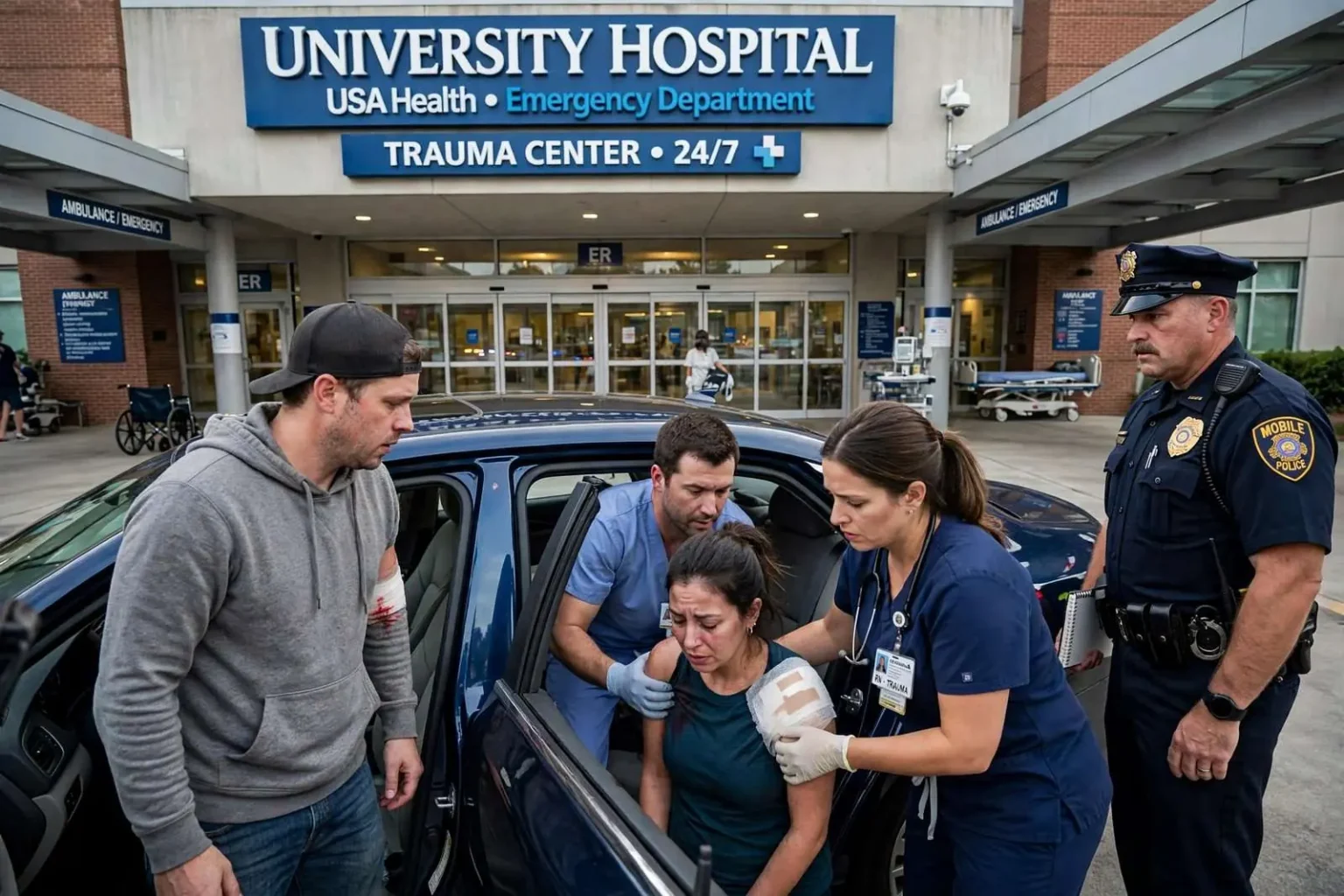
Mobile police investigated a shooting in late July 2019 that left a man and a woman wounded, after the pair arrived at University Hospital in a personal vehicle. Police said the victims showed up at the hospital around 4:25 p.m. with gunshot wounds. Investigators worked to determine where the shooting took place and what led up to it. Authorities did not release the victims’ ages or details about their conditions as the investigation continued.
The case began not with a 911 call from a scene but with a car pulling into an emergency department entrance. Two people — a man and a woman — arrived at University Hospital around 4:25 p.m. with gunshot wounds, brought by someone in a private vehicle rather than an ambulance. It is a pattern trauma centers know well: in a substantial share of non-fatal shootings, victims or the people with them choose the fastest route to care they can think of, and in a city like Mobile that route is often a personal car driven by a friend, a relative, or sometimes the victim himself. The decision can save minutes that matter, and it also means the hospital, not the street, becomes the place where the police first learn a shooting has happened.
By the time officers reached the emergency room, the victims were in the care of medical staff, and investigators had the bare elements of a case: two people shot, a hospital arrival time, and no confirmed location for the shooting itself. Working backward from an emergency room admission is standard practice for police departments, and Mobile investigators launched the same sequence of inquiries that such cases demand — interviewing the victims when their conditions allowed, speaking with whoever drove them, canvassing for witnesses near wherever the shots were fired, and checking surveillance along the corridors where the vehicle might have traveled.
The hospital as a starting point
University Hospital — the teaching hospital at the heart of the USA Health system, operated by the University of South Alabama — serves as Mobile’s primary trauma center, treating the most serious injuries from across the Gulf Coast region. Its emergency department sees the city’s shootings, stabbings, and serious vehicle crashes, and its trauma teams operate around the clock. When gunshot victims arrive, medical care comes first and questions come second: staff stabilize and treat, and only once patients are out of immediate danger do detectives get their window to interview, often in fragments, while the victims move between surgery, recovery, and sedation.
Private-vehicle arrivals present investigators with both an advantage and a gap. The advantage is that whoever drove the victims knows something — where they picked them up, what they saw, what the victims said on the ride. The gap is that no ambulance crew documented a scene: no paramedic notes about the location, no police response to the block where it happened, no crime scene secured in the minutes after the shots. Everything about the location has to be reconstructed from statements and physical evidence, and in cases where victims decline to cooperate — which is common in urban shootings — the reconstruction can stall entirely.
Police departments also work the hospital itself as a source of information. Security cameras cover entrances and waiting areas, registration records establish the timeline, and hospital staff observe who accompanies patients and how they behave. Detectives arriving at an emergency room after a shooting arrival typically review that material quickly, because the first hour is when the accompanying driver is still present and the details of the ride are freshest.
Working backward to a scene
Determining where a shooting happened is the case’s central task, and it proceeds on several tracks at once. Investigators interview the victims and the driver, though trauma, medication, and reluctance all limit what those conversations produce early on. They check ShotSpotter-style detection if the area is covered, review calls for service from the afternoon for any reports of shots fired or disturbances, and canvass neighborhoods where the victims are known to spend time. They also examine the victims themselves — the number of wounds, the caliber, the range — which can suggest whether the shooting was close-quarters or a spray of gunfire, and whether the pair were targeted or caught in something wider.
The fact that two people were wounded together shapes the analysis. Shootings that injure a man and a woman in the same incident most often involve circumstances that connect them — a shared location, a shared dispute, a shared social circle — and investigators work the relationships first. Was the shooting a domestic situation? A disagreement that escalated at a gathering? A targeted attack on one person that caught the other in the fire? Each possibility points the investigation to different places, different witnesses, and different records, and early in a case like this all of them remain open.
Mobile’s police leadership has long described the department’s approach to non-fatal shootings as a priority area precisely because they are leading indicators: every non-fatal shooting carries the risk of retaliation, and the cases that go unsolved contribute to the cycle. Detectives assigned to violent crimes work these cases with the same evidence chain as homicides — ballistics, phone records, witness interviews, surveillance video — though the cooperation of victims, or the lack of it, often determines how far the evidence carries the case.
What authorities said — and didn’t
Authorities did not release the victims’ ages or details about their conditions as the investigation continued, and the withholding of those details is routine rather than mysterious. Conditions can change in the days after a shooting, and police departments have learned not to characterize them until the medical picture stabilizes. Ages, similarly, are often withheld in the early going, both because they contribute nothing to public safety and because identifying details can complicate the investigation of a case where no arrests have been made. What the department confirmed — two victims, gunshot wounds, a 4:25 p.m. hospital arrival in late July 2019 — was the floor of what it knew, not the ceiling.
The absence of a public location for the shooting underscored how much remained unknown. When police know where a shooting happened, they typically publicize the area to ask for witnesses; when they do not, the appeal goes out more generally, and detectives chase the location through records and interviews. In either case, the department’s ask to the public is the same: anyone who saw something, heard gunshots that afternoon, or has video from the relevant area should come forward.
For the neighborhood where the shooting actually occurred — wherever it was — the afternoon’s gunfire may have passed with no report at all. Research on urban gun violence consistently finds that many shootings go unreported to police, either because no one calls, because the sound is mistaken for fireworks, or because witnesses prefer to stay out of it. A private-vehicle hospital arrival with no scene call is often the first indication a department receives that a shooting happened at all, which is why detectives treat the first hours after such an arrival as decisive.
The broader context
Late July 2019 fell within a period when Mobile, like many mid-sized Southern cities, was wrestling with gun violence patterns that concentrated among a small set of social networks but touched neighborhoods across the city. The city’s leaders and police command have repeatedly emphasized the combination of enforcement and community outreach that the department uses against it — focused attention on the people and places driving violence, partnerships with community groups, and the victim-services work that tries to interrupt retaliation before it begins. Non-fatal shootings sit at the center of that work because they are both the most common form of gun violence and the most likely to repeat.
The role of trauma care deserves note as well. The survival of both victims — neither death was reported in connection with the case — reflects the reality that modern trauma medicine saves a large share of shooting victims who reach a hospital, and that the interval between being shot and reaching definitive care is the single most important factor in survival. That is precisely why so many shooting victims arrive by private car: the people around them are not waiting for an ambulance, they are driving.
What became of the case in the days that followed — whether a scene was identified, whether suspects were named, whether charges were filed — was not part of the initial accounts, and such cases unfold quietly through warrants, interviews, and ballistics long after the first reports fade. What the initial accounts establish is the shape of the incident: two people wounded, an emergency room arrival by private vehicle on a summer afternoon, and investigators working backward from a hospital bay toward the place where the shots were fired, trying to assemble the answer to the question every such case turns on — what happened, and where.
Mobile police asked anyone with information about the shooting to contact the department or its tip channels as the investigation continued.