
Man Convicted of Murder in Fatal Crash That Ended Baldwin County Police Chase
Thomas Norton was convicted of murder and attempting to elude after a Baldwin County police chase ended in a fatal crash.
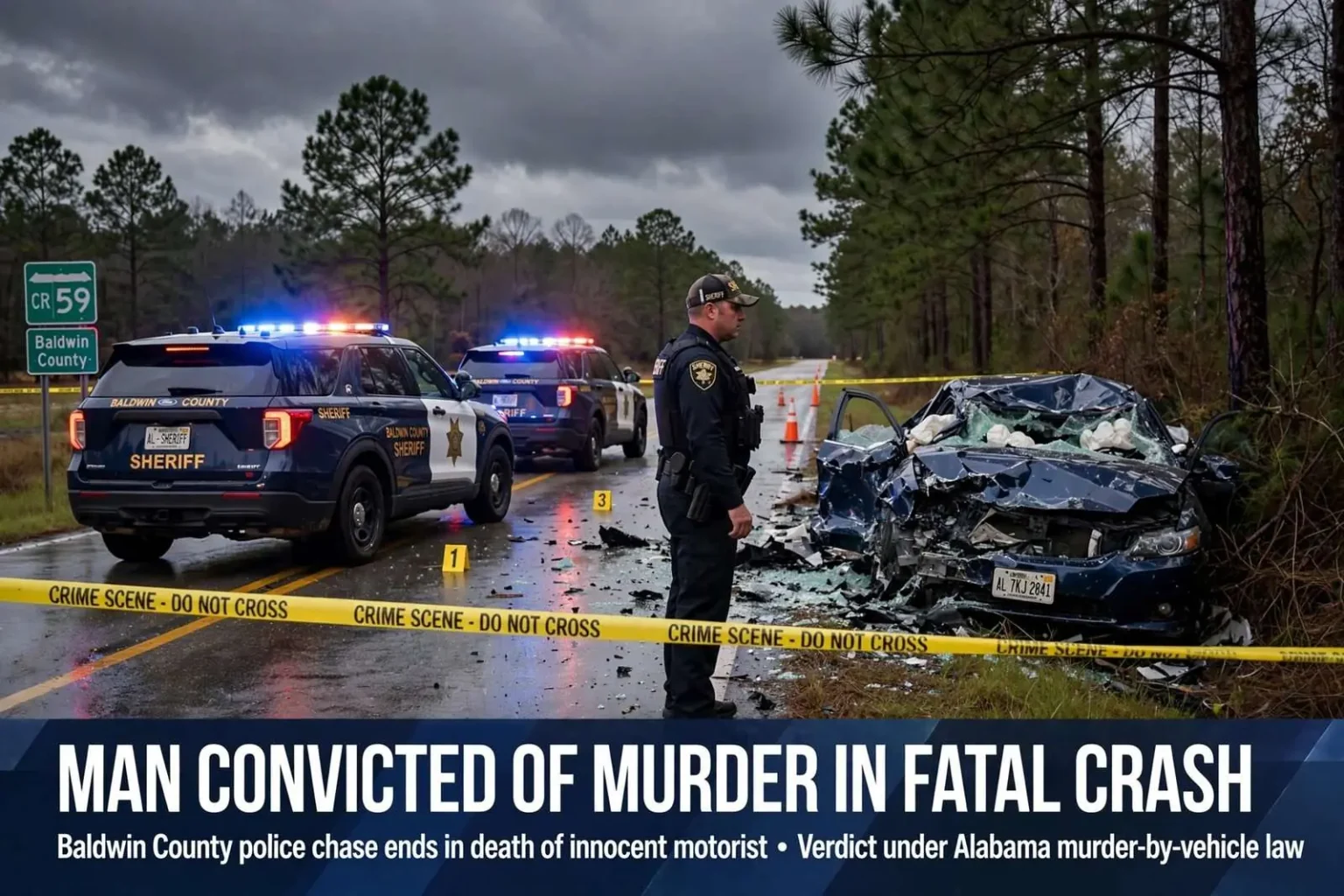
A man who led Baldwin County authorities on a chase that ended in a deadly collision has been convicted of murder, according to the Baldwin County District Attorney’s Office. The verdict closes a case that turned a police pursuit through Baldwin County into a fatal wreck that claimed the life of an innocent motorist.
Prosecutors said Thomas Norton was found guilty of murder and attempting to elude after he fled from police and crashed into an innocent woman’s vehicle, killing her. The jury’s decision held Norton responsible for the death even though he did not set out that day to harm anyone — because, under Alabama law, the deadly outcome of the flight itself was enough.
The conviction ties the fatal wreck directly to Norton’s decision to run from pursuing officers, a theory prosecutors pursued under Alabama’s law allowing murder charges when a death occurs during the flight from law enforcement. To the jury, the argument was straightforward: when a driver chooses to flee at dangerous speeds, the deaths that follow are his responsibility, no different in law than if he had pulled the trigger.
How Alabama’s murder-by-vehicle law works
Alabama is among the states that treat deaths during flight from police as murder, and the statute is deliberately unforgiving. A driver who flees or attempts to elude a law enforcement officer using a vehicle, and whose flight causes a death, can face the same murder charge — with the same potential punishment — as any other person accused of intentionally killing someone.
The law’s logic rests on the concept that acting with extreme indifference to human life is morally equivalent to intending harm. A high-speed chase through traffic, in that view, is precisely such an act: the fleeing driver creates a deadly risk that he cannot control and cannot undo, and when someone dies as a result, the law treats the death as his doing.
For prosecutors in Baldwin County, the charge carried an advantage that other charges could not: murder convictions in Alabama can carry sentences of decades to life in prison, and the mandatory weight of the charge removes much of the discretion that lesser offenses leave open. Norton, prosecutors said, faces a lengthy prison term on the murder count alone.
The chase and the crash
What began as a routine encounter along Baldwin County’s roads ended when Norton fled from officers attempting to stop him. Pursuits through the county’s mix of highway corridors and two-lane rural roads build speed quickly, and officers must weigh in real time the danger a fleeing driver poses to the public against the importance of the stop.
The pursuit ended the way prosecutors told the jury it was always likely to: in a collision with an innocent woman’s vehicle. She died as a result of the wreck, and Norton was taken into custody at the scene, the pursuit’s final act written into the crash report and the case file that would eventually go to trial.
Baldwin County’s courts and the pursuit cases that reach them
The Baldwin County District Attorney’s Office prosecutes cases from across Alabama’s largest county by area — a jurisdiction that stretches from the Mobile city limits east to the Florida line, and from the Gulf beaches north to the timber country above Interstate 10. Its courts in Bay Minette handle the felony dockets that include the county’s pursuit deaths, and prosecutors there have built a record of charging fleeing drivers when their getaways end in tragedy.
Chases in Baldwin County present particular risks because of the county’s geography. High-traffic routes like Highway 59, Highway 98 and the beach highway carry heavy seasonal traffic, while the interior’s rural roads invite speeds that fleeing drivers exploit. A pursuit can move from a subdivision to a state highway in seconds, and the public is rarely warned before a fleeing vehicle tears through.
That risk calculus is why pursuit policy matters to every agency in the county, from the Baldwin County Sheriff’s Office to the municipal departments along the Eastern Shore and the coast. Officers are trained to evaluate whether continuing a pursuit is justified by the reason for the stop, and supervisors can call one off when the danger to the public outweighs the need to make an arrest. The decisions, however, ultimately belong to the person who chooses to run.
The victim at the center of the case
The woman who died was, in the language prosecutors used at trial, innocent — a driver going about her day who had no role in the chase that ended her life. Cases like hers are the reason Alabama’s law exists: the person killed in a pursuit death did nothing to place herself in danger, and the criminal justice system’s answer is to place the full weight of the death on the person who created the risk.
For the victim’s family, the trial offered the formal verdict the law allows, though no sentence can restore what was lost. Victim advocates in the prosecutor’s office guide families through the process — from indictment through trial and sentencing — and victims’ relatives are entitled to address the court at sentencing before the judge imposes punishment.
What the conviction means
Sentencing details were not immediately available, and Norton faces a lengthy prison term on the murder count alone. In Alabama, a murder conviction carries a sentence of 20 years to life, with parole eligibility governed by the terms of the state’s sentencing laws and the discretion of the court.
The attempting-to-elude conviction adds a separate felony to the record, one that documents the conduct that set the fatal chain of events in motion. Together, the two convictions tell the complete story of the case: a driver who ran, a crash that killed an innocent woman, and a jury that decided the man who ran was responsible for her death.
The case stands as the outcome prosecutors hope every pursuit-death prosecution delivers — a verdict that makes clear, on the record and in the community, that choosing to flee from police is not a victimless gamble. The next driver weighing that decision on a Baldwin County road will do so knowing where the law draws its line.
Inside the trial
Trials built on pursuit deaths follow a familiar arc in the courtroom. Prosecutors walk the jury through the chase in sequence — the initial stop, the moment the driver made the choice to flee, the route of the pursuit, and the seconds before impact — using dash and body camera footage, crash reconstruction testimony and the officers who were chasing to put the jury on the road that day.
Crash reconstruction experts play a central role in cases like this one, calculating speeds from the physical evidence at the scene: skid marks, vehicle deformation, the final resting positions of the cars. Those calculations become the backbone of the state’s argument that the fleeing driver’s speed and choices made the collision inevitable.
The defense in such cases typically focuses on the chain of causation — arguing that intervening factors, including the pursuit itself, contributed to the crash. Alabama’s law is designed to answer that argument directly, placing the death at the feet of the driver who fled, and the Baldwin County jury’s verdict shows that prosecutors made their theory stick.
Pursuit deaths and the law’s message
Nationally, hundreds of people die each year in crashes connected to police pursuits, and a large share of the victims are bystanders — people in other vehicles or on sidewalks who had no connection to the reason for the chase. Alabama’s legislature answered that reality by writing flight from police into the state’s murder statute, making the state one of the clearest in the country on the question of responsibility.
Prosecutors in the region have used the law in case after case involving deaths on highways and city streets, and juries have repeatedly returned convictions under it. The theory is simple enough to state in a sentence — if you flee and someone dies, you killed them — and severe enough to make drivers think twice before pressing the accelerator.
The Baldwin County conviction joins that line of cases. Whatever sentence the court ultimately imposes, the verdict itself delivers the law’s message: a fleeing driver owns every consequence of the flight, including the lives it takes.
Remembering the cost
Beneath the legal doctrine is the original loss — a woman killed in her own vehicle on a Baldwin County road by a stranger’s choice. Her death is the reason the case exists, the reason the pursuit policy reviews happen after every chase, and the reason prosecutors devoted the resources of a murder trial to holding one man accountable.
Her family will mark the verdict in their own way, as families do after the trials that follow a sudden loss. The conviction does not close the case for them so much as it confirms its central fact: the person responsible for her death has been identified, tried and found guilty by a jury of his neighbors.
For the officers who chased, the medics who responded and the investigators who built the case, the verdict is the end of months of work. For the community, it is a reminder written in the most costly terms possible: the decision to run from police is never made alone — everyone else on the road is along for the ride.