Marine Cleanup Begins at Cotton Bayou After Hurricane Sally
Crews began clearing roughly 800 displaced boats from Orange Beach waterways after Hurricane Sally, with marina operators predicting a two-to-three-week.
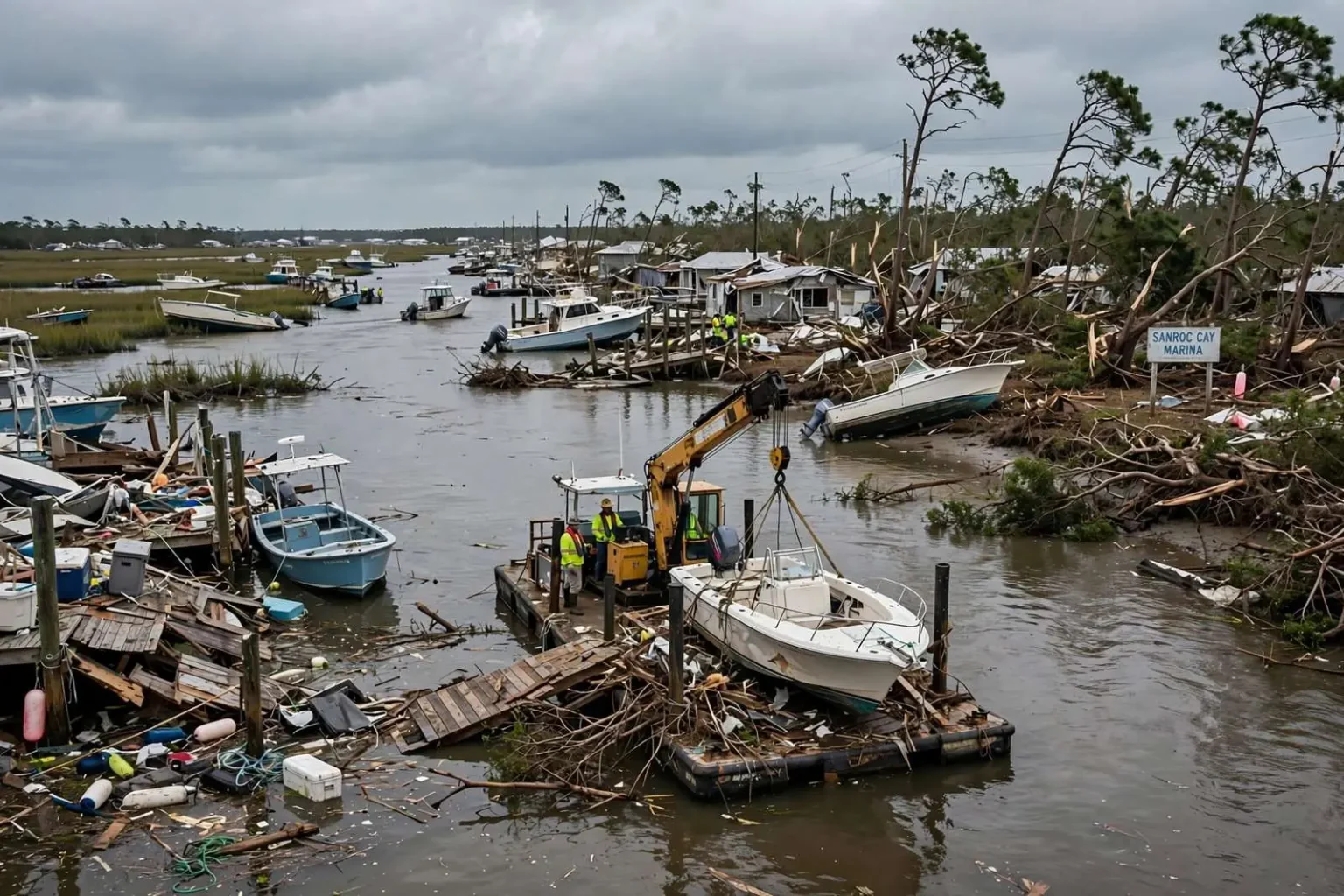
ORANGE BEACH, Ala. — Orange Beach was among the hardest-hit communities when Hurricane Sally came ashore, and now the long job of clearing its waterways is getting underway. Early estimates put roughly 800 boats displaced in or around the water, and marine cleanup was set to begin later in the week, though aerial video made clear the scale of the task facing the coastal city’s marinas, canals and bayous.
Sally’s slow crawl ashore in mid-September delivered a historic punch to the Baldwin County coast. The storm’s winds, sustained near 120 mph with gusts up to 150 mph according to Randy Boggs, captain and owner of Sanroc Cay Marina, pushed water and wreckage through the city’s marinas and residential canals. The wind direction — from the northwest, unusual for the area — caught many boaters off guard, he said, driving storm surge and waves into positions where boat owners rarely expect them and leaving vessels sunk, stacked or scattered.
The aftermath transformed the water. Cotton Bayou and the surrounding waterways filled with displaced craft, debris and the machinery of recovery, and the job of clearing them fell to salvage crews working from the air, from docks and from boats of their own. Boggs said salvage crews were already on the water even before the organized cleanup formally began, and he predicted the waterways could be largely cleared within two to three weeks, with repairs to follow.
An Unusual Storm From an Unusual Direction
Hurricane Sally’s most dangerous quality was its pace. The storm dawdled across the northern Gulf before coming ashore near Gulf Shores, and its slow forward speed meant hours of unrelenting wind and storm surge rather than a brief peak. Winds bent on the scale Boggs described — sustained near 120 mph with gusts to 150 — stripped boats from their moorings, snapped dock pilings and pushed hulls onto shores, under buildings and atop one another.
The northwest wind direction compounded the damage. Orange Beach’s waterfront is arranged around canals and bayous that open toward the Gulf-facing south and east, and most storm planning along the northern Gulf Coast assumes winds that come off the water from the south or southeast. A wind out of the northwest blew the opposite way across the low-lying peninsulas and canal systems, pushing surge into pockets that rarely see it and catching boaters who had prepared for a more typical storm track.
Aerial video of the aftermath documented the result: vessels driven onto land and into marsh, docks torn apart, and waterways crisscrossed with masts, decking and floating debris. For a community whose economy and identity are built on the water, the images were a measure of how much work lay between the storm and a return to normal.
Boats as Economic Lifeblood
The estimated 800 displaced boats represent more than property losses; they are the working equipment of a coastal economy. Orange Beach’s charter fishing fleet, its marinas, its dolphin and sunset cruise operators, and its pleasure-boating visitors all depend on vessels that stay afloat, powered and accessible. When that many boats are displaced, the effects ripple through the fall season — charter trips canceled, slips unusable, fuel docks and shipyards buried under the demand for repairs.
Sanroc Cay Marina, where Boggs serves as captain and owner, sits on Cotton Bayou at the heart of Orange Beach’s boating district, a complex of slips, shops and charter operations that anchors the city’s waterfront tourism. From that vantage, Boggs saw both the damage and the response: crews beginning the salvage work boat by boat, owners assessing their vessels, and the community organizing around the recovery almost before the water had settled.
The cleanup’s first phase — clearing the waterways — is the prerequisite for everything else. Displaced and sunken vessels block channels, endanger navigation and leak fuel and fluids into the very waters the fishing industry depends on. Getting them out, in the two-to-three-week window Boggs predicted, would let marinas reopen their channels and begin the slower, costlier phase of repairs to docks, buildings and boats themselves.
The Cleanup Job on Cotton Bayou
Marine salvage after a major hurricane is a specialized and laborious craft. Displaced vessels — some sunk, some aground, some piled against structures — must be located, refloated or hoisted, secured against leaks and moved to staging areas, all while working around debris, damaged docks and uncertain depths. The roughly 800 boats estimated in and around Orange Beach’s waters made the local effort one of the larger salvage operations the Alabama coast has seen, and the aerial footage that circulated after the storm gave responders and residents alike an honest preview of the timeline.
That the crews were on the water within days mattered. Salvage work compounds: a boat left in a channel becomes an obstacle for the cranes and barges that need to reach the boats behind it, and petroleum leaking from a damaged hull creates environmental problems that grow with every tide. Beginning the work immediately, as Boggs described, is both a practical necessity and a signal of the community’s intent to get back on the water quickly.
The predicted schedule — waterways largely cleared within two to three weeks, repairs to follow — reflected the difference between clearing and rebuilding. Clearing requires coordination among salvage crews, the city, state agencies and the Coast Guard; rebuilding requires contractors, insurance adjusters and supply chains already strained by a storm that damaged property across the entire region. Orange Beach faced both jobs at once, along with the restoration of power, water and roads that the whole coastal community needed.
Recovery in a Fishing Town’s Own Words
Boggs’s assessment of the storm — the winds, the unusual northwest direction, the boaters caught off guard — carried the authority of someone who lives and works at the waterline. But it was his confidence about the future that captured the city’s mood. “When you give the fisherman in Orange Beach a chance, we will recover from this,” Boggs said, tying the community’s recovery to the people whose livelihoods run through Cotton Bayou and the city’s other waterways.
The remark reflected the resilience that Gulf Coast fishing communities have demonstrated through previous storms. Coastal Alabama’s charter fleet and commercial operators have rebuilt before, and the knowledge base for that work — where to find a sunken boat, which crew can haul it, how to patch a marina back together — lives in the same community the storm damaged. Recovery in Orange Beach has always been an inside job, with local captains and crews doing much of the lifting.
The two-to-three-week clearing estimate also set expectations for the fall season. If the waterways reopened on that schedule, charters and cruises could resume while the region was still reeling from the storm’s broader damage — a modest but meaningful sign of normalcy for a tourist economy that depends on visitors finding the water open for business.
Orange Beach After the Storm
Hurricane Sally’s damage to Orange Beach went well beyond its boats. The city’s homes, condominiums, restaurants and infrastructure took the same hours of wind and surge, and the recovery effort stretched across the community and across Baldwin County. But the water is where the city measures itself, and the state of its marinas and channels is the most public marker of how recovery is going.
The images from the first days — masts above the waterline in the wrong places, hulls stacked along canal banks — gave way over the following weeks to the less dramatic machinery of recovery: cranes, barges, pumpouts and repairs. Boggs’s prediction about the two-to-three-week clearing window framed that process for the public, and the salvage crews working from the storm’s first days made the timeline plausible.
For now, the facts stood as reported: roughly 800 boats displaced in or around the water, marine cleanup set to begin later in the week, salvage crews already at work, and a marina owner’s promise that his city’s fishermen would recover — given the chance. The waterways of Cotton Bayou and Orange Beach had taken Sally’s best; the people who worked them were already answering.
How Salvage Operations Work
The mechanics of clearing hundreds of displaced boats involve a chain of specialized roles. Dive teams inspect submerged vessels and attach rigging; crane barges lift hulls that cannot be refloated; smaller workboats shuttle crews and equipment through channels littered with debris; and environmental responders handle the fuel, oil and batteries that every damaged boat carries. Coordination falls to a mix of local government, the Coast Guard and private salvage contractors, with marina owners like Boggs acting as the local knowledge base for where vessels sat before the storm and where they ended up after.
Prioritization follows the water. Channels that serve working boats and emergency traffic get cleared first, followed by marina basins, then the residential canals where so many Orange Beach vessels were knocked loose. Each recovered boat must be checked for leaks and towed to a staging area — often a parking lot or an empty shoreline — where owners can find it and insurers can assess it. The logistics read routine on paper and unfold slowly on the water, which is why a two-to-three-week clearing window was an ambitious target.
The environmental stakes add urgency. Cotton Bayou and the surrounding waters feed the same estuary system that supports the area’s fishing, and a fleet of damaged boats is a fleet of pollution sources. Salvage crews work to plug tanks and pump out vessels as they recover them, limiting what reaches the water — part of the unglamorous work that makes the community’s later recovery possible.
Sally’s Place Among Gulf Storms
Hurricane Sally came ashore in the middle of an extraordinarily active 2020 Atlantic season, one so busy that forecasters exhausted the traditional storm-name list. For coastal Alabama, though, the season’s story was Sally: a storm that spent days drifting in the Gulf, confounding expectations before its eventual landfall near Gulf Shores, and then delivered days’ worth of wind, rain and surge to the communities between Mobile Bay and the Florida line.
The storm’s winds — the 120 mph sustained figure and 150 mph gusts that Boggs reported from the Orange Beach waterfront — placed Sally among the strongest hurricanes to strike the Alabama coast in the modern record. The unusual northwest wind direction made its effects distinctive even among Gulf storms, pushing water into places the area’s usual storm geometry rarely reaches and contributing to the boat-dispersal pattern that cleanup crews confronted.
The measured recovery that followed — clearing, then repairing, then reopening — is the pattern Gulf Coast communities have repeated through decades of storms. What distinguished Orange Beach’s version was the speed with which its marine community mobilized: salvage crews on the water within days, a clearing timeline announced in weeks and a promise from the marina industry that the fishing fleet would be back in business as soon as the waterways allowed.
What Comes After the Water Clears
The repairs Boggs said would follow the clearing phase represent the longer road. Boats that survived the storm often still need engine, electrical and hull work from immersion or impact; docks and lifts must be rebuilt; and marina facilities — fuel systems, shore power, restrooms — require repair before normal operations resume. Insurance processes govern much of that work, and the demand for marine contractors across the storm-damaged Gulf Coast meant the queue for repairs could stretch far longer than the salvage queue.
For Orange Beach’s charter and tourism economy, the interim period was about confidence as much as construction. Visitors decide on fishing trips weeks in advance, and the community’s public message — that the water would be cleared and the fleet would run — was aimed at keeping those bookings alive through the fall. Boggs’s pledge that fishermen would recover “given the chance” carried exactly that message: help the waterways reopen, and the rest of the recovery would follow on its own momentum.
The cleanup at Cotton Bayou thus stood for more than debris removal. It was the first visible step in Orange Beach’s return to being the place its visitors know — a town built around fishing, boating and the water, where the captains who run the fleet take the lead in putting it back together, storm after storm.