
MAWSS to Conduct Routine Hydrant Flushing Across West Mobile
MAWSS will flush fire hydrants across several West Mobile corridors over the coming weeks, which may cause temporary water discoloration or pressure changes.
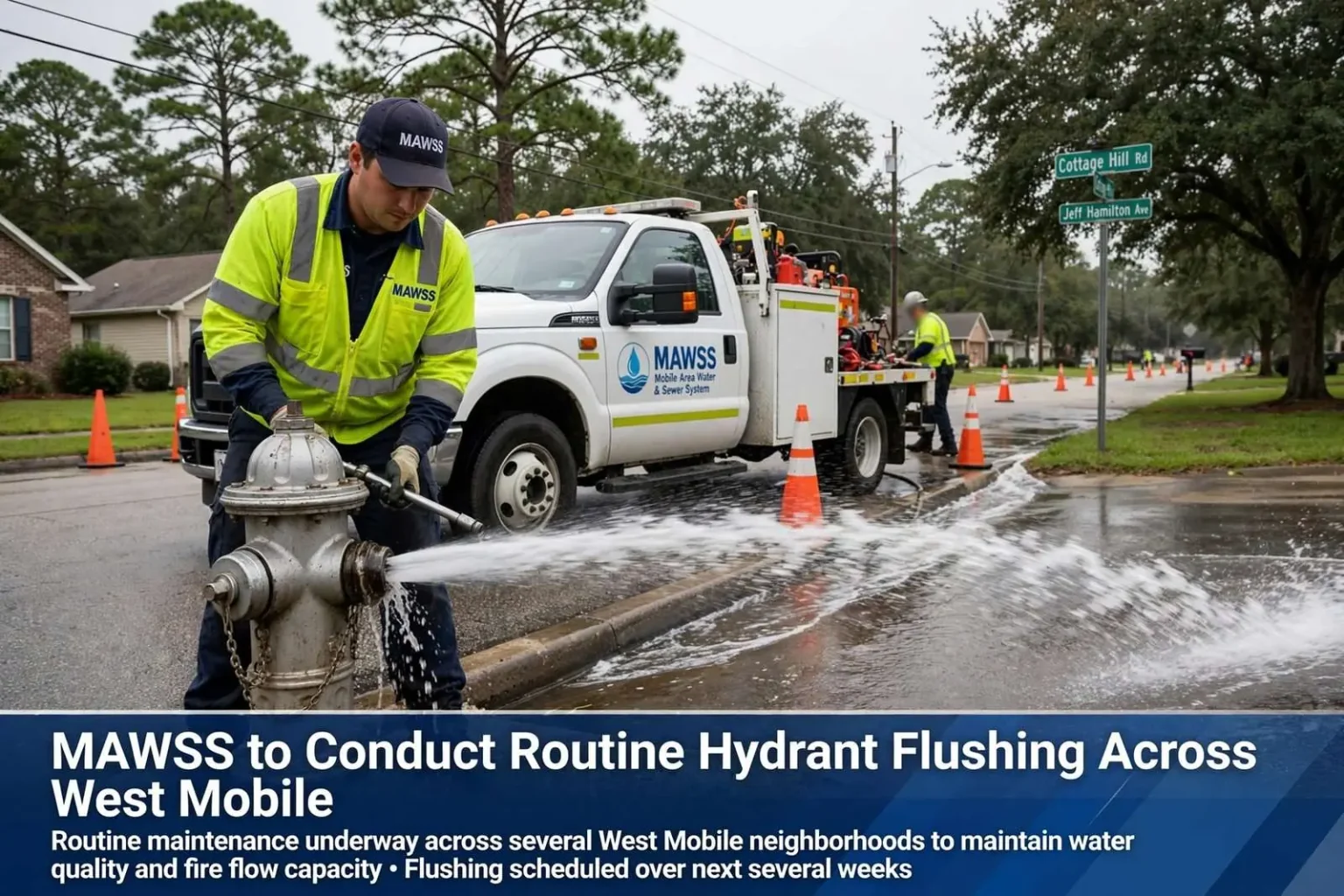
The Mobile Area Water & Sewer System (MAWSS) will conduct routine hydrant flushing across several West Mobile neighborhoods over the next several weeks, part of an ongoing effort to maintain water quality and keep the region’s fire suppression system in working order.
Hydrant flushing is a standard maintenance practice used by water utilities across the country. By opening hydrants and running water through the pipe network at high volume, crews are able to remove sediment and rust buildup from the interior of water mains, which helps preserve water clarity and taste. The process also allows MAWSS to test fire flow capacity at individual hydrants, verifying that adequate water pressure and volume would be available to firefighters in the event of a nearby fire.
“While flushing hydrants may seem like a waste of clean water, it is essential to keeping water safe and maintaining the integrity of a pipe network,” MAWSS said in its announcement of the maintenance work.
Why utilities flush in the first place
Water mains are buried, out of sight and largely out of mind, but they age like any other infrastructure. Over years of service, naturally occurring minerals in the water supply settle out of suspension, and older unlined iron mains can slowly corrode from the inside, shedding rust particles into the flow. Under normal daily demand, water moves through the network too slowly to scour those deposits away, and they accumulate along the pipe walls and in low-use dead ends.
Left alone, that buildup has consequences customers eventually notice: water that runs rusty or yellow at the tap, off tastes and odors, and reduced capacity in the pipes themselves. The same deposits can also shelter bacteria, which is why water quality regulators expect utilities to maintain a consistent program of flushing and main cleaning as part of routine system care.
Opening hydrants in a controlled sequence reverses the problem. High-velocity flow scours sediment loose and carries it out through the hydrant, where crews can see the water clear as the line cleans itself. Each hydrant gets exercised in the process — valves turned, caps checked, flow measured — so the utility learns about any hydrant that would fail when it is needed most, before an emergency supplies the answer.
Fire flow is the quieter half of the work
The water quality benefits of flushing are visible; the fire protection benefits are not, but they matter just as much. Every hydrant on the MAWSS system is a connection point between the water network and the fire service. When a structure fire breaks out, engine companies expect each hydrant to deliver a measured volume of water at adequate pressure, and their attack plans depend on it.
During flushing, crews effectively test that promise hydrant by hydrant. Measuring flow and residual pressure while the hydrant is wide open reveals whether the main feeding it still has the capacity it was designed for. A hydrant that underperforms gets flagged for follow-up — a valve repair, a main cleaning or a capacity study — rather than being discovered mid-emergency.
West Mobile’s mix of established subdivisions and commercial corridors along roads like Cottage Hill, Azalea and Schillinger makes that verification work especially worthwhile. The area has grown in phases over decades, which means its pipe network is a patchwork of vintages, and periodic testing is the only reliable way to confirm that the whole system performs as intended.
What West Mobile Residents Can Expect
Customers in and around the flushing zones may notice temporary water discoloration or a brief drop in water pressure while crews are working nearby. MAWSS describes this as a normal, temporary occurrence tied directly to the flushing process rather than a sign of a larger problem with the water supply.
If discoloration does appear at the tap, MAWSS recommends running a cold water faucet for a few minutes until the water runs clear again. The utility also advises residents to hold off on washing white or light-colored laundry until water clarity has returned to normal, since discolored water can occasionally cause staining.
The discoloration itself is not a health concern — it is sediment and mineral particles stirred up by the high-velocity flushing, the same material the program is designed to remove. It looks alarming in a drinking glass or a washing machine, but it settles or flushes out quickly once the line clears. Customers who notice a lingering rusty taste after the water runs clear can let the tap run a bit longer, and cold water is the right choice for flushing household plumbing because hot water tanks can draw the sediment deeper into the home’s system.
The corridors on the schedule
The flushing work is scheduled to take place across the following West Mobile corridors:
- Jeff Hamilton at Cottage Hill Road
- Hamilton Creek Drive North to Cottage Park Drive South
- Azalea Road to Lakeside Drive
- Pleasant Valley Road to Government Boulevard
- Springdale Road to Burma Hills Drive
The list spans the heart of West Mobile: the Cottage Hill and Jeff Hamilton intersection anchors a busy commercial and residential crossroads, while the Azalea Road and Government Boulevard corridors carry some of the heaviest daily traffic in the area and sit close to major medical and retail districts. Springdale Road connects residential neighborhoods that have grown steadily since the 1970s and 1980s, when much of West Mobile was developed out of piney woods and dairy land.
Because flushing is being conducted over a period of several weeks rather than a single day, the schedule for any given street is weather- and workload-dependent, and crews may move between zones as conditions warrant. Residents who miss the announcement will usually know the work has arrived by the signs: hydrants flowing openly onto the street, crews in safety gear working a few blocks away, and — briefly — a tap that runs rusty.
The flushed water itself follows the storm drain network. Crews generally direct the discharge to keep it from flooding intersections, and in neighborhoods with older drainage the volume of a wide-open hydrant can look more dramatic than it is. The water leaving the hydrant is untreated by any additive; it is the same system water that normally sits in the main, now carrying the sediment the main has been collecting.
Understanding MAWSS and the system behind the taps
The Mobile Area Water & Sewer System serves customers across the city of Mobile and surrounding areas of Mobile County, operating the treatment plants, pumping stations, storage tanks and thousands of miles of water and sewer mains that make modern indoor life in the region possible. The utility is governed by a board and funded through customer rates rather than general tax revenue, which puts routine maintenance like flushing in the same category as any other operating cost the system cannot defer forever.
The region’s drinking water is drawn primarily from surface sources — most notably Big Creek Lake, the reservoir in western Mobile County that has supplied the area’s drinking water for generations. Treated water is pumped into a distribution network of mains ranging from small neighborhood lines to large transmission pipes, and maintaining water quality end to end means maintaining all of it, including the quiet residential loops that see only modest daily use.
That last point explains why flushing matters most in exactly the kind of neighborhoods on this schedule. A main that serves a stable subdivision with steady demand may carry less flow than it was sized for, and slow-moving water is where sediment accumulates and disinfectant residual fades fastest. Periodic high-volume flushing is the reset button for those stretches of pipe.
A routine worth noticing
Hydrant flushing rarely makes news, and that is by design: when the program works, most customers experience nothing worse than a few minutes of discolored water and a hydrant running in the street. But the work it represents is foundational. Water utilities that skip routine flushing tend to rediscover its value the hard way, through widespread discoloration events, taste complaints and hydrants that fail when firefighters need them.
For West Mobile residents, the practical response to the announcement is minimal. Note the corridors on the schedule. Expect crews sometime in the coming weeks rather than on a precise day. If the water runs discolored, run a cold tap until it clears, and postpone the white laundry until it does. And if discoloration persists well after crews have left the area, that is the point at which a call to the utility is warranted, since a persistent problem can indicate a main issue that flushing did not resolve.
Businesses along the affected corridors — restaurants, salons, medical offices — have the same considerations on a larger scale, since discolored water is more visible in commercial settings. The same guidance applies: flush cold lines until clear and plan water-sensitive work around the crews’ presence.
The bigger maintenance picture
Flushing is one entry in a long list of unseen work that keeps a water system functioning: valve exercising, meter replacement, main repair, tank inspection and the constant monitoring that regulators require. Each task prevents problems that would be far more expensive and disruptive if left alone. A valve that is exercised on schedule works during an emergency; a hydrant that is flow-tested on schedule delivers when a fire truck connects to it.
The cost of the water used during flushing is part of that calculation. The utility’s own announcement addressed the objection directly — flushing can look like waste, but it is the least expensive way to protect water quality and confirm fire flow across hundreds of miles of pipe. Alternatives such as mechanical pipe cleaning or main replacement cost far more and disrupt streets and traffic far longer.
For customers in the flushing zones, the takeaway is simple. The crews opening hydrants in West Mobile over the next several weeks are doing two jobs at once: cleaning the pipes that carry the region’s drinking water and testing the fire protection network that stands ready behind every hydrant. A few minutes of rusty tap water, easily cleared by running the cold faucet, is the modest price of both.