Mayor Stimpson proposes turning vacant downtown Mobile Gayfer’s building into affordable housing
Mayor Sandy Stimpson wants to convert the long-vacant downtown Mobile Gayfer's building into 94 affordable housing units using American Rescue Plan funds.
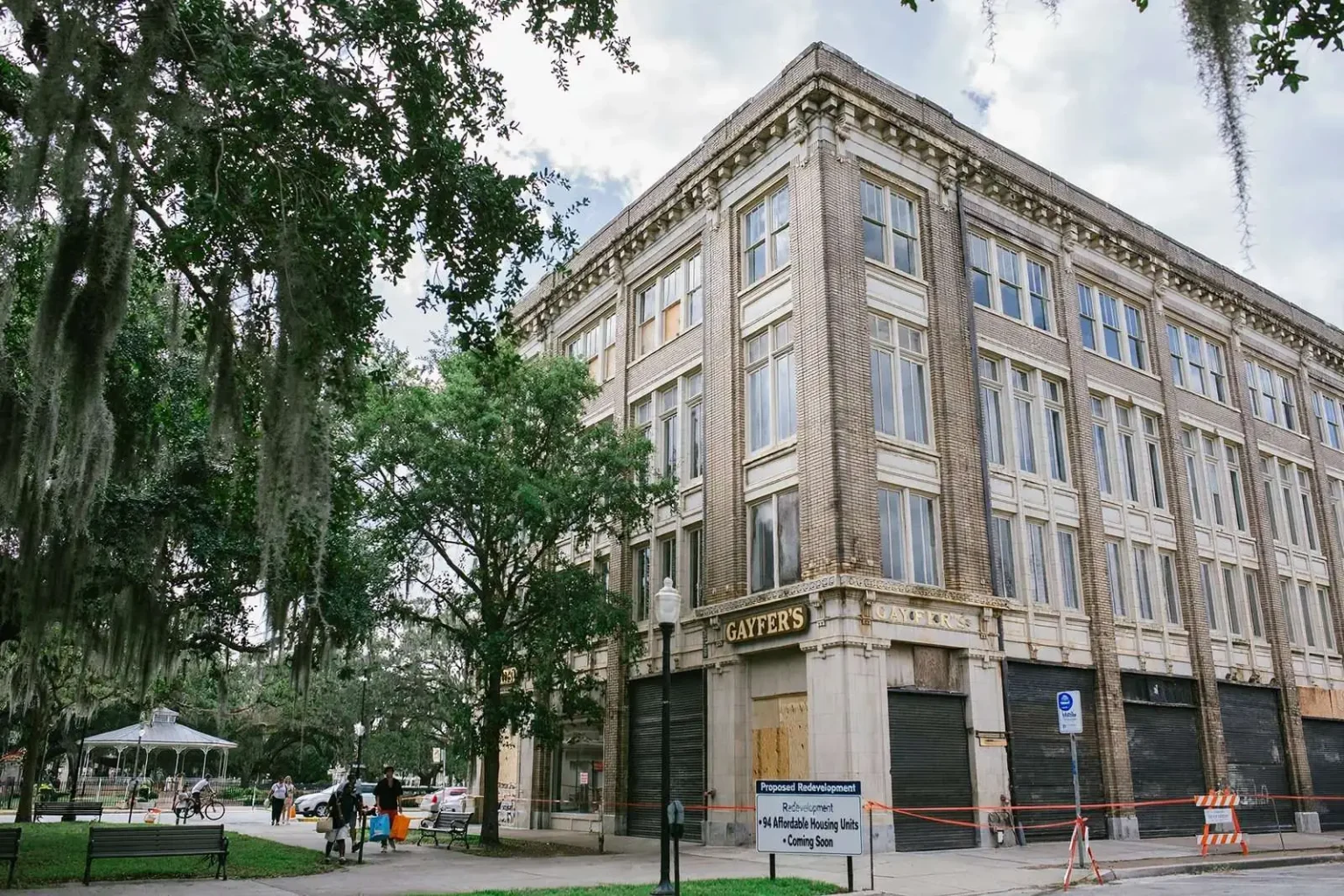
MOBILE, Ala. — A downtown Mobile building that has sat vacant for decades could soon be reborn as affordable housing. The plan, discussed by Mayor Sandy Stimpson during a Friday town hall, would convert the former Gayfer’s department store into 94 low-income housing units, with the ground floor set aside for businesses.
The announcement gave residents one of the most concrete visions yet for a structure that has loomed over Bienville Square as a puzzle for city planners for a generation. Downtown Mobile has seen waves of investment in recent decades — restaurants and entertainment venues along Dauphin Street, new hotels, and the steady growth of the medical district nearby — but upper-floor housing downtown has remained comparatively scarce, and vacancies like the old Gayfer’s building stand out against a backdrop of renewed activity.
The building occupies about half a city block on Bienville Square in the heart of downtown. Its position directly across from the park that serves as downtown’s front lawn makes it one of the most visible vacant structures in the city, and its scale — a full department store from the era when such buildings anchored Main Street retail — means that any redevelopment would put a substantial number of residents and businesses into a block that now holds none.
The Financing Plan
The project is expected to cost about $25 million. The city has received $29.1 million of the $58 million allocated to it through the American Rescue Plan and plans to commit $8 million toward the redevelopment. The nonprofit Gulf Coast Housing Partnership would match every dollar the city invests.
That structure — city money matched one-to-one by a nonprofit partner — is the standard architecture for difficult historic redevelopments. Buildings like the former Gayfer’s store present classic financing gaps: the cost of asbestos abatement, updated mechanical systems, code compliance and historic-preservation work often exceeds what the completed apartments can support in rent, particularly when a share of units must be reserved for low-income tenants. Federal housing tax credits, historic tax credits and public contributions are the usual tools for closing that gap, and a committed municipal match strengthens every application a nonprofit partner makes for the rest.
The American Rescue Plan, signed into law in 2021, gave cities wide latitude to spend allocations on recovering from the pandemic’s economic effects, with housing investments among the explicitly encouraged uses. Mobile’s share, $58 million, ranks among the largest single infusions of federal money in the city’s modern history, and directing $8 million of it toward a signature downtown building ties pandemic relief to a permanent public asset.
The Mayor’s Case
“What we have is a building that has been abandoned for over 40 years, and every year that goes by that it is not rehabilitated it will cost more money,” Stimpson said. The mayor said his goal is to let people who work downtown also live there.
The argument about escalating costs is a familiar one in preservation circles, and it is arithmetic as much as sentiment. A vacant building deteriorates; roofs leak, facades spall, copper is stripped, and each year of neglect adds remediation expense to the eventual project. Cities across the country have watched once-restorable landmarks pass the point of no return for precisely that reason. Stimpson’s framing presents the $8 million not as a subsidy to a developer but as the purchase of an option that will not remain available indefinitely.
The second half of the mayor’s case — people who work downtown should be able to live downtown — reflects a broader shift in urban policy. Employees of the city’s growing downtown employment base, from the courthouse complex to the medical district to the port’s administrative offices, currently commute in from across the metro area. Affordable units within walking distance of those jobs would serve workers who cannot afford downtown market rents, shorten commutes, and put foot traffic on streets that empty after business hours.
The Gayfer’s Legacy
For generations of Mobilians, the name on the building means something specific. Gayfer’s was a beloved homegrown department store chain, founded in Mobile in the nineteenth century, that grew to locations across the Gulf Coast before its era ended in the wave of retail consolidation in the late twentieth century. Its downtown flagship, with Bienville Square at its doorstep, was a destination for school clothes at the start of each year, Christmas shopping in December and lunch-counter meals in between.
The store’s departure left behind a building that is both an asset and a burden. Its size and solid construction make conversion physically feasible in a way that smaller vacant structures are not; its age, layout and decades of disuse make the work expensive. Cities that have converted similar department stores — buildings with deep floor plates, generous windows and strong floors — typically carve apartments around the perimeter and use interior space for parking, amenity areas or the ground-floor retail that the Mobile plan already contemplates.
Keeping the ground floor in commercial use would preserve the block’s traditional relationship to the street. Department stores were built to draw pedestrians, and a rehabbed Gayfer’s with shops or restaurants at sidewalk level and residents above would restore the kind of mixed-use activity that Bienville Square’s surroundings were designed around.
A Mixed Reception
Reaction among residents is mixed — some welcome the investment, while others worry it could hurt existing businesses. The concerns raised at the town hall reflect debates playing out in downtowns across the country over the role affordable housing should play in district revitalization.
Supporters of the plan point to the straightforward math of vacancy: an abandoned half-block produces no rent, no sales tax, no foot traffic, and its dead windows drag down the perception of an entire district. Ninety-four households, by contrast, mean daily customers for nearby restaurants and shops, and residents with a stake in downtown’s cleanliness and safety. Affordable housing advocates also note that the demand is not hypothetical — service workers, young teachers, hospital staff and retirees on fixed incomes all need housing priced within reach of the local wage base.
Skeptics counter with questions about concentrations of poverty, effects on property values and whether subsidized units in a flagship location are the best use of limited federal dollars. Urban research on the question has generally found that well-managed affordable housing developments do not depress surrounding property values, and that mixed-income buildings with active ground floors integrate more smoothly than the segregated projects of the mid-twentieth century. The Gulf Coast Housing Partnership’s involvement is relevant here: nonprofit developers with local track records typically emphasize long-term management quality over quick construction, and their projects are structured to remain affordable for decades rather than aging into liability.
The Private-Public Approach
Stimpson argued the public-private approach is the only realistic way to restore the structure within the next 20 years. The candid framing acknowledged what decades of inertia around the building have demonstrated: no private developer has been able to make the numbers work alone, and the city’s own budget could not absorb a $25 million acquisition-and-renovation project outright.
That realism is the plan’s quiet strength. Cities that have successfully revived vacant landmarks almost always assembled the same kind of package — municipal contribution, nonprofit developer, tax credits and philanthropic or bank investment — because historic buildings priced out of the private market need public value creation to justify public money. The alternative, in Mobile’s case, was another decade of the same windows staring vacantly across Bienville Square while remediation costs climbed.
If the project proceeds on the outline Stimpson described, the sequence will be familiar to anyone who has watched a similar conversion: financing closed through layered public and private sources, design work respecting the historic structure, construction absorbing the surprises that forty-year-old buildings always hold, and finally a reopened block where the ground floor hums with commerce and ninety-four households call one of downtown’s most storied addresses home. For a building that has waited through four decades of proposals, the town hall marked the most serious step yet from vacancy back toward the life of the city around it.
What Downtown Housing Means for the Square
Bienville Square has anchored Mobile’s downtown since the nineteenth century, named for the city’s French colonial founder, and the blocks around it have cycled through eras of department-store prosperity, mid-century decline and the current wave of restaurants, offices and event venues. The fate of the old Gayfer’s building is intertwined with that cycle: as long as its half-block sat dark, the Square’s eastern edge told a story of decline that no amount of festival activity across the street could quite erase.
Residential conversion changes the calculus of the surrounding blocks in small, cumulative ways. Residents buy groceries, fill prescriptions, walk dogs and meet friends at nearby establishments seven days a week, not just during festivals and lunch hours. Planners who study downtown revitalization consistently identify permanent residents as the single most reliable foundation for retail recovery, ahead of tourism, offices or entertainment, because residents spend in every season and have a direct interest in the neighborhood’s condition.
With the mayor’s proposal now public and a matching nonprofit partner identified, the former department store that once outfitted generations of Mobilians may yet serve the city again — this time as a place to live rather than to shop.