
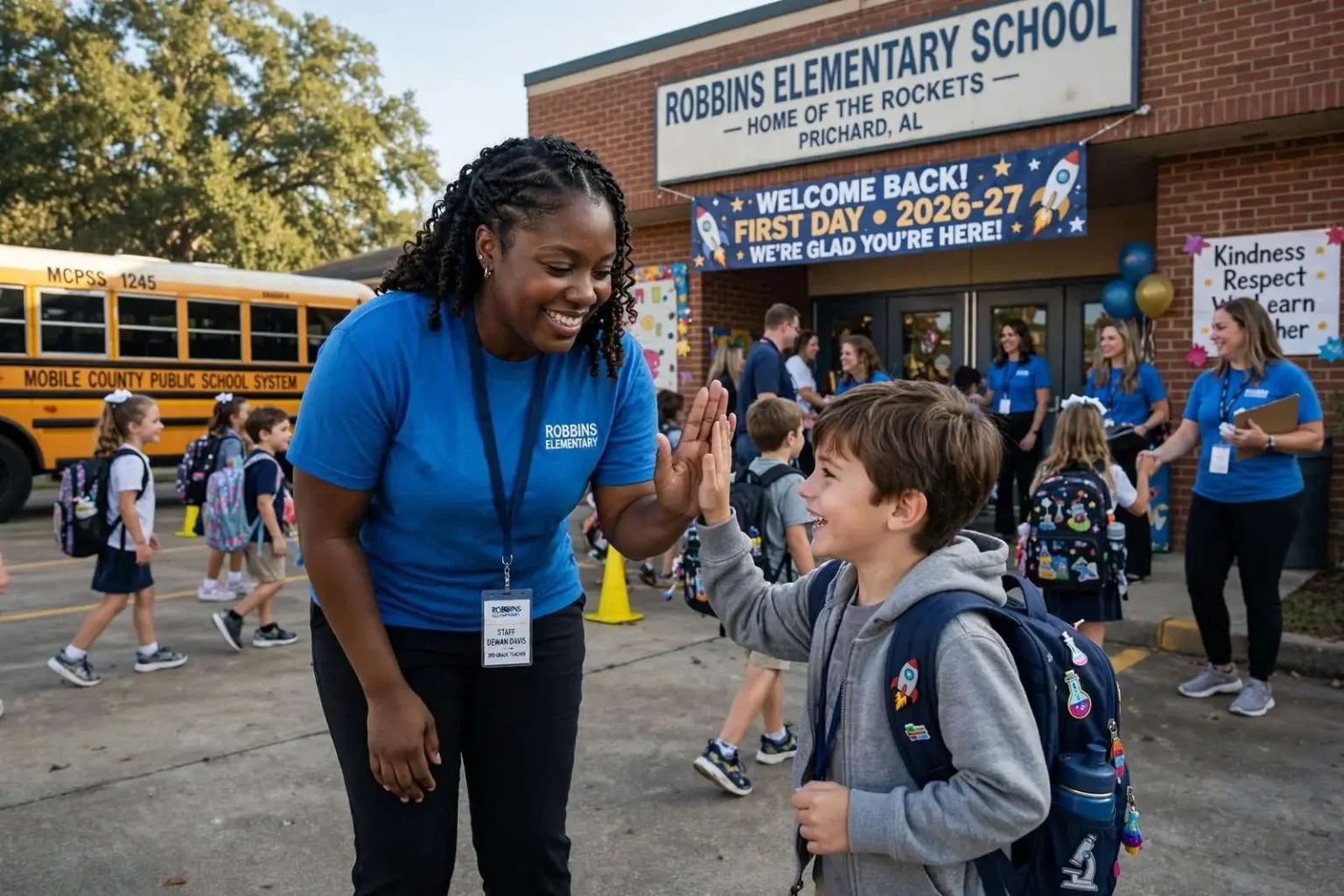
PRICHARD, Ala. — Monday marked a big day along the Gulf Coast as the Mobile County Public School System welcomed back roughly 50,000 students for the first day of the 2026-27 school year. MCPSS is the largest school system in Alabama, spanning 90 schools across the county. At Robbins Elementary School in Prichard, faculty and staff greeted returning students with smiles, high-fives and hugs as buses and cars pulled in for the morning drop-off.
The scale of a first day in Mobile County is hard to overstate. No other district in the state moves 50,000 students into classrooms on a single morning, and the logistics behind that morning — bus routes plotted across one of Alabama’s largest counties, meals prepared for tens of thousands of children, schedules built for 90 schools — represent one of the largest single-day operations of any kind on the Gulf Coast. District transportation teams finalize routes through the final days of summer, and teachers spend the preceding week preparing classrooms that will absorb students from every corner of the county, from downtown Mobile to Citronelle on the northern edge.
Fourth grader Carter Inge said he was more than ready for summer to end. “I was not wanting summer to go longer,” he said, laughing. “I was ready for it to end!” He said his favorite part of school is learning new subjects, from science to gym class. “My favorite part about school is we get to learn new stuff. We learn about science, and we get to play in P.E.,” he said.
His enthusiasm captured what educators hope every student feels on the first day. Elementary schools like Robbins work deliberately to build that excitement, decorating hallways, greeting students by name, and treating the opening morning as a celebration rather than an ordeal. Research on early grades consistently shows that a child’s attitude toward school forms early, and the teachers who welcomed Robbins students back understood the morning as an investment in the whole year.
Teachers Set the Tone
Teachers felt their own mix of nerves and excitement heading into the new year. Third grade teacher Dewan Davis, who has taught at Robbins for four years, said the first day sets the tone for everything that follows. “It’s nervousness for us, but it’s so important,” Davis said, adding that her favorite part of the job is “seeing the excitement on my students’ faces when they unlock their knowledge.”
The first-day stakes are well understood in elementary education. Classroom routines established in the opening days — how students enter the room, how they ask for help, how they treat one another — shape behavior for months. Davis’s nerves reflected the weight experienced by teachers across the district’s 90 buildings, each of whom greeted a new roster of students whose needs, personalities, and starting points would only reveal themselves over the following weeks.
Davis said building relationships starts immediately. “We meet all of our new babies and just trying to create that bond and culture in our classroom,” she said. The emphasis on relationships mirrors what school systems nationwide have learned about student success: children learn best from teachers they trust, and the work of building that trust cannot wait until October. In a district serving a high-needs population across urban and rural communities, that bond-building is treated as foundational rather than optional.
Lessons in Kindness From Robbins Students
Students at Robbins said kindness is central to a good school year. “Always be kind to each other. Treat others how you want to be treated, and always follow directions,” Carter said. For a fourth grader, the advice distills the culture that Robbins and elementary schools like it work to instill — social-emotional expectations delivered alongside reading and math, and repeated enough that students can recite them unprompted.
Elementary educators across Mobile County have embraced social-emotional learning as a formal part of the school day, using morning meetings, classroom pledges, and structured lessons on empathy and conflict resolution. The approach reflects a decade of research showing that students’ ability to manage emotions and relationships is closely tied to academic performance, and districts serving diverse communities have found that explicit teaching of kindness and respect pays dividends in fewer discipline problems and stronger classroom communities.
The golden-rule phrasing students used at Robbins also reflects the community around the school. Prichard’s neighborhoods have deep ties to their schools, with generations of families attending the same campuses, and the district’s elementary schools function as neighborhood anchors. First-day traditions — teachers greeting families in the car line, staff who remember older siblings, parents lingering to take photos — reinforce those ties each August.
New Tools for a New Year
The first day comes as MCPSS continues broader efforts to support students and families across the district, including recent additions like the new “Speak Up” safety-reporting app and continued gains in reducing chronic absenteeism countywide.
The Speak Up app gives students and families a confidential channel to report safety concerns — threats, bullying, weapons, or a classmate in crisis — directly to district and school officials. Anonymous reporting systems have become standard in large districts nationwide after years of evidence that students often know about dangers before adults do and will report them when given a safe, private way to do so. For a system of 90 schools, the app extends the reach of administrators and school resource officers into situations that might otherwise stay hidden until they escalate.
The district’s progress on chronic absenteeism addresses the other end of the engagement problem. Chronic absence — missing a substantial share of the school year for any reason — is one of the strongest predictors of falling behind, and it surged in school systems nationwide following the pandemic-era disruptions. Districts that have moved the needle typically combine outreach teams that call and visit families, attendance incentives, and wraparound support that addresses the transportation, health, and housing issues that keep children out of school. Mobile County’s continued gains signal that those strategies are taking hold across its campuses.
A District’s Year Begins
For the roughly 50,000 students who boarded buses and walked through doors Monday, the first day looked much like first days everywhere — new backpacks, new teachers, and classroom rules read aloud before lunch. For the district that organized it, the day launched a year that will test the system’s safety tools, its attendance initiatives, and the classroom cultures that teachers like Davis build from the first morning.
The smiles and high-fives at Robbins Elementary offered the county a snapshot of what educators across its 90 schools were working toward the same morning: students ready to learn, teachers ready to teach, and a district using its scale not just to open doors, but to open them well.
Prichard’s Robbins Elementary Sets the Welcome Standard
Robbins Elementary has long been one of Prichard’s neighborhood anchors, serving families in the northern Mobile County city where generations have walked the same hallways. First days there follow a tradition the district’s elementary campuses have refined over years: staff stationed along the drop-off line with high-fives and name greetings, teachers waiting at classroom doors, and administrators making sure no child starts the year lost or anxious. The hugs and smiles that greeted Monday’s arrivals were the visible surface of a month of preparation — rosters balanced, classrooms labeled, buses routed — that makes the opening morning look effortless.
The school’s faculty understand what the first day signals to a child. Students who feel welcomed and known in the opening hours adapt faster, trust sooner, and engage more deeply, and Robbins has built its culture around that belief. Teachers spent the opening week not just on academics but on rituals — class names, shared rules, morning meetings — that turn a collection of students into a classroom community.
The District Behind the Day
MCPSS’s opening day also showcased the operational muscle that comes with being Alabama’s largest district. Food service staff served tens of thousands of breakfasts and lunches on day one; transportation teams ran hundreds of routes across a county that stretches from the Gulf-facing suburbs to rural communities near the Washington County line; and school leadership monitored campus openings across 90 buildings simultaneously. The district’s size means innovations roll out differently than in small systems — programs like the Speak Up app and the absenteeism initiatives reach tens of thousands of students at once, and their impact is measured countywide.
That scale also shapes the district’s economic role. MCPSS is among Mobile County’s largest employers, with thousands of teachers, aides, bus drivers, cafeteria workers, and support staff whose work year begins the same Monday the students return. The first day is as much an economic event for the county as an educational one.
Looking Down the Year
With the excitement of the first morning behind them, the district’s roughly 50,000 students now settle into the rhythm the opening day was designed to establish. For fourth graders like Carter Inge, the year ahead holds the subjects he was already looking forward to — science experiments and P.E. — and the classroom expectations students like him can recite on demand. For teachers like Dewan Davis, the early weeks are for bonding and routines, the foundation everything else builds on. And for a district continuing its safety and attendance pushes, the 2026-27 year offers the next measure of how a system this large keeps improving, one first day at a time.