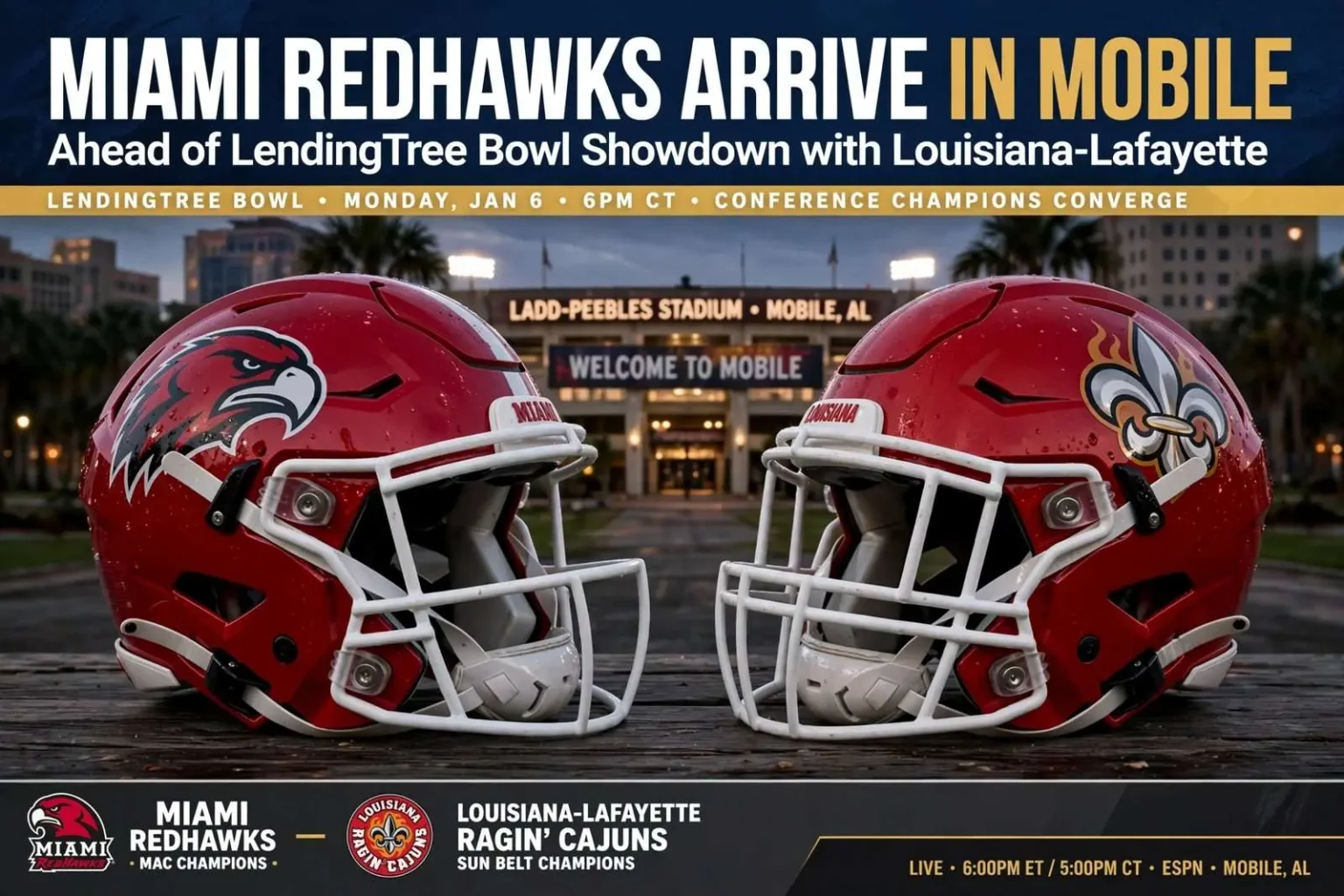
The college football bowl season rolled into Mobile this week as the Miami RedHawks arrived in town ahead of the annual LendingTree Bowl at Ladd Stadium. The RedHawks were set to face the Louisiana-Lafayette Ragin’ Cajuns in a kickoff scheduled for 6 p.m. on Monday, January 6, giving the Port City a primetime matchup between two of the mid-major ranks’ most established programs.
Head coach Chuck Martin spoke with reporters upon the team’s arrival, reflecting on the season that brought his squad to the Gulf Coast and looking ahead to the challenge posed by the Ragin’ Cajuns. For the RedHawks, the trip to Mobile capped a resurgent campaign that earned the program one of its most notable postseason berths in years — a reward for a rebuilding effort that has been years in the making and a signal that the Oxford, Ohio program intends to compete for championships rather than merely play out its schedule.
Bowl trips carry meaning well beyond the game itself. The extra weeks of practice bowl eligibility affords are widely regarded across college football as a de facto spring training, giving younger players repetitions they would otherwise wait months for. For a program on the rise, the berth also functions as a recruiting billboard: a nationally televised January game on the Gulf Coast tells high school prospects that Miami competes deep into the season and does so in a destination city.
A January tradition on the Gulf Coast
The LendingTree Bowl has become a fixture of Mobile’s winter calendar, drawing fans from both programs to the historic stadium in the heart of the city. The game brings visiting teams and their followers into downtown Mobile during what is typically a quiet stretch between the holidays and the start of Carnival season — a window when hotels, restaurants and attractions welcome the boost before Mardi Gras festivities transform the city’s schedule.
Ladd-Peebles Stadium, long a centerpiece of football in the Port City, hosts the matchup each year, and local businesses count on the influx of visitors for an early-January boost. The stadium has been the stage for generations of Gulf Coast football, from high school championships to nationally significant bowl games, and its place along the Gulf Coast corridor between New Orleans and the Florida panhandle has made Mobile a natural bowl destination since the modern bowl era took shape. Sponsors have changed over the years, but the game’s slot in the postseason calendar — and its role as one of the few bowl stops on the central Gulf Coast — has made it a reliable marker on the schedule of mid-major programs across the Southeast and Midwest.
For fans who travel with their teams, bowl week in Mobile offers a compact experience. The stadium sits minutes from downtown hotels and the restaurants of the historic districts, and early January weather on the Gulf Coast is a considerable draw for visitors arriving from Ohio Valley winters. That ease of movement between hotel, stadium and downtown entertainment is part of what bowl officials cite when they describe Mobile as a host city, and it is part of why both programs’ traveling parties arrive days before kickoff.
Conference champions converge
The Ragin’ Cajuns entered the game as representatives of the Sun Belt Conference, while the RedHawks arrived as champions of the Mid-American Conference. The pairing gives the bowl a meeting of two league titlists — an outcome bowl organizers always hope for, since it guarantees both fan bases arrive with championship momentum rather than the mixed emotions that follow a losing record.
The MAC champion’s trip to Mobile also fits a familiar geography of the bowl season. Mid-American Conference programs have long looked south for their postseason destinations, and the Gulf Coast has been a recurring landing spot for MAC teams over the years. For Miami’s roster, many of whom have never played in the Deep South, the week includes the kind of regional experience — Gulf seafood, historic districts, mild January air — that bowl officials deliberately build into the host city’s welcome.
What to expect on the field
Martin’s remarks centered on how the extra weeks of bowl practice have prepared his team for Louisiana-Lafayette’s offense and on the opportunity a bowl victory presents for the program’s momentum heading into the offseason. Bowl preparation compresses into a few weeks what a normal season spreads across months, and coaches consistently describe it as the most concentrated teaching window on the calendar. Against an opponent from a different conference — one whose tendencies Miami’s regular-season film cannot fully preview — that preparation time is doubly valuable.
The matchup pits two programs against each other with no common opponents and sharply different regional styles, which is part of the appeal of bowls outside the championship hierarchy. Sun Belt teams bring the pace and physicality of the Louisiana high school talent pipeline, while MAC programs have built reputations in recent decades for disciplined, well-coached football that develops players over four and five years. Kickoff at Ladd Stadium was set for 6 p.m., giving Mobile fans a primetime showcase of two of the mid-major ranks’ most consistent programs.
What the game means for Mobile
For the city, the bowl is both an economic and a civic event. Hotels along the I-10 corridor and in downtown Mobile absorb the influx of team travel parties, bands, spirit groups and fans; restaurants and bars in the historic districts plan their biggest pre-New Year staffing of the winter around bowl week; and the game itself puts Mobile on national broadcasts during a week when college football attention is at its annual peak. Local officials have long treated the bowl as a piece of the city’s events portfolio — alongside Mardi Gras, the Senior Bowl and the year-round convention calendar — that keeps visitors arriving through the tourism calendar’s traditional trough.
The Monday, January 6 kickoff also gives the game the national stage to itself. With most of the season’s biggest bowls scheduled around New Year’s Day, a Monday-night January slot means a national audience with fewer competing games — valuable exposure for two programs that rely on the postseason to introduce themselves to recruits and fans outside their regions.
For the RedHawks, the week in Mobile represents the payoff of a resurgent season and a chance to finish it with a trophy. For the Ragin’ Cajuns, it is an opportunity to defend home-region turf in front of what figures to be a friendly geographic crowd. And for Mobile, the game continues the January tradition that has made Ladd-Peebles Stadium an annual stop on the bowl map — a mid-major showcase in the heart of the Port City, kicking off at 6 p.m. under the lights, with two conference champions from the Midwest and the Gulf South set to decide it on the field.
The road each team traveled
Miami’s berth in Mobile reflects one of the more patient rebuilding projects in the Mid-American Conference. The Oxford, Ohio program spent several seasons near the bottom of the league standings before climbing back into contention, and Martin — a longtime college assistant with deep Ohio roots — has repeatedly been credited with stabilizing the roster through player development rather than quick fixes. Bowl eligibility, and a conference championship that converts it into a title-game caliber destination, validates that approach and gives the program’s younger players a taste of the standard the fan base expects to maintain.
Louisiana-Lafayette’s appearance carries its own significance. The Ragin’ Cajuns have built themselves into one of the Sun Belt’s flagship programs, drawing on a talent-rich home state and a fan base that travels well within the Gulf South region. Their presence in Mobile effectively extends their season’s home-field advantage a few hours east, which is why the RedHawks’ preparation for the trip has emphasized handling an opponent that will feel at home in front of a regionally friendly crowd.
Bowl games as a mid-major measuring stick
For programs outside the power conferences, the bowl season serves purposes the regular season cannot. Wins over opponents from other regions and other styles offer measurable proof of program quality for polls, recruiting pitches and coaching résumés alike. Mid-major conferences like the MAC and the Sun Belt send teams across the country each December precisely because those games are the only chances their members get to measure themselves against unfamiliar competition — and the LendingTree Bowl’s pairing of two league champions raises the stakes of that measurement for both sides.
The game also matters for the conferences themselves. Bowl revenue is shared across league members, so every program in the MAC and Sun Belt has a financial stake in how their champion performs in Mobile. Strong showings raise the profile of the entire league in the eyes of bowl selection committees and television partners, which shapes where future teams land and how many bowl slots each conference holds. That collective dimension is easy to overlook from the stands, but it is a real part of what both teams will be playing for on Monday night.
A showcase under the Ladd lights
When the RedHawks and Ragin’ Cajuns kick off at 6 p.m. on Monday, January 6, the matchup will close out Mobile’s bowl week with the kind of even, high-stakes pairing the postseason is supposed to produce. Two conference champions, two patient coaching staffs and two fan bases arriving from different corners of the country will fill Ladd-Peebles Stadium for a primetime kickoff, with a trophy, a national broadcast and months of offseason momentum on the line.
For Mobile, the event once again demonstrates why the city has held onto its bowl game through years of shifting sponsorships and a crowded postseason calendar: a compact downtown, a historic stadium, mild January weather and a tourism calendar with room in early January for one more big crowd. For the fans who make the trip — whether from south Louisiana or southwestern Ohio — bowl week in the Port City offers the full Gulf Coast experience wrapped around a football game between two of the mid-major ranks’ most consistent programs. And for the players, Monday night is the final answer to a season’s worth of work: a chance to leave Mobile with a win, a trophy, and a head start on the campaign that comes next.