
Mississippi Baptist Disaster Relief shifts from Kentucky floods to Jackson water crisis
Mississippi Baptist Disaster Relief wrapped up Kentucky flood recovery and shifted to Jackson's water crisis, distributing bottled water to residents.
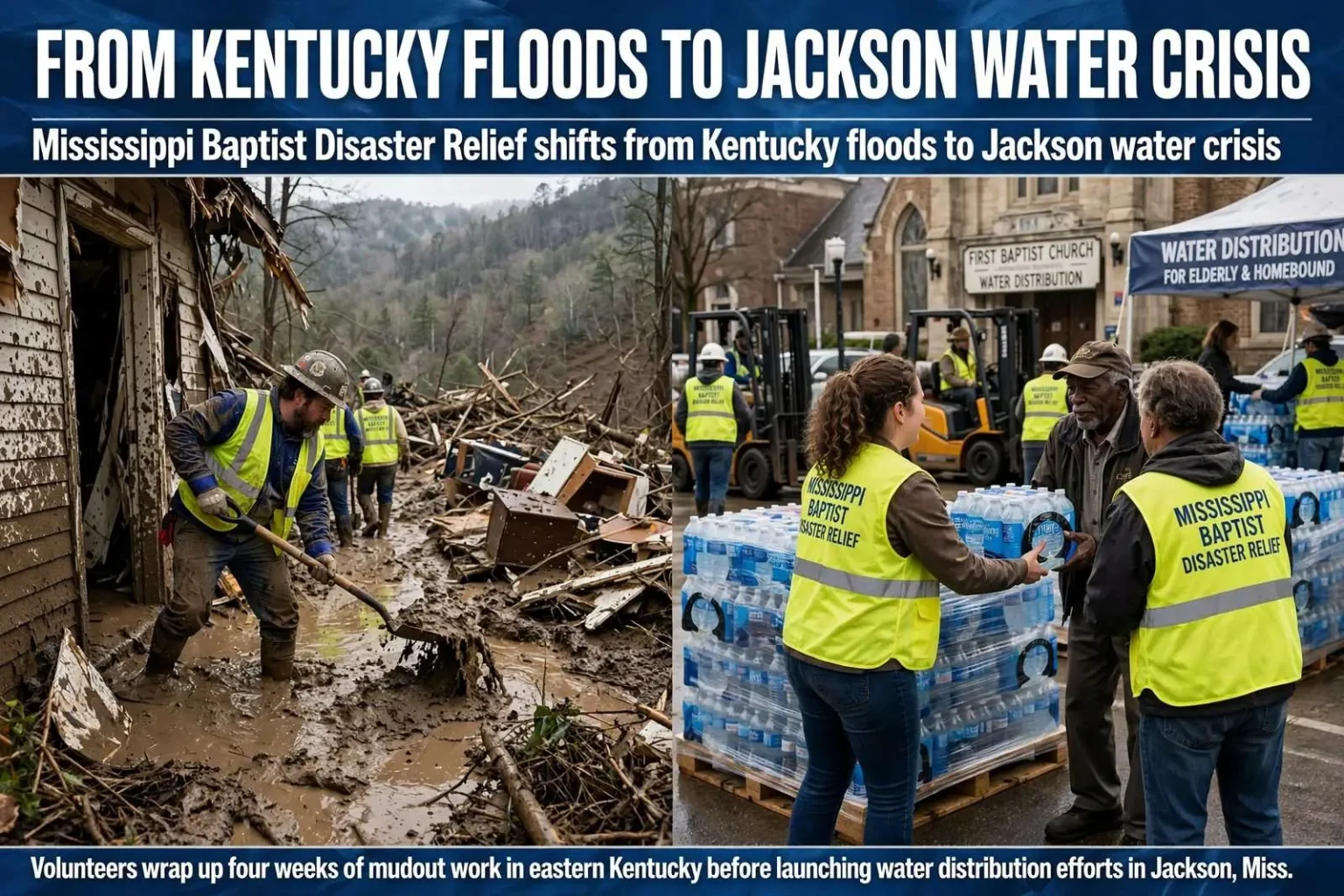
JACKSON, Miss. — Even as hurricane season stayed quiet across the Gulf this August, Mississippi Baptist Disaster Relief kept busy across the region, wrapping up one major deployment and launching another within the same month. The volunteer organization, one of the largest faith-based disaster response networks in the country, closed out four weeks of flood recovery work in eastern Kentucky and immediately pivoted to the water crisis unfolding in Mississippi’s own capital city.
A team of volunteers returned home after helping in eastern Kentucky, where late-July flooding destroyed entire communities along the mountain creeks and hollows of the Appalachian region. According to disaster relief representative Hubert Yates, 10.5 inches of rain fell across 12 counties in just three to four hours, sending water as deep as 20 feet moving downhill at speeds up to 100 miles per hour.
The human toll was severe. At least 39 people were killed, hundreds of homes were destroyed and thousands of residents went without power for more than a week. In the narrow valleys of eastern Kentucky, floodwater from the surrounding ridges funnels into creek beds and valley floors with little warning, and entire stretches of communities that line those waterways were swept away or buried in the deluge.
Four Weeks in the Mountains
When MBDR volunteers arrived Aug. 10, the floodwaters had long receded but the damage remained everywhere they looked. Up to four inches of mud and sludge covered many areas, coating the interiors of homes that had been underwater and leaving behind a cleanup task measured in months for the families affected. Local water systems near the team’s staging site in Hazard, Ky., remained offline, meaning volunteers worked in an area where residents themselves had no running water even weeks after the rain stopped.
The Mississippi team specialized in mudout work — the labor-intensive phase of flood recovery that comes before rebuilding can begin. Mudout teams helped homeowners recover salvageable items, clear debris and remove damaged materials from floors and walls ahead of repairs. In practice, that means shoveling silt out of living rooms, tearing out soaked drywall and insulation, hauling ruined furniture and appliances to the curb, and treating exposed framing so homes can dry before reconstruction.
Fifteen volunteers formed the initial team, with additional assessor, chaplain and cleanup crews arriving the following week. The assessors documented damage and coordinated with homeowners on what each property needed, while chaplains provided the emotional and spiritual care that accompanies every MBDR deployment. The site closed Aug. 27 after four weeks of operation, by which point the teams had served homeowners across some of the hardest-hit hollows of the region.
The Volunteer Model
Mississippi Baptist Disaster Relief operates as part of the Southern Baptist Disaster Relief network, a nationwide system of trained volunteers who mobilize after floods, hurricanes, tornadoes and other disasters. Mississippi’s units include feeding teams capable of preparing thousands of meals a day, chainsaw and recovery crews, mudout specialists, shower and laundry units, and chaplains. The volunteers pay their own way, take unpaid time from work and retirement, and train regularly so they can deploy on short notice when a call comes.
That structure is what allowed the organization to run a four-week operation in another state while simultaneously monitoring conditions at home. As August closed, the quiet Gulf hurricane season meant those units were available — and the crisis in Jackson made the case for redirecting them toward Mississippi’s own capital.
The Jackson Water Crisis
MBDR has now turned its attention to Jackson, where most of the capital city’s roughly 163,000 residents lost running water after Pearl River flooding overwhelmed the city’s long-neglected main treatment plant. The crisis followed days of heavy rain that pushed the river over its banks and strained pumps and treatment equipment that had struggled for years with deferred maintenance and staffing shortages. When the plant failed, water pressure collapsed across much of the city, leaving taps dry, hobbling fire protection and forcing schools, businesses and hospitals onto emergency measures.
Jackson’s water system has been a source of chronic trouble for years, with boil-water notices issued repeatedly even before this summer’s failure. The loss of the main treatment plant turned a long-running infrastructure problem into an immediate humanitarian emergency, and state and federal agencies mobilized to restore pressure and distribute drinking water while repairs proceeded under emergency conditions.
For residents, the practical challenge was simple and constant: where to find safe water for drinking, cooking, flushing and bathing. Distribution sites sprang up across the city, and churches — with their parking lots, volunteers and community connections — quickly became some of the most reliable points of access, particularly for residents without transportation to reach the larger state-run sites.
Water Delivery to Those Most at Risk
Local ministries are prioritizing water delivery to the elderly, infirm and homebound, the populations least able to stand in line at a distribution point or haul cases of bottled water up apartment stairs. In a city where a significant share of households includes older residents living alone, door-to-door delivery is not a convenience but a necessity, and congregations have organized routes, callers and drivers to reach people who would otherwise go without.
MBDR is seeking bulk, palletized bottled water to supplement government distributions, leveraging the organization’s logistics experience to move large quantities efficiently. Palletized water can be unloaded quickly with forklifts and staged for both walk-up distribution and delivery runs, making it the most practical format for sustained relief operations. The organization’s feeding units and other teams remain ready to expand their role in Jackson if the recovery from the plant failure extends for weeks, as officials have warned it could.
A Month of Response Across Two States
The back-to-back deployments illustrate the range of disasters that Gulf South relief organizations now plan for. In eastern Kentucky, the emergency was a sudden, catastrophic flood that destroyed communities in hours; in Jackson, the emergency is a slow-motion infrastructure failure that leaves residents without a basic service while repairs unfold over weeks. Both demand the same underlying assets — trained volunteers, clean water, heavy labor and pastoral care — which is precisely what the Mississippi organization had positioned and ready.
The Kentucky operation also demonstrated the scale at which volunteer teams operate. Four weeks on the ground in the Hazard area, with rotating crews handling assessment, mudout, cleanup and chaplaincy, means hundreds of individual volunteer shifts served homeowners whose insurance and federal aid will take months to arrive. Mudout work, in particular, determines whether a flooded house can be rebuilt at all, since materials left in place after a flood breed mold and rot that make the structure uninhabitable.
For Jackson residents, the partnership between government distribution and volunteer organizations fills gaps that neither could cover alone. Government sites provide volume, but churches and relief teams provide proximity and persistence — the ability to keep a distribution point open in a neighborhood day after day, and to knock on the doors of the people who cannot come to the water. Yates’ organization has historically specialized in exactly that kind of sustained, locally embedded response, and the call for palletized water is aimed at keeping those local points supplied as the crisis wears on.
The Region’s Recent History of Flooding
The eastern Kentucky disaster that drew the Mississippi volunteers fits a broader pattern of extreme rain events across the Appalachian and Gulf South regions in recent years. The kind of rainfall Yates described — more than ten inches in a matter of hours across a dozen counties — overwhelms mountain terrain where creeks rise faster than residents can react, and it echoes the flash flooding that has struck communities across Tennessee, Alabama, Mississippi and Louisiana in recent seasons. Disaster relief organizations have adjusted by keeping trained rosters ready year-round rather than concentrating on the traditional June-through-November hurricane window.
For Alabama readers, the geography of the response is familiar. Eastern Kentucky’s flood victims and Jackson’s water customers are neighbors in the same regional network of Baptist state conventions, and Mississippi volunteers routinely cross state lines for disasters in Louisiana, Tennessee and the Florida panhandle, just as out-of-state teams came into Mississippi after its own tornadoes and floods. The reciprocity is built into the system: every deployment a state organization makes builds the experience and relationships it will draw on when the next storm hits home.
What Comes Next
The Jackson response is expected to continue as long as the city’s water system remains fragile, and relief planners are preparing for the possibility that the plant’s recovery proceeds in stages, with pressure restored in some neighborhoods while others remain dry. Each stage changes the demand: initial response emphasizes bottled water for drinking, while longer recovery adds needs for cleaning supplies, food service and repairs to homes and churches affected by low pressure or contamination.
In Kentucky, meanwhile, the transition from volunteer mudout crews to long-term rebuild will take months or years, and homeowners in the flooded hollows face a winter of construction ahead. The Mississippi teams that spent August shoveling mud out of mountain homes returned with the same assessment volunteers bring back from every flood deployment: the emergency news coverage ends in days, but the recovery is measured in seasons.
Residents who want to support the ongoing work in Jackson can donate bulk bottled water or funds through Mississippi Baptist Disaster Relief, and the organization continues to coordinate with local ministries who are delivering water directly to elderly, infirm and homebound residents across the capital city.