Mississippi Governor Signs Emergency Declaration Ahead of Hurricane Zeta
Gov. Tate Reeves signed an emergency declaration ahead of Hurricane Zeta, with a FEMA pre-landfall disaster request covering 13 Mississippi Gulf Coast-area.
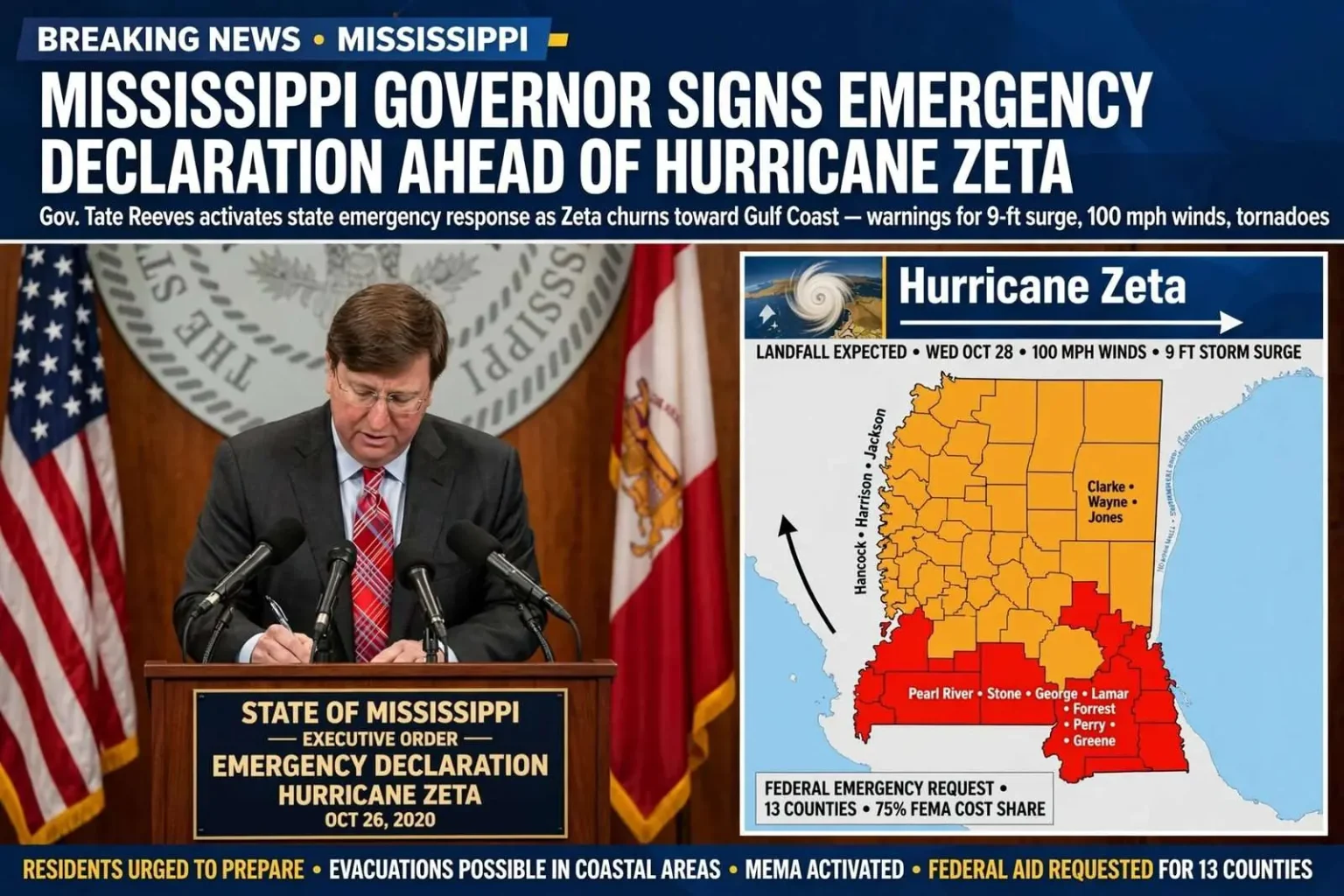
Mississippi Gov. Tate Reeves signed a state emergency declaration as Hurricane Zeta churned toward the northern Gulf Coast, warning residents to take the storm seriously and giving state agencies the authority to mobilize ahead of landfall.
“Watch the weather. Be prepared. Emergency operators are working to get ready for storm surge and hard winds — up to 9 feet of surge and winds up to 100 MPH. Stay sharp, stay safe,” Reeves said in announcing the move.
The declaration put Mississippi’s emergency machinery on a wartime footing before the first rainband arrived, activating the framework that allows the Mississippi Emergency Management Agency and its county partners to preposition supplies, coordinate evacuations and seek reimbursement for protective actions. The state also requested a pre-landfall federal disaster declaration, a step designed to speed federal help to the coast rather than waiting for damage assessments after the storm passed.
Federal Request Covers 13 Counties
Under the requested federal emergency declaration, FEMA would be authorized to provide emergency protective measures — including direct federal assistance under the Public Assistance program at 75 percent federal funding — for thirteen Mississippi counties: Clarke, Jones, Wayne, Lamar, Forrest, Perry, Greene, Pearl River, Stone, George, Hancock, Harrison and Jackson.
The list maps the storm’s expected footprint across the southern half of the state. It runs from the coastal counties — Hancock, Harrison and Jackson, where Zeta’s landfall winds and surge were expected to be harshest — up through the Pine Belt communities of Forrest and Lamar, and across a band of southeastern counties including Greene, George, Perry, Stone, Clarke, Wayne and Jones, where forecasters warned of inland wind damage and prolonged power outages.
The declaration is intended to provide assistance for measures needed to save lives and protect property and public health, or to lessen the threat of a catastrophe in designated areas. In practice, that language covers the unglamorous work that determines how a storm is survived: opening shelters, staging generators and high-water vehicles, clearing debris from evacuation routes and positioning National Guard assets where counties expect the worst.
The 75 percent federal cost share matters most for small, rural counties. A county like Perry or Clarke can face storm-response costs that dwarf its annual budget, and the federal reimbursement structure keeps a single hurricane from becoming a fiscal crisis for local taxpayers.
A Unified Congressional Push
The state’s congressional delegation — U.S. Sens. Roger Wicker and Cindy Hyde-Smith, along with Reps. Steven Palazzo and Michael Guest — sent a letter urging President Trump to approve the pre-landfall disaster request, noting forecasts called for heavy rainfall, damaging winds and possible tornadoes across the southeast portion of the state as Zeta came ashore.
Pre-landfall declarations remain relatively rare, and the unified, four-member push reflected lessons Mississippi drew from earlier storms. When federal help arrives only after roads are surveyed and paperwork filed, recovery starts days late; a declaration signed in advance allows FEMA staff to move into affected counties alongside the storm rather than behind it.
Zeta’s Threat to the Coast
Zeta approached at the tail end of a historically busy hurricane season, and its forecast track put the Mississippi Gulf Coast on the dangerous right side of the storm, where winds and surge are typically most severe. The up to 9 feet of surge Reeves cited threatened the low-lying neighborhoods of Bay St. Louis, Waveland, Pass Christian, Long Beach, Gulfport, Biloxi, D’Iberville, Ocean Springs, Pascagoula and Moss Point — communities that have spent decades rebuilding from Camille and Katrina and know precisely what a waterline on the wrong side of a sea wall means.
Winds of up to 100 mph carried a different kind of threat inland. On that strength, Zeta was capable of snapping pine trees across south Mississippi, toppling power lines and leaving thousands of residents without electricity for days. Downed trees remain the state’s signature hurricane killer in storms of this caliber, and emergency officials urged residents to shelter away from windows and old hardwoods through the worst hours of the passage.
Tornadoes embedded in outer rainbands added a third hazard, particularly across the southeastern counties named in the federal request. Spiral bands sweeping onshore ahead of landfall can spin up quick, violent cells that give residents only minutes of warning — one more reason officials pressed residents to finish preparations before dark.
What Residents Were Told to Do
The governor’s message boiled down to three commands: watch the weather, be prepared, stay safe. Emergency managers translated that into a familiar checklist. Residents in surge zones were urged to know their evacuation routes and be ready to leave when local officials called for it — coastal residents do not need to travel far, only out of the surge footprint. Families elsewhere were told to secure loose outdoor items, fuel vehicles, charge phones, and keep several days of water, food and medications on hand in case power and water service were interrupted.
Officials also emphasized patience after the storm passes. Downed power lines were to be treated as energized, generators were to be run outdoors and away from windows to prevent carbon monoxide poisoning, and residents were asked to stay off roads to let crews clear debris and restore service. In past Mississippi storms, post-landfall hazards have claimed lives even when the storm itself did not.
How the Emergency System Works
The sequence Reeves set in motion follows a structure Mississippi has refined through repeated storms. A governor’s state emergency declaration is the legal trigger: it suspends rules that would slow response, allows state agencies to spend emergency funds, activates mutual aid agreements and lets MEMA coordinate resources across county lines. Without it, a sheriff’s department in one county might struggle to borrow a pump or a patrol boat from a neighbor while the storm bore down.
The federal emergency declaration, once approved, layers national resources on top. FEMA’s Public Assistance program reimburses emergency protective measures — sheltering, search and rescue, emergency medical care, debris clearance needed to protect public health — and, in this request, allows direct federal assistance, meaning federal crews and commodities can be deployed into the field rather than merely paid for after the fact.
MEMA, headquartered in Pearl, works from the state’s emergency operations center during activations, where representatives of the highway patrol, the National Guard, the Department of Transportation, the Department of Health and utility companies share a room and a common picture of the storm. County emergency management agencies feed reports upward while pushing state resources back down to fire stations, police departments and public works crews.
A Season Without Breath
Zeta arrived in a season that had already strained Gulf Coast residents’ nerves and budgets. Storm after storm had swept the basin in 2020, forcing families along the coast to run through preparations repeatedly and leaving utility crews, many already rotated through Gulf assignments, exhausted. Emergency managers noted that hurricane fatigue is itself a hazard: residents who prepared faithfully in August and September can grow numb by late October, skipping the sandbags and the supply run that would have mattered this time.
The governor’s blunt language — watch the weather, be prepared, stay sharp — was aimed squarely at that fatigue. State officials have long said the first hours of a hurricane response are won or lost before the storm arrives, in the decisions residents make while the sun is still out.
What Comes After Landfall
Once Zeta moved through, the state’s posture would shift from protection to recovery. Damage assessment teams were to begin surveying the affected counties as soon as conditions allowed, their findings determining whether the federal emergency declaration would be supplemented by a major disaster declaration unlocking individual assistance for homeowners and renters.
Utility crews would face the long job first. Restoration across south Mississippi’s pine forests can take days even in a fast-moving storm, and officials urged patience alongside the standard warnings about downed lines. Schools in affected districts planned closures based on power status and building damage, and state highway crews focused on clearing primary evacuation and supply routes before residential streets.
For the thirteen counties named in the federal request, the paperwork filed before landfall may prove as consequential as anything that happened during the storm. It is the difference between rebuilding with help and rebuilding alone — a distinction Mississippi communities have learned, at great cost, to take seriously.
Local officials along the coast echoed the state’s urgency in the final hours before landfall. Mayors and county emergency directors took to social media and local broadcasts with the same refrain: the time to argue about the forecast is over, the time to act is now. Sandbag distribution sites saw steady traffic through the afternoon, and marina owners pulled boats from the water where they could.
State offices in the affected counties closed ahead of the storm, and officials asked residents not to call 911 for storm information, keeping emergency lines free for genuine life-threatening calls. Information about shelters, road closures and curfews flowed through county emergency management pages and local media instead.