
Mobile and Baldwin Counties Log First Heat Advisory of 2022, With More Expected
Mobile and Baldwin counties saw their first heat advisory day of 2022, with more dangerous heat expected through the week.
Summer arrived with force across the Alabama Gulf Coast, as Mobile and Baldwin counties recorded their first heat advisory day of 2022, and forecasters expected more to follow through the week. The advisory put the region’s signature combination of heat and humidity on full display, with heat index values pushed to levels considered dangerous for anyone spending extended time outdoors. For a region that spends months each year managing the Gulf’s summer weather, the timing still managed to feel punishing, arriving with the season barely underway.
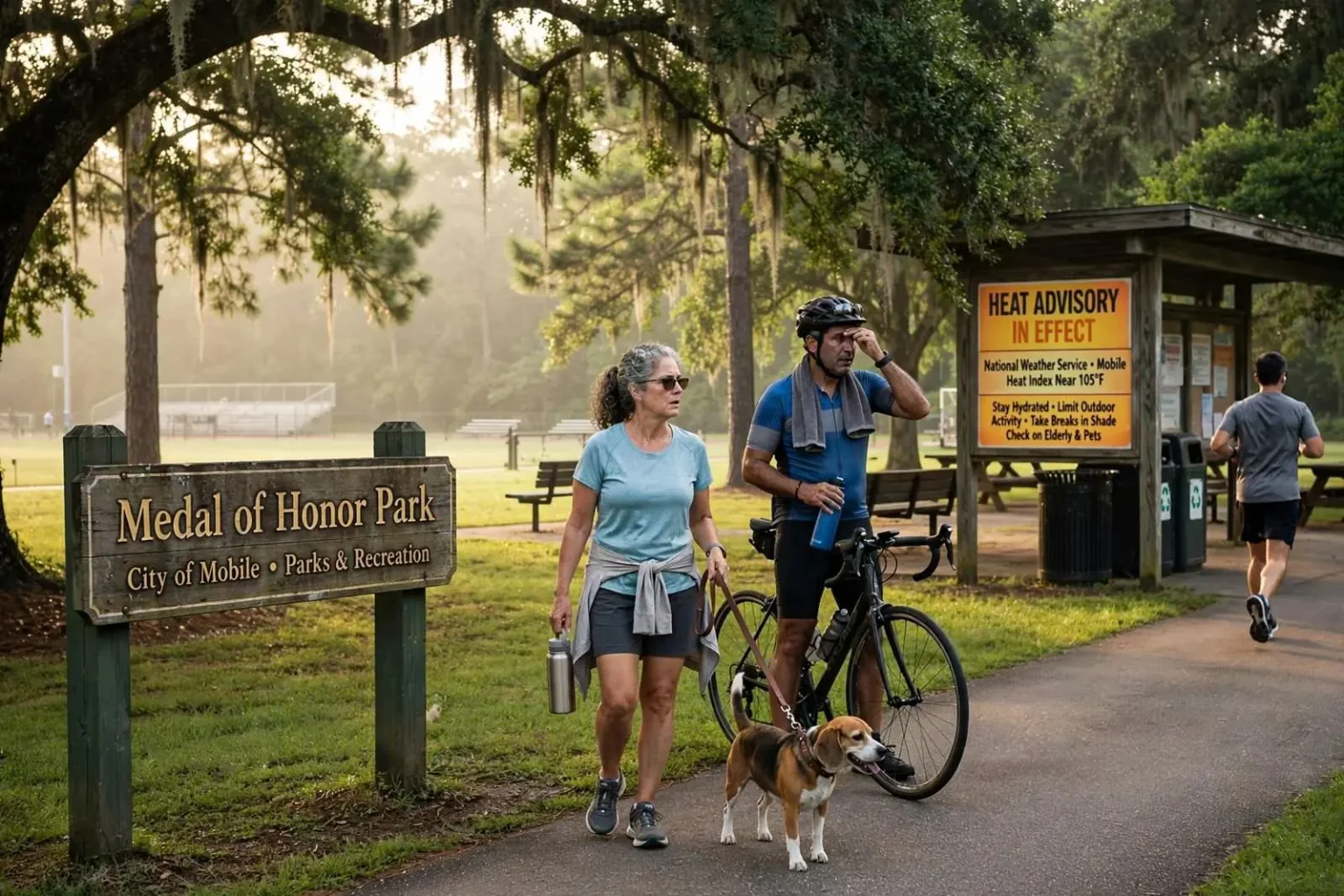
At Medal of Honor Park in west Mobile, the oppressive conditions had regulars adjusting their routines. The park, one of the city’s most popular outdoor spaces, draws joggers, cyclists, dog walkers and families through its walking trails and ball fields, but on advisory days the crowd thins out dramatically by mid-morning. “It’s hot, it’s hot like I don’t know, like we’re living up in a sauna or something,” said Kelly Johnson, one of the park-goers navigating the early-week heat.
Early Birds Beat the Heat
The prevailing strategy among park-goers was simple: get moving before the sun does its worst. “You always have to get out early, just keep your wits, get out stay mobile and you might live a little bit longer,” said Charles Cantrill as he wrapped up a bike run around the park. Runners, cyclists and dog walkers all squeezed their outdoor time into the morning hours, with the busiest stretch on the trails coming before nine o’clock, when temperatures were still tolerable and the shade from the park’s mature oaks and pines still offered some protection.
Thelma Bunch said her summer plan was even more conservative. “Get the walk in early and then just stay home. We don’t go nowhere, just mostly home.” That approach mirrors the guidance public health officials give every summer, particularly for older residents, who face elevated risk from heat-related illness. Gulf Coast humidity makes the danger worse than the thermometer alone suggests, because moist air limits the body’s ability to cool itself through the evaporation of sweat.
Mobile’s climate makes it one of the most humid cities in the United States, and the moisture that rolls in from the Gulf of Mexico keeps overnight temperatures elevated even after sunset. That matters for anyone working outdoors, because the body never gets the overnight recovery window that residents of drier climates take for granted. Dew points in the mid-70s, common on the Alabama coast from June through September, are enough to push heat index values well above the actual air temperature.
What a Heat Advisory Means
Heat advisories are issued by the National Weather Service office in Mobile when heat index values reach levels considered dangerous, and officials typically urge residents to hydrate, limit outdoor exertion and check on elderly neighbors during stretches of extreme Gulf Coast heat. The heat index combines air temperature and relative humidity into a single “feels like” figure, and when it climbs high enough, the weather service begins warning that heat illness is possible with prolonged exposure or strenuous activity.
The advisory covers everyone from road crews and construction workers to athletes and landscapers, but the people at greatest risk are those without reliable access to air conditioning, young children, older adults and anyone with chronic health conditions. Emergency rooms along the Gulf Coast typically see an uptick in heat exhaustion and heat stroke cases during advisory stretches, and officials emphasize that heat stroke, in which the body’s temperature regulation fails entirely, is a life-threatening emergency requiring immediate medical attention.
Simple precautions make a measurable difference, according to safety guidance repeated each summer by county health departments and emergency management agencies. Drink water before you feel thirsty, take breaks in shade or air conditioning, wear lightweight light-colored clothing, and never leave children or pets in a parked vehicle, where interior temperatures can become lethal within minutes even on days that seem merely warm.
For outdoor workers across Mobile and Baldwin counties, an advisory day means adjusting schedules rather than simply enduring. Construction sites, roofing crews and municipal workers often shift to earlier start times, moving the heaviest labor into the dawn hours and reserving the afternoon for indoor or shaded tasks. Employers in the region have long followed the pattern, and federal workplace safety guidance encourages frequent rest breaks and water access whenever heat index values climb into the danger zone.
The first advisory of the season also carries a familiar warning for coastal residents: the heat and the hurricanes travel together. Warm Gulf waters are the fuel for tropical systems, and an early-season heat wave is often a sign that sea surface temperatures are running above normal for the date. “Kind of makes me really concerned about hurricanes, being this hot this early,” said Frank Alardo at Medal of Honor Park, giving voice to a connection many long-time residents have made themselves over the years.
An Ominous Sign?
The observation is more than folklore. The Gulf of Mexico’s surface temperature plays a direct role in hurricane intensity, and forecasters with the National Hurricane Center watch water temperatures closely through the June-to-November season. A Gulf that is already running hot in early summer gives any developing system additional energy to draw on, which is part of why meteorologists caution that early-season heat and a busy hurricane season often go hand in hand along the northern Gulf Coast.
For now, though, the immediate concern for residents of Mobile and Baldwin counties is much more ordinary: getting through the week without overheating. Forecasters expected the pattern to persist, with more advisory days possible as high pressure held over the region and southerly flow continued pumping moisture ashore. In a typical year, the Gulf Coast logs its first heat advisory sometime in June and can see advisories issued repeatedly through August and into September, making the first one less an anomaly than an opening bell.
County and municipal officials use advisory days as a cue as well. Public libraries, community centers and other cooled public spaces serve as informal refuges for residents without adequate air conditioning, and outreach workers and neighbors are encouraged to check on homebound seniors, who face some of the highest risks during extended heat. Pets need consideration too, with veterinarians advising early walks, shaded rest areas and constant access to water during the summer months.
Long-time Gulf Coast residents tend to develop their own adaptations, and the crowd at Medal of Honor Park offered a cross-section of them. Some exercise only in the early morning and move indoors for the summer. Some break activity into short sessions with water stops in between. Nearly everyone agreed on the fundamentals that health officials preach each June: respect the humidity, plan around the sun, and treat the first advisory of the year as a reminder that the long Gulf Coast summer has only just begun.
Health experts distinguish between two main forms of heat illness, and knowing the difference can save a life. Heat exhaustion develops first, with heavy sweating, weakness, dizziness, nausea, headache and a rapid pulse. The treatment is straightforward if caught early: move the person to shade or air conditioning, loosen clothing, apply cool water to the skin and provide sips of water or a sports drink. If those symptoms are ignored, or if the person stops sweating entirely and becomes confused or unconscious, the condition has escalated to heat stroke, which requires an immediate 911 call and aggressive cooling while help arrives.
The Gulf Coast’s medical community sees the consequences of underestimating the humidity every summer. Because sweat cannot evaporate efficiently in saturated air, a person can lose large amounts of fluid while feeling relatively little relief, and dehydration can set in faster than most people expect. Health officials advise starting hydration early in the day, before outdoor activity begins, and avoiding alcohol and caffeinated drinks during advisory stretches because both can contribute to fluid loss.
Adjusting to the Long Gulf Summer
The region’s summer climate is not a brief inconvenience but a months-long condition. From late May through September, high temperatures in Mobile regularly reach the low-to-mid 90s, and humidity keeps the heat index well above that on most afternoons. Residents plan their calendars around it: yard work happens at daybreak, youth sports practices move to evening slots, and outdoor festivals schedule their main activities after sunset during the warmest months.
School systems in the two counties build heat protocols into their athletics programs as well, with acclimatization rules governing when football and band practices can be held, how long they can run, and what water breaks must be provided. Those rules, developed in cooperation with sports medicine specialists, exist because adolescent athletes are among the most vulnerable groups during the season’s first hot weeks, before their bodies have adjusted to summer conditions.
The first advisory of 2022 arrived right on that calendar, and forecasters’ expectation of more to come fit the region’s historical pattern exactly. For the regulars at Medal of Honor Park, the response was already second nature. The bike riders finished their loops before the shade burned off, the dog walkers kept their routes short and stuck to the tree lines, and anyone who could do so simply stayed home until the sun dropped low enough to make the evening tolerable. In a region where the heat index, not the thermometer, tells the real story, the first advisory of the year is a reminder that summer on the Alabama Gulf Coast always has the final word.