‘How Would You Tether a Snake?’ Mobile’s Animal Ordinance Heads to Committee After Residents Pick It Apart
Mobile's proposed animal ordinance overhaul is headed to the Public Safety Committee on Aug. 25 after residents and business owners criticized its breed-specific rules and broad 'high-risk animal' definitions at a pre-council meeting.
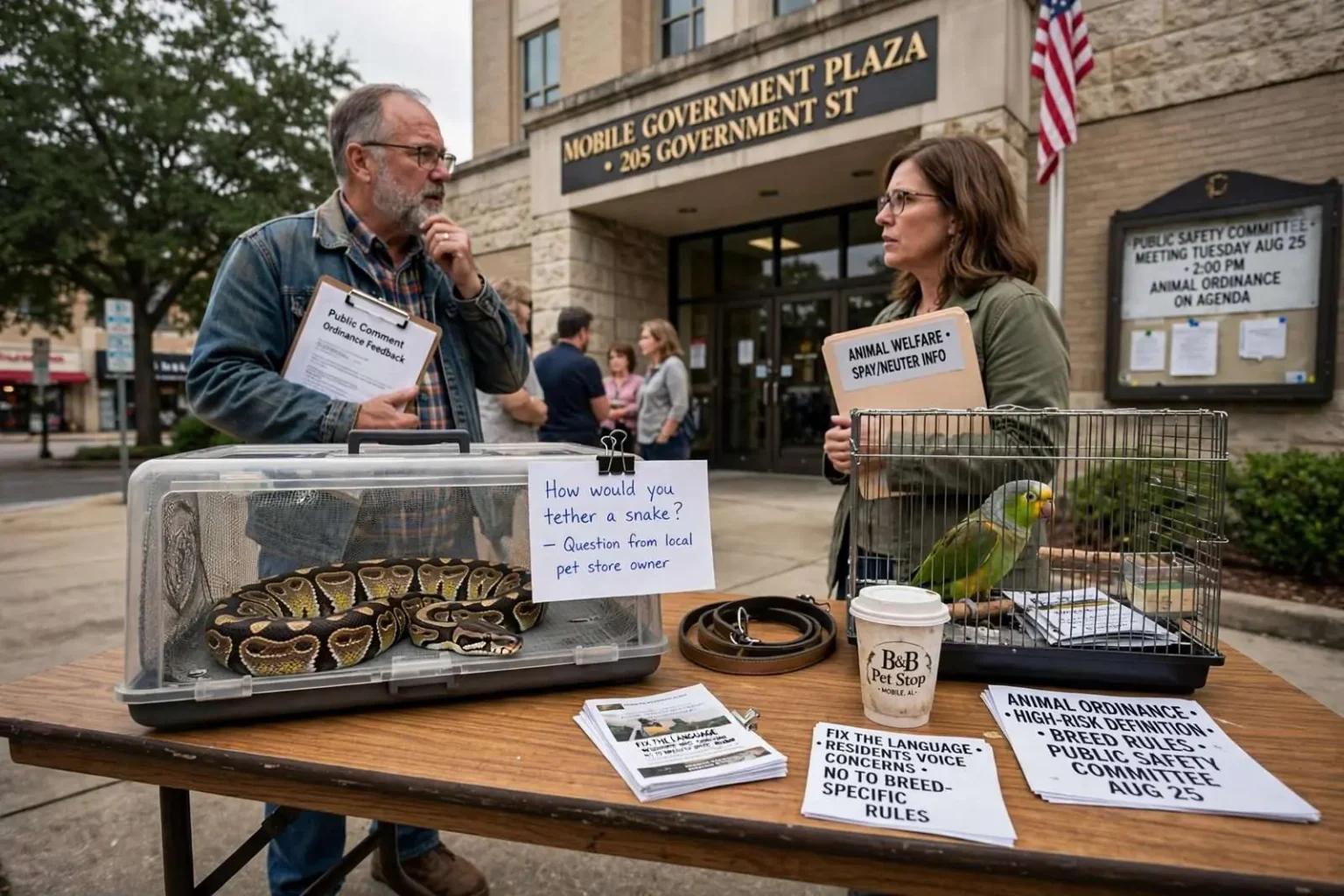
MOBILE, Ala. — A proposed overhaul of Mobile’s animal laws is going to committee instead of to a vote, after city council members heard enough objections from residents and business owners to conclude the language needs more work. During a pre-council meeting last Tuesday, council members declined to move the measure forward and instead referred it to the Public Safety Committee.
The deferral is a familiar step in Mobile’s legislative process. The pre-council meeting, held before the council’s regular session, is where items are introduced, questioned and sometimes held back when support looks uncertain. Sending an ordinance to committee rather than killing it outright leaves the measure alive while giving its drafters time to answer specific criticisms — in this case, a running list of objections to definitions, restraint requirements and breed classifications that residents and business owners laid out one after another.
What the Ordinance Would Do
The proposal would rewrite substantial portions of the city’s animal code. It would increase fines, regulate breeders, cap the number of animals allowed on some properties and create a new set of requirements for animals classified as high-risk.
Supporters have framed the rewrite as a way to give Animal Control real tools for chronic neglect and repeat offenders, replacing a code that critics say has been too weak to deter much of anything. Higher fines are aimed directly at the economics of neglect: when the penalty for a violation costs less than the care an owner was already refusing to provide, enforcement changes nothing. The breeder regulations would add oversight of a trade that has operated largely unregulated within city limits, and the property caps address the hoarding situations that generate a disproportionate share of Animal Control’s worst calls.
The high-risk classification is the proposal’s most consequential feature, because it attaches new requirements — restraint, confinement, potentially insurance or registration-type conditions — to whatever animals land in the category. Which animals actually qualify is precisely where the ordinance ran into trouble.
The ‘High-Risk’ Definition Problem
Several residents and business owners told council members the definitions in the draft are too broad to enforce fairly. Bill Trufant, co-owner of B&B Pet Stop, said he supports updating the city’s animal laws but objected to how the ordinance defines high-risk animals.
“The term exotic species is undefined, and the phrase other non-domesticated cat or animal means virtually every species on the planet, other than a dog or a cat,” Trufant said.
Trufant, who has owned B&B Pet Stop for 45 years, also questioned language requiring high-risk animals to remain physically restrained, arguing it could sweep in ordinary retail pet interactions.
“Someone could violate the ordinance just by letting their parrot out of the cage,” he said. “Frankly, a lot of harmless pets can’t be leashed or tethered. How would you tether a snake?”
The objections came from someone with as long a view of Mobile’s pet trade as anyone in the room. A retail pet store that has operated for four decades across multiple versions of the city code has seen how enforcement actually works at the counter, and Trufant’s point was not that the city should leave its animal laws alone — he said explicitly that he supports updating them — but that the draft’s categories were written too broadly to be applied by any officer consistently. A definition that technically covers every non-domesticated animal, from a parakeet to a python, cannot function as a targeting tool; it either gets ignored in practice or enforced selectively, and both outcomes undermine the code the rewrite is meant to strengthen.
Mayor: Pets Inside the Home Are Not the Target
Mayor Spiro Cheriogotis said the ordinance is aimed at public safety and stronger protections for animals, not at penalizing responsible owners. He said animals inside a home would not fall under the restraint provisions.
“If you’re inside your home, which is humanely confined within a wall, a fence, a vehicle, or other enclosure, you’re never going to get in trouble for letting your parrot out of the cage,” Cheriogotis said.
The mayor’s clarification answered the most alarming reading of the restraint language — the idea that a family pet playing in a living room could constitute a violation — by framing any humane enclosure, including the walls of a home, as sufficient confinement. But the clarification also highlighted the drafting gap the critics had identified: if the ordinance requires that explanation from the mayor to be understood, critics argued, the text itself is not clear enough to be enforced or followed by ordinary residents without a lawyer in the room.
Breed-Specific Language Draws the Sharpest Objections
The most pointed criticism landed on the ordinance’s breed-specific provisions, which would automatically classify several breeds — including pit bulls, Rottweilers and Dobermans — as high-risk animals regardless of an individual animal’s history.
District 2 resident Anna Bush urged council members to strike that section entirely.
“The breed language is simply irredeemable, and this is absurdly arbitrary and doesn’t really address dogs that are actually dangerous. This language just needs to be stricken,” Bush said.
Bush’s objection tracks the direction animal-welfare policy has moved nationally over the past two decades. Breed-specific rules have been repealed in a long list of cities after studies and veterinary organizations concluded that a dog’s breed is a poor predictor of its behavior, and that such provisions sweep up well-behaved family pets while doing little to identify the individual animals — of any breed — that actually pose a danger. Under a breed-based system, a gentle Rottweiler is regulated while an aggressive dog of an unlisted breed faces no added scrutiny at all.
Bush argued the city would get further by expanding access to spay and neuter services and increasing microchip use. She said she offers low-cost spay and neuter services and still cannot fill the appointment slots she has available — a gap that points less to demand than to awareness and access.
“How do we make the resources more available, but also when we’re addressing these problems, these are the animals we must prioritize,” Bush said.
Her argument was, in effect, a different theory of the problem: unaltered, unowned and unidentified animals drive the bulk of stray populations, bite incidents and shelter intakes, so dollars spent expanding spay-and-neuter access and microchipping do more for public safety than labels attached to breeds. The unfilled appointment slots she described suggested the bottleneck is not willingness among owners but information — many owners of the animals most at risk simply do not know the services exist or how to reach them.
Council Signals a Rewrite Is Coming
Council members acknowledged the substance of the objections and agreed more discussion is needed before any vote.
“We definitely understand that we need to go back and look at the restraint requirements along with how we’re classifying the, you know, using breeding as a classification,” said Councilwoman Samantha Ingram.
Ingram’s comments named the two sections most likely to be redrafted: the restraint requirements that drew the pet-store objections, and the breed-based classification that drew the sharpest testimony of the meeting. Neither criticism questioned the goal of the rewrite — stronger tools against neglect and dangerous animals — only the machinery the draft would use to get there.
What Happens Next
The proposed animal ordinance goes before the Mobile City Council’s Public Safety Committee on Tuesday, Aug. 25. Committee review gives the administration and council members room to redraft the contested sections — particularly the definitions of exotic and non-domesticated animals, the restraint requirements and the breed classifications — before the measure returns to the full council.
Committee is where Mobile ordinances are ordinarily rebuilt. The Public Safety Committee can hold public input sessions, request revised language from the city attorney’s office and hear from stakeholders in a smaller setting than a full council meeting allows. For the parties on each side of this proposal, the Aug. 25 session is the practical deadline for suggesting specific fixes: the pet trade and animal owners who want narrower definitions, and Animal Control and public-safety advocates who want the rewrite to keep its teeth.
The stakes of getting the definitions right are more than academic. An ordinance with a category that covers every non-domesticated species is either unenforceable or a license for inconsistent enforcement; a breed list that ignores individual behavior spends enforcement capacity on dogs that pose no risk while the genuinely dangerous ones of any breed go unaddressed. The council’s decision to slow the process down — rather than pass the draft and patch it after problems surfaced — reflects how widely those concerns were shared across the witness list.
Residents who want to weigh in before the redraft can contact their district council representative or the Public Safety Committee ahead of the Aug. 25 session. Any revised version that emerges from committee would return to the full council for introduction, a public reading and a vote — with another opportunity for public comment before the new animal code takes effect anywhere in the city.
Until then, the city’s existing animal ordinances remain in force, and Animal Control continues to operate under the current code that all sides in the debate agree is overdue for replacement. The question now before the committee is not whether Mobile gets a new animal code, but how precisely its lines are drawn — and whether the final version can survive the kind of scrutiny its first draft received Tuesday.