
Mobile Animal Shelter Shuts Doors Ahead of Hurricane Sally, Halts Owner Surrenders
The City of Mobile Animal Shelter temporarily closed and halted owner surrenders as Hurricane Sally approached, with staff working 24-hour shifts.
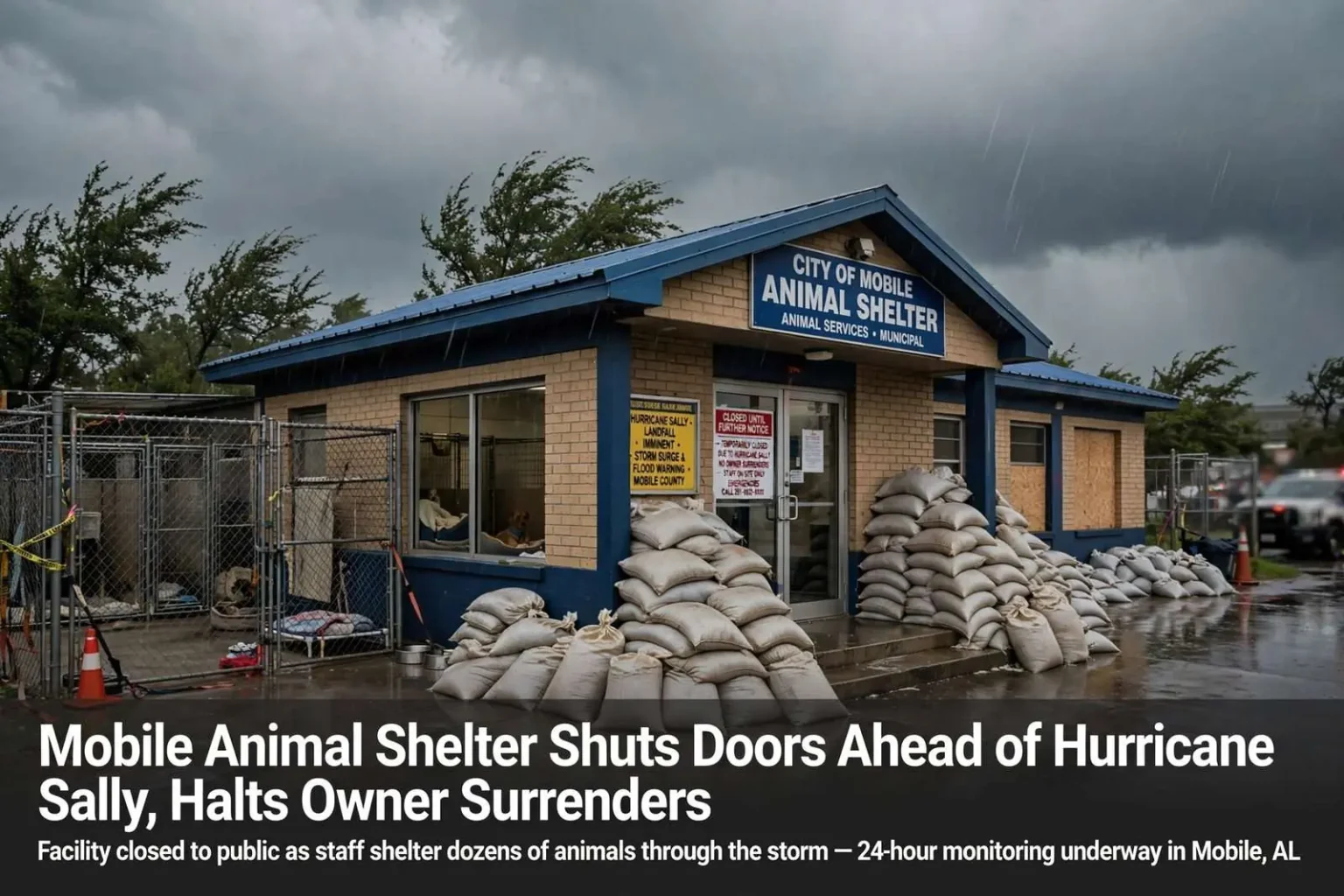
With Hurricane Sally bearing down on the Gulf Coast, the City of Mobile Animal Shelter has temporarily closed to the public and stopped taking owner-surrendered animals as the storm approached the Alabama coastline.
Shelter officials said the facility had already reached capacity as Sally tracked toward landfall, leaving little room to bring in additional animals even under normal conditions. The decision to close was made as part of the city’s broader emergency preparations ahead of a storm that forecasters warned would bring days of rain, storm surge and flooding across Mobile County.
Getting the facility ready
Workers placed sandbags around the building, a standard precaution for a facility in a city that routinely floods in heavy rain even outside hurricane season. The sandbags were staged at entry points and around areas where water has historically pushed in during prolonged downpours.
Inside the building, staff relocated dogs within the shelter to areas less vulnerable to flooding. Moving animals to interior kennels and higher ground within the facility is one of the most time-consuming parts of a shelter’s storm preparation, requiring every animal to be walked, documented and settled in a new location while staff continue feeding and caring for the full population.
Shelter workers also topped off food and water supplies, tested generators, and secured outdoor runs and equipment that could become dangerous in high winds. Items left loose around a facility can become projectiles in tropical storm conditions, and a lost fence panel or gate can scatter animals across a neighborhood in the middle of a storm.
Staff staying around the clock
Employees have been organized into 12-hour shifts so that staff are on site 24 hours a day through the storm. Around-the-clock coverage ensures that someone is present to respond if the facility loses power, takes on water, or if any of the animals in care develops a medical problem during the height of the weather.
Storm-duty staffing is a familiar routine for Mobile’s municipal shelter, which has ridden out previous hurricanes and tropical systems that swept the Gulf Coast. Employees who remain on site during a storm work without the usual public traffic, focusing entirely on feeding, cleaning, medicating and monitoring the animals already in the building.
The shelter will remain closed until further notice, and workers plan to respond only to dire emergencies while conditions deteriorate. That means routine calls — stray pickups, bite complaints, welfare checks that can wait — will be deferred until conditions allow staff to travel safely, while genuine emergencies involving animals in immediate danger will still be handled.
A message to pet owners
City officials urged pet owners to include animals in their hurricane preparations and hold off on surrendering pets until normal operations resume after the storm passes. The guidance reflects a reality seen in nearly every major Gulf Coast hurricane: animals separated from their families during evacuations and flooding are far harder to reunite than animals that stayed with their owners.
Emergency management officials recommend that every household with pets keep a kit ready that includes several days of food and water, medications, leashes and carriers, vaccination records and a current photo of each animal. Microchips and identification tags are the single most effective tool for reuniting lost pets with their families after a disaster, and veterinarians across Mobile County offer microchipping year-round.
Residents who must evacuate are encouraged to take their pets with them whenever possible. Many public shelters historically did not accept animals, which is why families are advised in advance to identify pet-friendly hotels, boarding facilities or relatives outside the storm’s path. Mobile County’s emergency management agency maintains information on pet-friendly resources during activations.
Why shelters suspend owner surrenders
Suspending owner surrenders during a storm is standard practice for municipal shelters on the Gulf Coast, and the reasoning is straightforward. A facility already at capacity has no physical space, staffing margin or supply buffer to absorb healthy animals voluntarily given up by owners in the middle of an emergency, and every kennel occupied by a surrender is one unavailable for an animal pulled from floodwaters or a destroyed home after the storm.
Animal services departments also prepare for a post-storm surge that few residents think about in advance: lost pets found wandering after landfall, injured animals rescued from damaged structures, and litters born to strays displaced by flooding. Those intakes can overwhelm a shelter within days of a storm clearing the area, which is why protecting capacity ahead of landfall is treated as an operational necessity rather than a convenience.
Residents who were scheduled to surrender an animal or who find themselves unable to care for a pet during the storm are asked to wait until the shelter reopens. In genuine crises, rescue organizations and veterinary offices in the area can sometimes provide temporary help, and neighbors checking on one another frequently absorb short-term pet care during evacuations.
Hurricane Sally and the Gulf Coast
Hurricane Sally approached the Gulf Coast as a slow-moving system, and forecasters warned repeatedly that its pace would compound the danger. Slow storms sit over an area and drop extraordinary amounts of rain, and Sally’s projected path put the central Gulf Coast — including Mobile, Baldwin County and the Florida Panhandle — in line for prolonged rainfall, rising rivers and significant storm surge around Mobile Bay.
Mobile residents have a long institutional memory of Gulf storms, from Hurricane Frederic in 1979 to Hurricane Katrina’s costly surge in 2005 and the flooding that accompanied later systems. Each storm has shaped the city’s preparation routines, including which low-lying roads flood first, which neighborhoods lose power most often, and how city facilities like the animal shelter harden themselves before landfall.
City departments coordinate during a storm activation under Mobile’s emergency operations framework, with public safety agencies, public works crews and animal services each handling their portion of the response. For the animal shelter, that means remaining staffed, keeping animals safe inside the building and being ready to scale up intakes as soon as it is safe to do so.
What residents can expect after the storm
Once conditions allow, the shelter plans to resume normal operations, and officials said updates on reopening will be shared as the city moves out of its emergency posture. In the days after a storm, municipal animal services typically prioritize emergency rescues, then shift to reuniting lost pets with owners, which is why families searching for a missing animal are encouraged to check the shelter in person and monitor its listings closely.
Residents who find a lost pet after the storm are asked to hold the animal when possible and report the find, since many animals remain close to home even after floodwaters displace them. Checking for microchips can be done at any veterinary office or at the shelter once it reopens.
For now, the shelter’s animals are indoors, staffed and dry, with employees working in shifts through whatever Sally brings to the Mobile area. The city’s message to pet owners is simple: include animals in every emergency plan, keep them with you when you evacuate, and wait out the storm before attempting any change in ownership, because the safest place for a pet during a hurricane is with the family it already knows.
Caring for animals in the days before landfall
The work of preparing a shelter for a hurricane stretches across several days, well before the first rain bands arrive. Kennels are cleaned and disinfected so that animals already stressed by weather and routine changes stay healthy, and medications are inventoried so that animals with ongoing conditions — heartworm treatment, antibiotics, seizure medications — do not miss doses while staff are locked in through the storm.
Food supplies are calculated to last beyond the expected duration of the emergency, since deliveries of donated food and supplies can be interrupted for days or weeks after a major storm by damaged roads and closed distributors. Water is stored for both drinking and cleaning, and battery stock, flashlights and radios are checked against the shelter’s emergency checklist.
Volunteers who normally walk dogs and socialize cats are typically told to stay home once conditions worsen, which concentrates the workload on the employees who remain. Those staff members balance animal care with their own family preparations, a reality that shelter directors across the Gulf Coast say makes advance planning essential — everything that can be done two days out should be done two days out.
Lessons from past Gulf storms
Gulf Coast shelters rebuilt many of their procedures after Hurricane Katrina in 2005, when thousands of animals were separated from families across the region and the images of stranded pets became a national turning point in disaster planning for animals. The federal Pets Evacuation and Transportation Standards Act, passed the following year, required state and local emergency plans to account for household pets and service animals, changing how communities like Mobile prepare.
Since then, pre-positioning supplies, planning for post-storm intakes and coordinating with rescue organizations have become standard elements of municipal animal services in hurricane-prone states. Shelters also keep lists of animals in care with photos and descriptions, so that if a building is damaged or an animal escapes during the chaos of a storm, records exist to support reunification afterward.
For Mobile’s shelter, the hours ahead of Sally’s arrival were the last window to finish those preparations. With sandbags in place, animals relocated, supplies staged and staff arranged into round-the-clock shifts, the facility settled in to wait out the storm — ready to protect the animals in its care and to resume serving the city’s lost and surrendered pets as soon as the weather allows.