
Mobile Annexation Vote Looms and Not All Council Members Are on Board
Mobile's city council votes on annexing three western areas as two members raise cost objections to adding 13,000 residents.
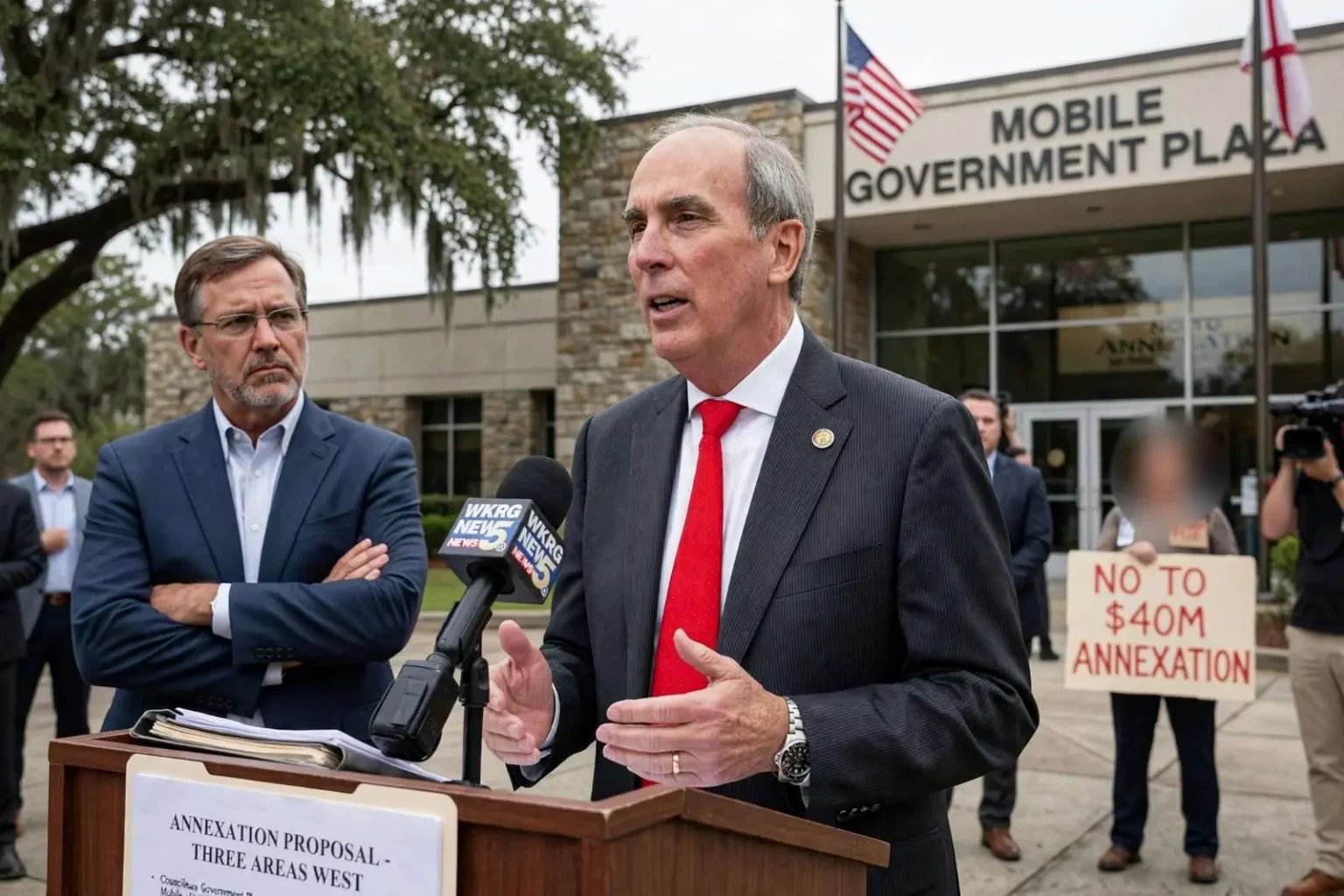
MOBILE, Ala. — Mobile’s city council is scheduled to vote Tuesday on annexing three areas west of the city, and for the first time in decades the outcome is genuinely uncertain — two council members say they are opposed. The vote will test a proposition that has long been a formality at Government Street: no council member has voted against any of the city’s five previous annexation proposals over the past 25 years.
The measure would extend Mobile’s city limits into three unincorporated areas west of the current boundaries, bringing thousands of residents into the city and expanding the city’s footprint across part of Mobile County. Annexation proposals have routinely passed with unanimous or near-unanimous council support in the past, which makes the current divide notable — and which gives the opponents leverage they have never had before.
Mayor Sandy Stimpson supports the new plan, which could add as many as 13,000 residents to the city. For an administration that has emphasized strengthening the city’s population, tax base and regional position, the annexation represents one of the most direct tools available. A larger population affects everything from census counts that determine federal funding formulas to the retail economics that shape commercial development along the city’s western corridors.
Councilman Fred Richardson is the loudest skeptic, arguing the math simply doesn’t work. He noted the city already loses roughly 700 people a year and questioned what lasting gain another 13,000 would bring. In his view, the population influx does not address the underlying outflow — the residents Mobile continues to lose — but instead adds territory the city must maintain without solving the problems that push people away.
“We’re only going to collect 2.2 million dollars from them,” Richardson said. “It’s going to cost us nearly 40 million dollars to service them.” The gap between revenue and cost is the centerpiece of his argument: fire protection, police coverage, garbage collection, road maintenance and the other services a city must provide across newly annexed territory carry real, recurring price tags that he says will dwarf the tax revenue the new areas generate.
He compared it to buying a rental building for far more than the rent it generates. “You think my vote’s going to be yes on that? I don’t think so.” The analogy captures his broader case — that the city would be acquiring an obligation far larger than the asset, with the difference made up by existing taxpayers.
What Annexation Would Mean for the City
The case for the annexation rests on growth. Mobile’s population has been essentially stagnant or slowly declining for decades, part of a broader pattern across many Deep South cities whose central populations have shifted to suburbs and unincorporated areas. Adding 13,000 residents would be one of the largest single expansions of the city’s population in its modern history, strengthening its standing in state and federal calculations and broadening the base of sales and property tax revenue.
Annexed areas typically bring commercial development as well as households. The corridors west of Mobile’s current limits include stretches of retail and residential growth that have flourished outside city boundaries while relying on nearby urban infrastructure. Bringing those areas inside the city means their shoppers and businesses contribute to municipal revenues, and their residents gain access to city services and voting rights in municipal elections.
For the residents of the three areas, annexation changes the practical details of daily life: city police and fire protection, municipal garbage collection, city planning and zoning, and Mobile’s municipal elections all extend to their addresses. Some welcome the services and identity; others prefer the lower tax environment of unincorporated Mobile County and have resisted earlier annexation efforts for exactly that reason. Sentiment in the affected areas has historically been one of the deciding factors in whether annexations succeed once they reach the ballot.
The fiscal argument cuts both ways in the debate. Supporters of expansion note that cities grow their way into infrastructure costs over time, as commercial development follows population and broadens the tax base. Critics like Richardson counter that the city cannot afford to subsidize the difference in the meantime, and that a $40 million service obligation against $2.2 million in revenue is not a growth strategy but a deficit with a delay attached.
A Council Divide Unlike Recent Memory
What happens next: five yes votes are needed for the annexation measure to pass. The seven-member council has not previously been tested on an annexation with announced opposition, and the arithmetic of the vote has become the central question at Government Street as Tuesday approaches. If two members hold firm against the plan, its supporters must hold every other vote — leaving no margin for absence or defection.
If it clears the council, a special election on annexation would follow by the end of the year, giving residents of the affected areas the final say. Alabama law requires that residents of territory proposed for annexation vote on whether to join the city, which means the council’s decision is a gate but not the finish line. A council approval would set in motion the campaign for votes in the three areas, where the outcome depends on persuading residents that city services and identity are worth city taxes.
The politics of the vote extend beyond the annexation itself. Richardson’s opposition gives voice to the residents of existing city neighborhoods who wonder whether their tax dollars are best spent extending services outward, and the debate has surfaced long-running tensions about the city’s growth patterns and priorities. Stimpson’s administration has staked its argument on the long-term benefits of scale, positioning the annexation as an investment in Mobile’s future rather than a cost on this year’s ledger.
Whatever the council decides Tuesday, the vote will be remembered as the moment the city’s annexation consensus finally broke. Twenty-five years of unanimous approvals have given way to a genuine debate about growth, cost and who benefits — and the answer will shape Mobile’s map, its budget and its politics for years to come.
How Mobile Got Here
The three areas proposed for annexation sit along Mobile’s western edge, in the unincorporated stretch of Mobile County where suburban-style growth has expanded for decades. The corridors along Schillinger Road and the surrounding neighborhoods have filled with subdivisions, schools and shopping developments that function in many ways as part of the Mobile metro area while remaining outside the city limits — and outside the city’s tax jurisdiction.
Mobile’s five previous annexations over the past quarter-century followed the same pattern: properties or neighborhoods at the city’s edge petitioned to join, the council approved, and the map grew. Those expansions added residents and tax base without controversy, and the council’s unanimity reflected a shared assumption among its members that growth at the margins was in the city’s interest. Richardson’s announced opposition shatters that assumption and forces the question that unanimous votes never had to answer: does expansion pay for itself?
The city’s demographic trajectory gives the debate its urgency. Mobile’s population peaked decades ago and has drifted downward since, as new growth concentrated in unincorporated west Mobile County, Daphne, Fairhope and the other municipalities that ring the city. Every census that shows a smaller Mobile means less weight in federal funding formulas, less drawing power for major employers and a weaker hand in state politics. The Stimpson administration has framed the annexation as a direct response to that erosion — a way to capture growth that is already happening, whether or not the city annexes it.
Richardson’s rebuttal targets exactly that framing. The roughly 700 residents the city loses each year, he argues, are the product of issues — schools, crime, aging neighborhoods — that annexing outward does nothing to fix. In his telling, the city is reaching across its boundary to claim thousands of new residents while the conditions that drive existing residents away continue unaddressed, and the $40 million service bill would drain resources that could be invested in the neighborhoods already inside the limits.
The Financial Mechanics of Annexation
The numbers at the heart of the dispute deserve unpacking. The $2.2 million Richardson cites represents the annual tax revenue the city expects to collect from the annexed areas — a combination of property taxes, sales taxes and other municipal levies. The nearly $40 million figure represents what he says it will cost to extend and operate city services across the new territory: fire stations and staffing, police beats and patrol coverage, sanitation routes, street maintenance and the capital improvements that bring annexed areas up to city standards.
Annexation critics across the country have pointed to similar arithmetic in debates from Texas to Georgia, where cities that aggressively annexed suburbs sometimes found that service costs outpaced revenues for years. The counterargument, made by municipal growth advocates, is that the comparison understates the growth that annexation itself stimulates: once an area is inside the city, its commercial corridors attract more development, its property values rise under city services, and the revenue picture improves over time.
The special election requirement adds another financial dimension. Alabama’s annexation law puts the decision to the residents of the affected territory, which means the city must not only win the council vote but persuade the people who live in the three areas that joining Mobile is in their interest. Those residents weigh the city services they would gain against the municipal taxes they would begin paying, and history along Mobile’s edges shows that the sales pitch is not automatic — some residents of unincorporated areas have organized against annexation precisely because they value the county’s lower tax rates.
For the Stimpson administration, the election timeline is both an obstacle and an opportunity. A campaign to win votes in the three areas would let the city make its case directly to the affected residents, with the specifics of service extension and infrastructure investment laid out in detail. A loss at the ballot, however, would end the expansion for that territory and leave the city to pursue its growth strategy through other means.
What the Neighbors Say
The residents of the three areas have the most at stake in Tuesday’s vote and the election that would follow. City residency would bring Mobile police and fire protection — a meaningful consideration in areas that currently rely on county sheriff’s patrols and volunteer or county fire services. It would also bring city garbage collection, access to municipal courts and services, and the right to vote in Mobile’s mayoral and council elections, giving the new residents a voice in the government that would serve them.
The costs are the other side of the ledger. Property inside the city carries municipal property taxes on top of county levies, and businesses in annexed areas become subject to city licensing and regulation. Residents who moved west precisely to escape city taxes see annexation as a cost imposed without their consent, while those who already work, shop and worship in Mobile often see joining the city as a formality that recognizes reality.
Tuesday’s vote will determine whether that choice ever reaches the residents at all. Five yes votes send the question to the ballot; four or fewer end it. Either way, the council’s debate has already changed the conversation about Mobile’s growth, giving the city’s most vocal expansion skeptic a platform it took 25 years of unanimous votes to make newsworthy.