Mobile Arts Council’s ART Works Throwdown puts the creative process on display
The Mobile Arts Council's ART Works Throwdown turned a fundraising night into a live art competition with five artists building on the spot.
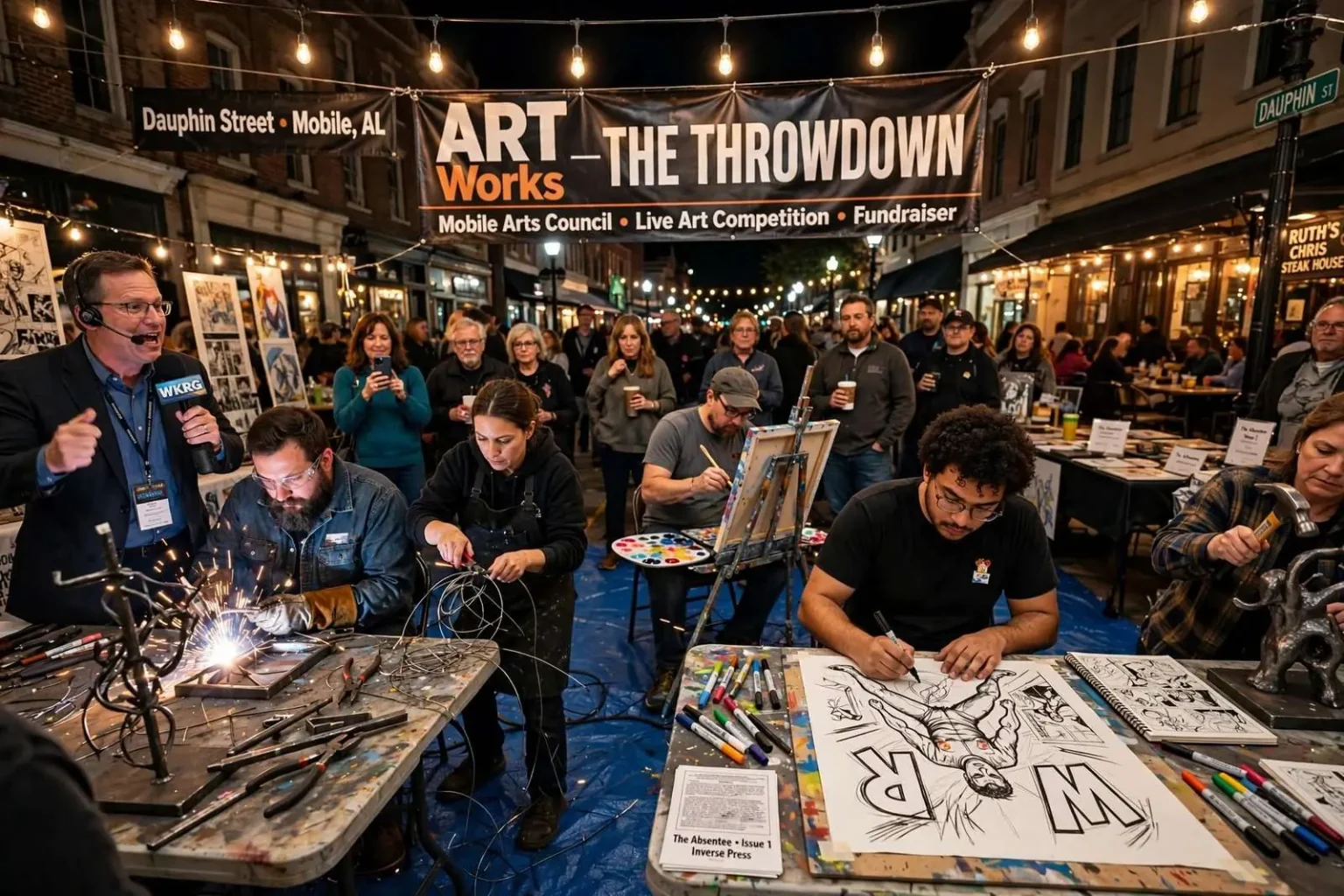
The Mobile Arts Council’s ART Works — The Throwdown turned a fundraising night on Dauphin Street into something closer to spectator sport, giving attendees the rare chance to watch the creative process unfold live rather than admire finished work after the fact. Instead of a quiet gallery opening with finished pieces hanging on white walls, guests found themselves ringside as five artists built original work from raw material in front of a crowd that cheered, wandered between tables and bid on the results before the paint was dry.
The setup was deliberately unpolished. Five contestants worked at tables spread across a giant blue tarp, swinging hammers, twisting wire, welding, painting and sketching as the audience pressed in close. Sparks, noise and improvisation were part of the show, and each artist had a fixed stretch of time to take a piece from idea to object while spectators watched every strike, weld and brushstroke. The loose, competitive format stripped away the formality that can keep newcomers away from fine art events and replaced it with the energy of a matchup.
WKRG weatherman and host John Nodar framed the evening as a reminder that, with city budget cuts, keeping art alive in Mobile is up to the community. That message set the tone for the night: the Throwdown was presented not simply as entertainment but as a grassroots answer to shrinking public support, with ticket buyers, bidders and sponsors asked to carry the load that public funding no longer does. For a nonprofit arts organization, every dollar raised in the room translates directly into exhibitions, programming and support for the artists who live and work in the city.
The Mobile Arts Council has long served as a connecting point for Mobile’s creative community, linking working artists with exhibition space, educational programming and public visibility across the city. Events like the Throwdown function as both fundraiser and showcase, letting supporters see exactly where their money goes and meet the artists it sustains. The organization’s home in downtown Mobile places it at the center of a walkable arts district, and its events regularly draw a mix of established collectors and first-time attendees who come for the atmosphere and leave with a new appreciation for the region’s talent.
An arena on Dauphin Street
Dauphin Street has become the natural home for an event of this kind. The downtown corridor anchors Mobile’s gallery scene and nightlife, and its mixture of shops, restaurants and venues makes it easy for a crowd to drift from dinner to an arts event without ever leaving the block. Hosting a live competition in that setting turns passersby into audience members and gives the night a street-festival quality that a closed gallery rarely achieves.
The choice of a live head-to-head format also reflects a broader effort among Gulf Coast arts groups to make the creative process itself the attraction. Demonstrations, open studios and quick-paint competitions have grown in popularity across the region because they give audiences something unrepeatable: a one-night-only performance in which the artwork on the auction block did not exist an hour earlier.
Five artists, one arena
The five contestants represented a cross-section of media and temperament. Some worked in metal, cutting and welding with the confidence of fabricators; others twisted wire into armatures, layered paint, or sketched out compositions in ink and graphite. The variety meant that no two tables looked alike, and the crowd could move between them to compare approaches in real time, much as fans circulate between attractions at a fair.
The physicality of the event was part of its charm. Contestants hauled materials, bent forms over their knees and sent sparks across the tarp, and the audience responded to the effort as much as to the aesthetics. By the end of the competition window, each table held a finished piece that carried visible evidence of the rush: hammer marks, visible seams, layered underpainting. Those imperfections, born of the clock, became selling points when the pieces went to bid.
Among the contestants was Rando Dixon, a sequential artist and the evening’s underdog as its only primarily two-dimensional artist. Dixon recently released his first comic book, The Absentee, through Inverse Press, and he came to the Throwdown representing the illustration and comics tradition rather than the metal-and-mixed-media crowd that typically dominates events of this kind. His presence gave the lineup range and reminded the audience that Mobile’s creative economy extends well beyond sculpture and painting into publishing and graphic storytelling.
Dixon’s war-themed piece — a two-dimensional figure flanked by three-dimensional “W” and “R” — proved the surprise of the night, drawing the highest bid of nearly $600. For an artist working on flat ground in a field of welders and fabricators, the result was a quiet statement about the breadth of what counts as serious work. The bid also gave the comics community a visible win on a stage usually claimed by more conventional gallery media.
The evening’s other storyline involved a champion’s near miss. Two-time champion Jim Hayward, known for form-driven work that protrudes off the canvas, was narrowly overtaken this time. Hayward’s signature style — sculptural relief that breaks the picture plane and casts real shadows — has made him a perennial favorite at live art events in the region, and his presence in the field raised the competitive stakes for everyone else at a table. That the two-dimensional newcomer edged past an established master of dimensional work only added to the night’s drama.
Auction and support
Before the competition began, guests browsed and bid on a silent auction of paintings, drawings, sculpture, pottery and photography donated by area artists. The silent auction is a staple of Gulf Coast arts fundraisers because it lets attendees acquire work at accessible price points while putting money directly into the hosting organization and the donating artists. Rows of pieces lined the space as bidders circled, revisited favorites and jotted down increasing offers in the final minutes before the sheets closed.
The live auction at the evening’s end showcased painted canvas dresses stitched by Jamie Brown and painted by local artists. The wearable pieces gave the auction a theatrical finish: garments that began as plain canvas became one-of-a-kind art objects, and bidders were effectively buying a collaboration between a seamstress and a roster of painters. The format underscores the collaborative spirit that the Mobile Arts Council cultivates, pairing makers across disciplines rather than leaving them to work in isolation.
Between the silent auction, the live competition pieces and the wearable art, the fundraiser offered entry points at nearly every price level. That layering matters for an organization that depends on community giving in the absence of robust municipal support: a first-time attendee can win a small photograph, a regular supporter can take home a competition piece, and a committed patron can claim the night’s top lot. Each tier feeds the same mission.
Sponsors and a wider network
The event drew support from sponsors including Ruth’s Chris Steak House, Hancock Bank and Regions, along with dozens of artist donors across the Mobile arts community. Corporate sponsorships of this kind are the financial backbone of small-city arts fundraisers, covering the fixed costs of staging an event so that door receipts and auction proceeds flow to programming rather than overhead. The breadth of artist donations — from established names to emerging contributors — reflects the reciprocity that defines Mobile’s arts scene, where artists who have benefited from exhibition opportunities routinely give work back to the organizations that showed them.
For attendees, the night served as a survey of the local scene in miniature: painters beside metalworkers, comic artists beside printmakers, wearable art beside photography. For the Mobile Arts Council, it was a demonstration that when public dollars recede, a community with enough galleries, sponsors and donors can still keep the lights on — and keep the creative process itself on public display.
What live art competitions mean for Mobile
Live art competitions have become an increasingly popular fundraising model across the Gulf Coast because they solve two problems at once. They give audiences an experience worth leaving the house for — something no online auction can replicate — and they compress months of gallery lead time into a single evening of production and sale. For artists, the format is a test of nerve as much as skill: there is no retouching, no second session, no waiting for a piece to come together over weeks. The work either stands or it does not, and the crowd knows it.
For Mobile specifically, events like the Throwdown help sustain a creative economy that contributes to the city’s identity well beyond the gallery walls. The downtown arts district draws visitors to restaurants and shops on event nights, provides programming for schools and families, and gives emerging artists their first public exposure. When municipal budgets tighten, that ecosystem depends more heavily on private giving, and fundraisers convert goodwill into operating revenue in a single evening.
The messaging from the evening’s host made that dependency explicit. As Nodar reminded the crowd, budget cuts mean the question of whether Mobile’s arts institutions survive is answered by attendance, bids and sponsorship checks rather than by line items at Government Street. The Throwdown’s full tables, energetic bidding and packed floor suggested the community is, for now, willing to answer.
The artists behind the tarp
Competitions of this kind also change how the public relates to artists. In a gallery, a finished sculpture offers no clue about the hours of cutting, fitting and grinding behind it; at a Throwdown, the audience watches the maker solve problems in real time, which builds a sympathy and familiarity that static display rarely achieves. Collectors who watch an artist work are measurably more attached to the resulting piece, which is precisely why live-auction bidding at these events is often spirited.
That attachment compounds over time. Attendees who meet an artist at one fundraiser follow them to the next, commission work, and carry the artist’s name into the community. In a city of Mobile’s size, those relationships form the actual infrastructure of the art market — more consequential than any single exhibition — and an evening that introduces five artists to a full house is an investment that pays out for years.
The Throwdown’s blend of spectacle and fundraising also gives younger and unconventional artists a stage. Dixon’s strong showing as a sequential artist demonstrates that the format rewards originality over medium, and organizers of Gulf Coast art events have taken note: lineups increasingly mix welders with illustrators, fiber artists with painters, on the theory that contrast is what keeps a crowd engaged from the first hammer strike to the final bid.
By the time the last piece sold and the tarp came up, the evening had accomplished what its organizers set out to do: it made the act of creation the entertainment, made the community the funding source, and made the case — visibly, loudly, and in front of a full Dauphin Street crowd — that Mobile’s art scene is worth fighting for. The nearly $600 top bid was a number, but the larger figure was the room itself, full of people who showed up to prove that when public money steps back, private passion can step forward.