
Mobile Author Stephanie Lawton Launches Debut YA Novel Set in the Port City
Mobile-based author Stephanie Lawton released her debut Young Adult novel WANT, set in Midtown Mobile and inspired by the city's Mardi Gras traditions and.
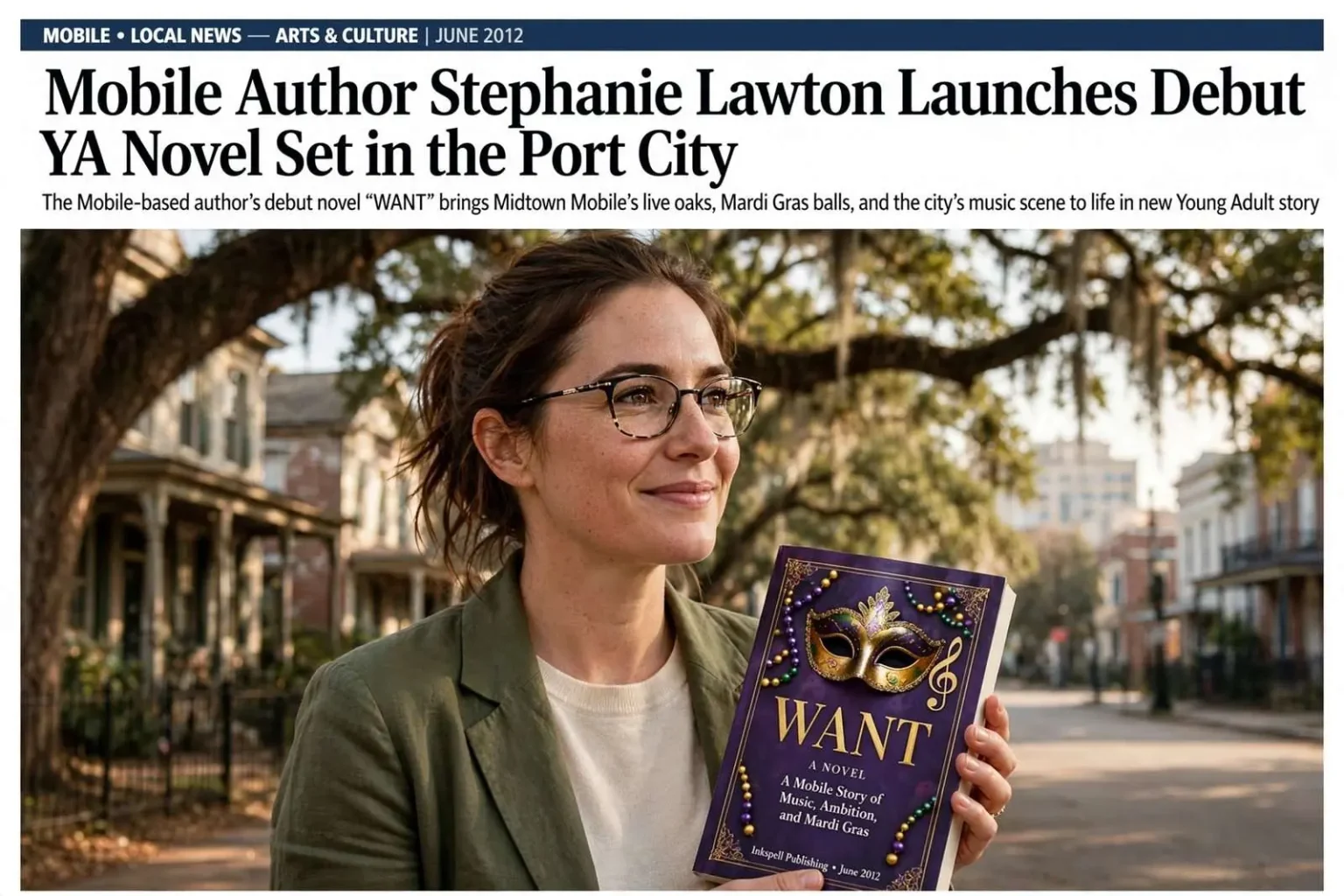
Mobile-based author Stephanie Lawton made her mark on the Young Adult fiction world with the release of her debut novel, WANT, published in June 2012 by Inkspell Publishing. The book is set squarely in Midtown Mobile and draws heavily on the culture, geography, and traditions of the Port City, including its famous Mardi Gras celebrations.
A story rooted in Mobile
The novel follows 17-year-old Julianne, a talented young musician desperate to escape Mobile and attend a prestigious music school in Boston. To sharpen her skills, she enlists the help of Isaac Laroche, a graduate of the New England Conservatory who has mysteriously returned to the South. As the two grow closer, their worlds collide at a Mardi Gras ball, forcing both to confront the true cost of getting what they want.
The setting is more than backdrop. Midtown Mobile, with its historic neighborhoods, live oaks and close-in streets, gives the novel a strong sense of place, and the city’s Carnival season — the oldest celebrated in the United States, with its mystic societies, debutante balls and parade traditions — provides the story with a social stage on which class, family and ambition all come into play. For readers outside the Gulf Coast, the book offers a window into a side of Mobile that visitors rarely see; for local readers, it is their own city rendered in fiction.
Though the story tackles serious themes, including difficult home situations and the pressures facing teenagers, Lawton balanced the heavier material with humor and heart. She noted that today’s YA fiction is far more sophisticated than many readers assume, with almost no topic off-limits as long as it is told authentically from a teen’s perspective. That observation reflects a broader shift in the genre, which has grown from a library niche into one of publishing’s most vigorous categories, read widely by adults as well as teenagers and increasingly willing to take on family dysfunction, mental health and economic strain without flinching.
An adopted Mobilian
Lawton, originally from rural Ohio, relocated to Mobile roughly three years before the novel’s publication after her husband’s company secured a contract to help build a production line at the ThyssenKrupp facility. The steel complex in north Mobile County was one of the largest industrial investments in the United States at the time, and its construction drew thousands of workers, engineers and their families to the region — transplants like the Lawtons who arrived to find a culture very different from the Midwest.
She described writing WANT as a way to process the culture shock of moving to the Deep South, capturing contrasts that were still vivid before she fully assimilated into her new community. That newcomer’s eye — noticing the cadences of speech, the weight of family tradition, the rituals of Mardi Gras, the way history sits visibly on the landscape — became an asset in her fiction, letting her describe Mobile with the fresh attention that locals often lose after decades of familiarity.
Despite being a transplant, Lawton quickly became active in Mobile’s literary community. She served on the board of the Mobile Writers Guild and participated in a local critique group, the working relationships where manuscripts are exchanged, lines are questioned and chapters are rewritten long before an editor ever sees them. Alabama author Rick Bragg even bestowed upon her the honorary title of “official ‘Bama girl” — a nod from the Pulitzer Prize-winning journalist whose books about his own Alabama roots have made him one of the state’s best-known literary voices.
Organizations like the Mobile Writers Guild play an outsized role in a market this size. Without the density of publishing houses, agents and writing programs found in New York, Gulf Coast writers rely on local groups for craft development, accountability and connections to the wider industry. Board service means helping organize workshops, author events and community outreach — the unglamorous work that keeps a regional writing scene alive.
The road to a debut
A debut novel is rarely a quick event. Manuscripts typically circulate for years through revisions, critique partners, queries to agents and submissions to editors before a publisher like Inkspell Publishing, a small press focused on romance and young adult fiction, brings a book to shelves. Small presses have become an important on-ramp for first-time novelists, offering professional editing, cover design and distribution without the lengthy acquisition timelines of the largest houses, though authors generally carry more of the marketing load themselves.
For a YA debut, the June release put WANT on shelves at the start of summer reading season, when teen readers have the most time and libraries run their annual programs. Local authors in that position typically lean on hometown support — bookstore events, library appearances, school visits and coverage in local media — to build the early sales that determine whether a book finds its footing.
Mobile as a literary setting
Lawton is part of a long tradition of writers who have set fiction in Mobile and the surrounding Gulf Coast, a region whose layered history of French, Spanish, British and American rule, its port economy and its Carnival culture give novelists material that feels distinct from anywhere else in the country. Midtown in particular, with its early-twentieth-century homes and walkable blocks, works well for YA fiction because teenage life there unfolds in neighborhoods rather than strip malls — front porches, school gyms and borrowed cars.
Using real local anchors — the music culture, the balls, the geography between Spring Hill and the bay — also gives a novel staying power with local readers, who encounter their own streets in published form. That was part of the appeal of WANT for Mobile audiences: a national-category book that could be handed to a teenager with the assurance that it takes their city seriously.
Future projects
At the time of her debut, Lawton was already at work on additional manuscripts, including a contemporary novel set in the Mobile area. Continuing to build in the region she had adopted made practical sense: she was writing what she knew, and what she knew — the culture shock, the Carnival season, the complicated loyalties of a newcomer learning the South — was the same material that gave WANT its voice.
Her trajectory is a familiar one for regional YA authors. A first novel establishes voice and setting; the books that follow either deepen the connection to place or branch out. Lawton’s stated interest in fiction that treats teenage readers as capable of handling difficult, authentic material positioned her within the strand of YA that has earned the genre its growing respect among educators and librarians, who increasingly use contemporary YA novels to open conversations about family, identity and ambition that teenagers are already living through.
What WANT offers local readers
For Mobile readers, WANT functions simultaneously as entertainment and as a portrait of home. Julianne’s desire to leave for Boston mirrors a tension familiar to talented young people across the Gulf Coast — the pull between the place that raised them and the opportunities that seem to exist only elsewhere. That the novel frames that tension through music, family obligation and a Mardi Gras ball gives it a specificity that a generic setting could not provide.
The book also documents a particular moment in the city’s recent history: the years when the ThyssenKrupp project brought an influx of new families to the area and reshaped the region’s economy and self-image. Fiction rarely records those shifts directly, but novels like WANT catch the texture of the era — who arrived, how they were received, and how the city looked to someone seeing it for the first time.
WANT remains available through booksellers and libraries, and Lawton’s debut stands as an example of the role small presses and regional writing communities play in bringing new voices to the YA shelf. For the Mobile Writers Guild and the critique group that helped shape the manuscript, its publication was evidence that the local writing infrastructure works — that a novelist who arrives as a stranger can, within three years, publish a novel rooted in the city and earn a title from one of Alabama’s most celebrated authors in the process.
The reaction to the book among Mobile readers also reflects how strongly local audiences respond to seeing their city in print. Bookstore events for a Mobile-set novel tend to draw friends, neighbors and readers who want to argue about whether the details ring true — a kind of quality control a New York writer could never access. For a debut author, that hometown base provides the early momentum that carries a book into the hands of readers farther away, through reviews, word of mouth and the regional media coverage that follows any locally rooted release.
Lawton’s path — a transplant who turned disorientation into material, plugged into the local writing community and published within a few years — has become a template other newcomers to the area have followed. The Gulf Coast’s growing roster of published novelists, many of them connected through the same guilds and critique groups, suggests that the region’s stories are being collected by more writers than ever, and that the next book set on Mobile’s streets is likely already circulating in a critique group somewhere in Midtown.


