
Mobile Author Traces the City’s Restaurant History, From Hot Dog Stands to White Tablecloths
Mobile author Malcolm Steiner's new book Old Mobile Restaurants digs into the city's dining history and a claim on jambalaya's origins.
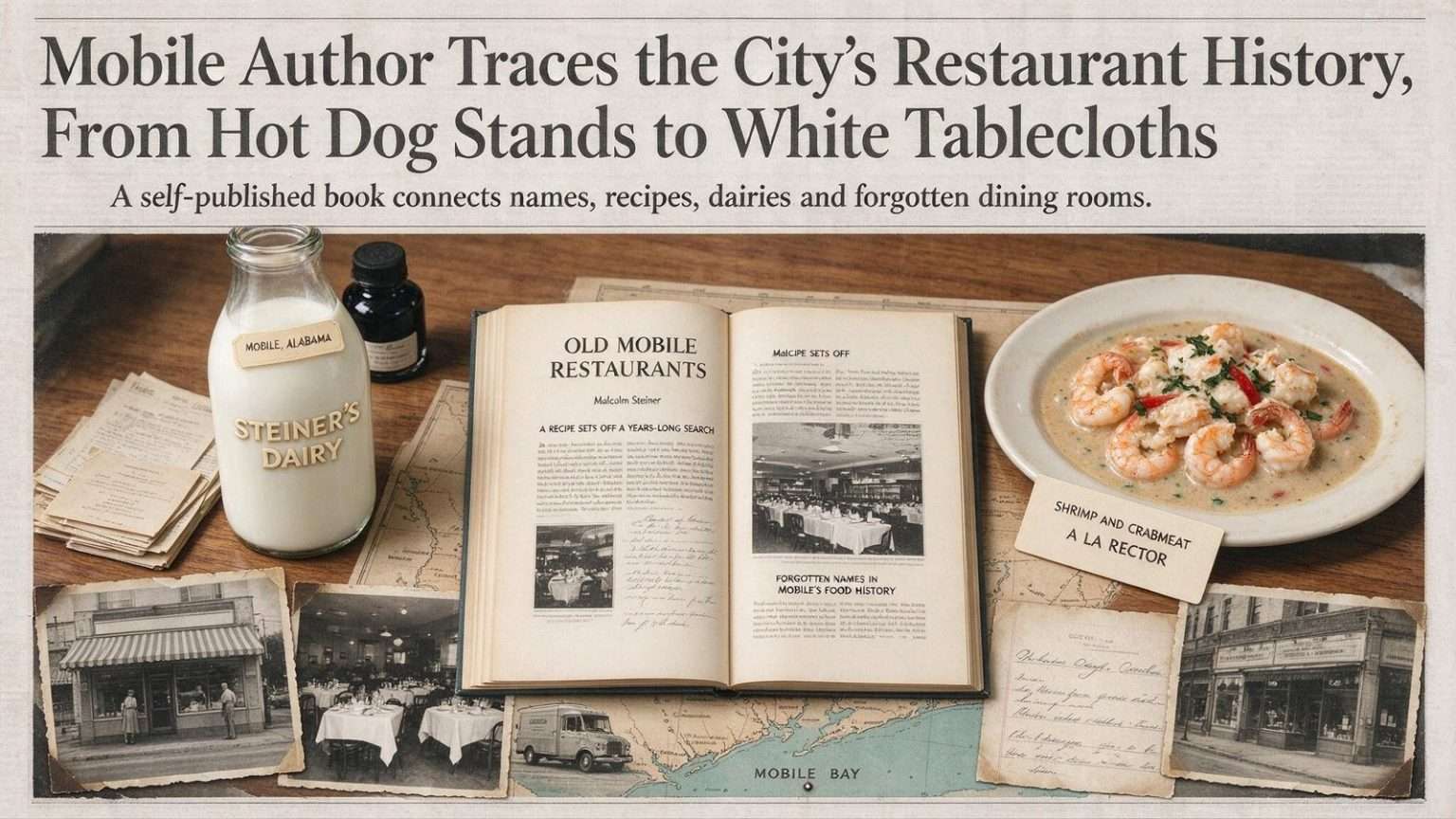
A new self-published book is putting names, dates and old family recipes to the restaurants that shaped how Mobile ate over the past century and a half. “Old Mobile Restaurants,” by lifelong Mobile resident Malcolm Steiner, traces the city’s dining history from modest hot dog stands to the white-tablecloth establishments that once anchored downtown, along with the multicultural cafes and food emporiums that fed generations of Mobilians.
Mobile’s restaurant past is inseparable from the city’s identity as the Gulf Coast’s oldest settlement. A port city with French, Spanish, Creole, Italian, Greek and Lebanese communities layered across two centuries of history, Mobile ate differently from its inland neighbors — its tables shaped by the seafood of Mobile Bay, the produce of the nearby truck farms and the recipes immigrants carried from half a world away. Steiner’s book documents how that mixture expressed itself in dining rooms and lunch counters across the city, from working-class eateries to the formal establishments where Mobile’s business and social leadership marked its milestones.
Steiner said his interest in the subject goes back further than his own memory of eating in the city’s restaurants. His family once owned Steiner’s Dairy, a Mobile institution that supplied milk and dairy products to the city’s families and restaurants from 1845 until it closed in 1959. Growing up around that legacy, along with a collection of dairy memorabilia passed down through the family, pushed him to start digging for other physical reminders and stories of Mobile’s food history.
A Recipe Sets Off a Years-Long Search
Steiner traces the origin of the book to a single dish: shrimp and crabmeat a la Rector, which he remembered eating years ago at Constantine’s, a Mobile restaurant. Researching the recipe led him back to the New York restaurateur George Rector, in whose restaurant a young Mr. Constantine had once worked. That connection continued into the 1950s, when a friend of Constantine’s named Mr. Kaller, who had also worked under Rector, opened his own Mobile restaurant called Rector’s, where the same dish was served. That kind of thread — a recipe or a name that connects one Mobile restaurant to another across decades — runs through much of the book, according to Steiner, who spent years tracking down the people, places and events behind the city’s dining scene.
The Rector connection is itself a piece of national culinary history landing in Mobile. George Rector was among the most celebrated restaurateurs of early 20th-century New York, and the migration of his cooks and his recipes southward shows how fine-dining standards reached Gulf Coast cities — through the chefs themselves, who carried training from the great urban dining rooms into the restaurants they opened in their adopted towns.
Forgotten Names in Mobile’s Food History
Among the stories Steiner considers most notable is that of Mr. Lemisle, described as Mobile’s first baker, whose history Steiner said is little known. He also says the book contains what he believes is the first published account crediting Mobile as the source of the earliest known jambalaya recipe, a claim that adds a local twist to a dish typically associated with New Orleans and Cajun country. The claim places Mobile inside one of the South’s most contested culinary genealogies, and it reflects the city’s role as a Gulf port where rice, seafood and Caribbean trade routes converged long before the dish spread across the region.
Other chapters cover Palmer Pillans’ account of oysters served on the hot shell, a once-common coastal preparation, and the story of Evelyn Golbaker, another figure in the city’s restaurant past. Oysters on the hot shell — roasted rather than served raw — belonged to the same Gulf Coast tradition that later made the baked and grilled oyster preparations of the region famous, and accounts like Pillans’ preserve a picture of how coastal Mobilians ate straight from the bay. The recovery of names like Golbaker’s represents the quieter work of the book: restoring to the record the restaurateurs, cooks and proprietors whose places closed decades ago and whose stories survive mainly in the memories of the people who ate there.
Steiner is a graduate of the University of Montevallo and Naropa University in Boulder, Colorado, where he studied writing under Beat Generation figures including William S. Burroughs, Allen Ginsberg and Ken Kesey. He works in real estate and also writes poetry and plays guitar, but says his research into Mobile’s restaurant history has been a long-running personal project shaped by his own family’s place in the city’s food industry. The Naropa connection — a Buddhist-founded university whose writing faculty in the 1970s included the central figures of the Beat movement — makes for an unusual lineage for a local history project, and Steiner’s account of Mobile’s dining rooms carries a storyteller’s sensibility as much as an archivist’s precision.
A Dairy That Fed the City
The Steiner family’s own enterprise is a story worth the telling that the book’s origin makes inevitable. Steiner’s Dairy operated from 1845 until 1959 — more than a century of supplying milk to Mobile families and to the very restaurants the book chronicles. A dairy of that longevity predates the Civil War, survived Reconstruction and the 20th century’s shift from milk wagons to supermarket cartons, and its closure in 1959 marked the end of an era in the city’s food economy. The family memorabilia Steiner inherited — bottles, signage, records — gave the book its physical starting point and a personal stake in the question of what else from Mobile’s food past remained to be found.
In a later conversation about the project, Steiner added more detail about his own background: a University of Montevallo graduate, he went on to study writing at Naropa University in Boulder, Colorado, where his instructors included William S. Burroughs, Allen Ginsberg and Ken Kesey. Outside of writing, he works in real estate, writes poetry and plays guitar. Among the stories he singles out in the book are little-known chapters of Mobile food history, including Lemisle, the city’s first baker; the claim that the first published recipe for jambalaya came from Mobile; Palmer Pillans’s account of eating oysters on the hot shell; and the story of Evelyn Golbaker. The dish that started the whole search, shrimp and crabmeat a la Rector, traces back through restaurateur George Rector to Constantine’s, and to a later Mobile restaurant called Rector’s run by a friend of Constantine’s.
Why the City’s Dining History Matters
Mobile’s culinary influence, as Steiner notes, often extended along the Gulf Coast and into the broader South. A port city with direct trade ties to New Orleans, the Caribbean and Europe, Mobile served as a conduit through which ingredients, dishes and dining customs moved between cultures. Restaurants here fed a population that included sailors and dockworkers as well as bankers and physicians, and the city’s establishments ranged from the hot dog stands that fed workdays to the white-tablecloth dining rooms where birthdays, business deals and weddings were marked. That range — from lunch counter to banquet hall — is the span the book sets out to record.
Self-published local restaurant histories have become one of the ways Gulf Coast cities preserve the details that formal archives rarely capture: menu prices, family recipes, the names of proprietors and cooks, the feel of a dining room. Steiner’s volume joins a small shelf of such works documenting Mobile’s past through its kitchens, and its reliance on family papers, interviews and years of legwork places it closer to oral history than to restaurant criticism. The book covers restaurants across Mobile’s history, assembled from the stories and physical remnants — menus, photographs, recipes — that survived the closings.
The book is available directly from the Old Mobile Restaurants website. For readers who ate at Constantine’s or Rector’s, or who remember the dairy trucks that once rolled through Mobile neighborhoods, the volume offers a documentation of meals remembered; for younger readers, it maps a city of restaurants that vanished before they could know them. Either way, the history it tells runs back past 1845 — to a dairy that fed the city for more than a century, and to a baker whose name might otherwise have been lost entirely.
The project also stands as a reminder of how much local food history depends on the people willing to chase it down. A single remembered dish, pursued through archives and old acquaintances, led Steiner from a Mobile dining room to a New York restaurateur and back — and from there into a century and a half of the city’s kitchens. The restaurants the book documents are gone, but the recipes, the names and the stories, like the shrimp and crabmeat a la Rector that started the search, remain available to anyone who opens the book.


