Mobile band Mob Towne Revival rocks Mardi Gras at the Brickyard
Mobile band Mob Towne Revival played a Mardi Gras show at the Brickyard on Dauphin Street with openers and a brass band for a packed downtown crowd.
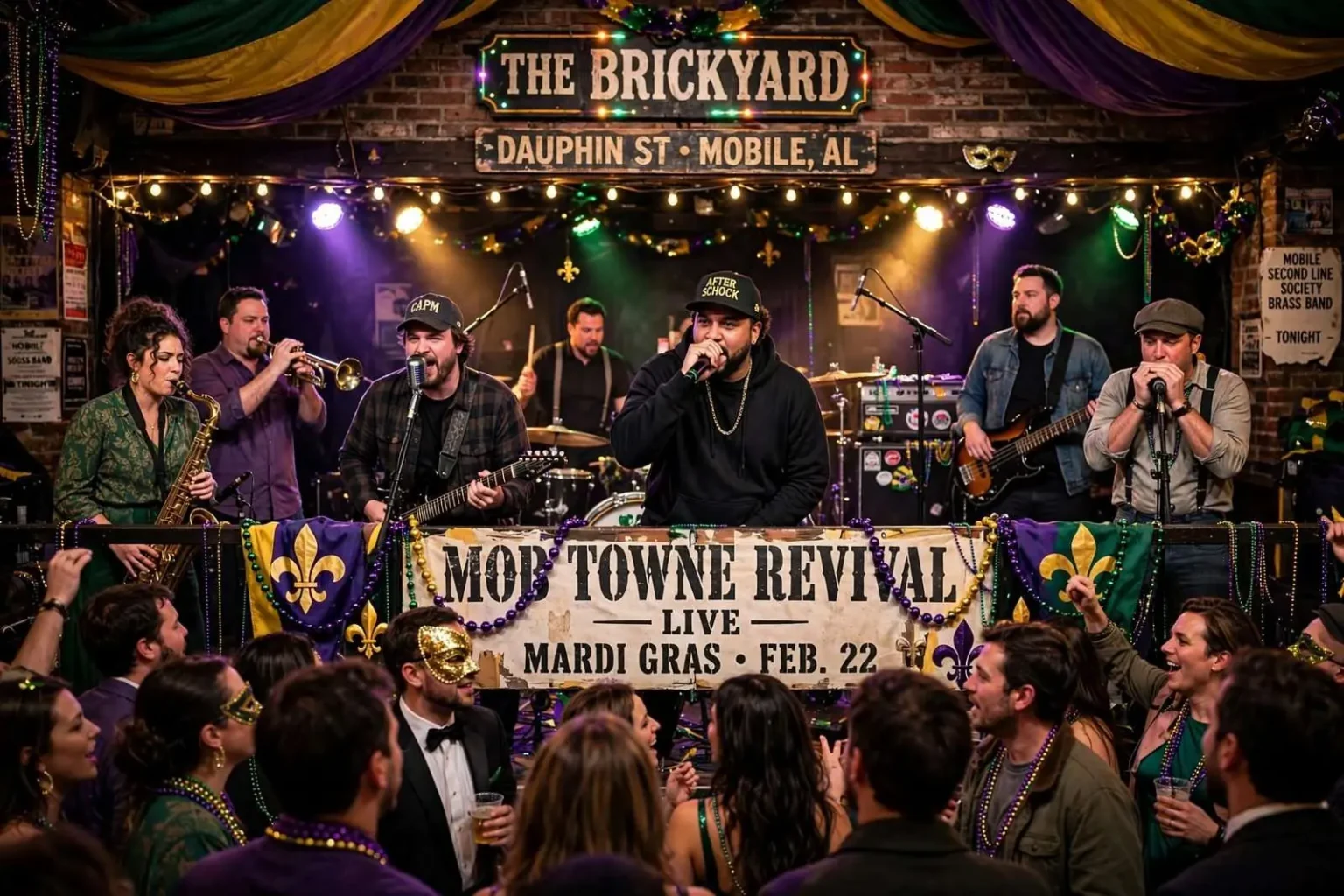
Mardi Gras season brought a packed crowd to Dauphin Street on Feb. 22 as Mobile band Mob Towne Revival took the stage at the Brickyard alongside openers Mobile Second Line Society Brass Band and After Schock with DJ Fragment. The group blends saxophone, trumpet, drums, harmonica, electric guitar and bass into a high-energy live show. Rapper and hype man Josh ‘After’ Schock said playing the Brickyard with the band feels natural, describing the eight members as an in-sync musical machine. Guitarist and vocalist Tre ‘Capm’ Hook credited the venue and its operators for helping keep the shows going.
A Carnival Season Night on Dauphin Street
Feb. 22 falls in the thick of Mobile’s Mardi Gras season, when downtown Dauphin Street transforms into the city’s party corridor and every venue with a stage competes for the ballgoers and revelers flowing between parades and nightspots. A packed house at the Brickyard on a Carnival weekend is the kind of night local bands build their reputations on — and Mob Towne Revival drew the kind of crowd that mixes tuxedoed and gown-clad ballgoers with downtown regulars who turned out to support the act and the rest of the lineup. The sight of formal wear and street clothes sharing a club floor is a Mobile February signature, born of the season’s rhythm of balls, parades and late nights.
The billing itself tells the story of Mobile’s live music scene: Mobile Second Line Society Brass Band brought the New Orleans-style brass tradition that runs deep along the Gulf Coast, where second line rhythms and horn-driven street beats have crossed state lines and taken root in Mobile’s own Carnival culture. After Schock, fronted by rapper and hype man Josh ‘After’ Schock with DJ Fragment, added the hip-hop energy that has become part of the region’s contemporary sound. Layering a brass band, a rap act and a genre-blending rock-funk band onto one bill is a distinctly Gulf Coast approach to a party — three branches of the same musical family tree, all reaching New Orleans and the port cities where jazz, funk and hip-hop first met.
Mob Towne Revival’s instrumentation explains its wide reach. The blend of saxophone, trumpet, drums, harmonica, electric guitar and bass gives the eight-piece the flexibility to move through funk, rock, blues and New Orleans-influenced grooves in a single set. Horn sections anchor the Gulf Coast sound — the same musical DNA that feeds Mobile’s Mardi Gras from the New Orleans side — and a band that carries saxophone and trumpet into every venue can speak that language fluently. The harmonica adds the blues and Southern rock textures that area audiences grew up on, letting the band pivot from a second line groove to a straight-ahead rock number without changing personnel.
The Brickyard and Mobile’s Independent Venues
The Brickyard, on Dauphin Street in the heart of downtown, has been a fixture of Mobile’s live music circuit, hosting local and touring acts in a room built for high-energy shows. Guitarist and vocalist Tre ‘Capm’ Hook credited the venue and its operators for helping keep the shows going — a nod to the reality that independent clubs are the infrastructure beneath every local music scene. Venues like the Brickyard take chances on original local bands, book them on the busiest nights of the year, and provide the stages where a band like Mob Towne Revival can grow a following. Every city that sustains a music scene sustains it through rooms like this one: modest in size, essential in function.
That role matters most during Carnival season, when downtown Mobile’s traffic is at its peak and the competition for entertainment dollars is fiercest. A packed Brickyard on Feb. 22 demonstrates what local music advocates argue constantly: Mobile audiences will come out for hometown bands when the scene gives them a reason. The audience that night — ballgoers still dressed from the evening’s festivities mixed with the downtown regulars — represents exactly the cross-section a local band needs to convert casual listeners into fans. A fan made during Mardi Gras returns in June; a fan made in June brings friends the next February.
The band pointed to independent venues like the Brickyard as an outlet that lets local musicians reach new audiences, and encouraged music lovers to explore the range of acts performing across Mobile during Carnival season. It is a message with substance behind it: Mobile’s Mardi Gras season spans weeks, with parades rolling from early February through Fat Tuesday, and the club scene along Dauphin Street runs a parallel festival of local music every night the mystic societies are not parading. For visiting tourists who come for the parades and stumble into a hometown band at full power, the club scene often becomes the discovery they did not expect.
The Band and Its Sound
Rapper and hype man Josh ‘After’ Schock said playing the Brickyard with the band feels natural, describing the eight members as an in-sync musical machine. The phrase captures what audiences see in a veteran local band: eight musicians who have played together long enough that transitions, vamps and crowd-work moments happen without visible effort. A hype man’s role in a band of this shape — bridging the horn-driven groove and the crowd’s energy — reflects the group’s hip-hop influences and its understanding of what a Carnival-season audience wants from a night out: momentum, humor and a reason to stay on the floor.
Mob Towne Revival worked through crowd favorites such as ‘Repo Man’ and ‘Real Good Feel Good,’ the kind of original material that a local act builds its identity around. Cover bands fill a function on Dauphin Street, but songs the crowd asks for by name are what turn a bar act into an institution. The pairing of those originals with the brass band and rap acts on the same bill shows a band confident in its own material and in the eclecticism of its audience. Titles like ‘Real Good Feel Good’ telegraph the band’s temperament — party music played with craft, built for rooms rather than studios.
The band’s name is a statement of local identity in itself — “Mob Towne” being a longtime nickname for Mobile — and the group has positioned itself as part of the city’s cultural fabric rather than a passing act. During Mardi Gras, when Mobile celebrates itself as the original home of American Carnival, a hometown band packing a Dauphin Street venue fits the season’s theme precisely: the city’s own music, in the city’s own room, on one of the year’s biggest nights. Bands that tie their identity to their city this way tend to become fixtures — the act a generation of locals measures their downtown nights by.
Carnival Season and the Mobile Music Economy
Mardi Gras in Mobile is not a single night but a season — weeks of parades, balls, dinners and nightlife that stretch the city’s entertainment economy to its annual peak. For musicians, the season is a working calendar: ball gigs, parade-route performances and club shows stack up across February, and the bands that play them are almost entirely local. The brass band tradition, the R&B and funk lineage of the Gulf Coast, and the newer hip-hop scene all converge downtown during Carnival, and audiences move among them in a single night.
The Feb. 22 show sits in that context as more than a single good night. It is evidence of the ecosystem the band and its openers represent: independent venues booking local acts, brass bands keeping the Gulf Coast’s musical heritage alive, hip-hop artists building audiences through live energy, and a crowd diverse enough to fill a room for all of it. City leaders and arts advocates have increasingly recognized that this scene — venues, bands, and the audiences that sustain them — is part of what makes downtown Mobile thrive outside of Carnival too. The LO DA arts district’s growth, the steady traffic along Dauphin Street and the restaurants that fill before every show all draw on the same energy a packed club generates.
For music lovers the band’s advice stands: explore the range of acts performing across Mobile during Carnival season. Between the parades and the balls, the clubs along Dauphin Street host the city’s own celebration — and on this Feb. 22, Mob Towne Revival and its lineup proved that the party inside the venues can match anything rolling past them on the street. The crowd left with tuxedos rumpled and the downtown regulars with their expectations met, and the eight-piece musical machine rolled on toward the next parade day, the next packed room and the next season when Mobile celebrates itself in music.
For the band members, nights like this one are the dividend on years of rehearsals, gear hauling and weeknight gigs in front of thin crowds. Every touring act that passes through the Gulf Coast plays rooms smaller than this on its way up, and local bands that can command a Mardi Gras Saturday in their home city possess the one asset no promotion can buy: a hometown audience that shows up on its own.