
Mobile Baykeeper Urges Residents to Push EPA on Corexit Dispersant Use
Mobile Baykeeper is urging Gulf Coast residents to write the EPA and Congress, arguing the dispersant Corexit was approved without fully tested effects.
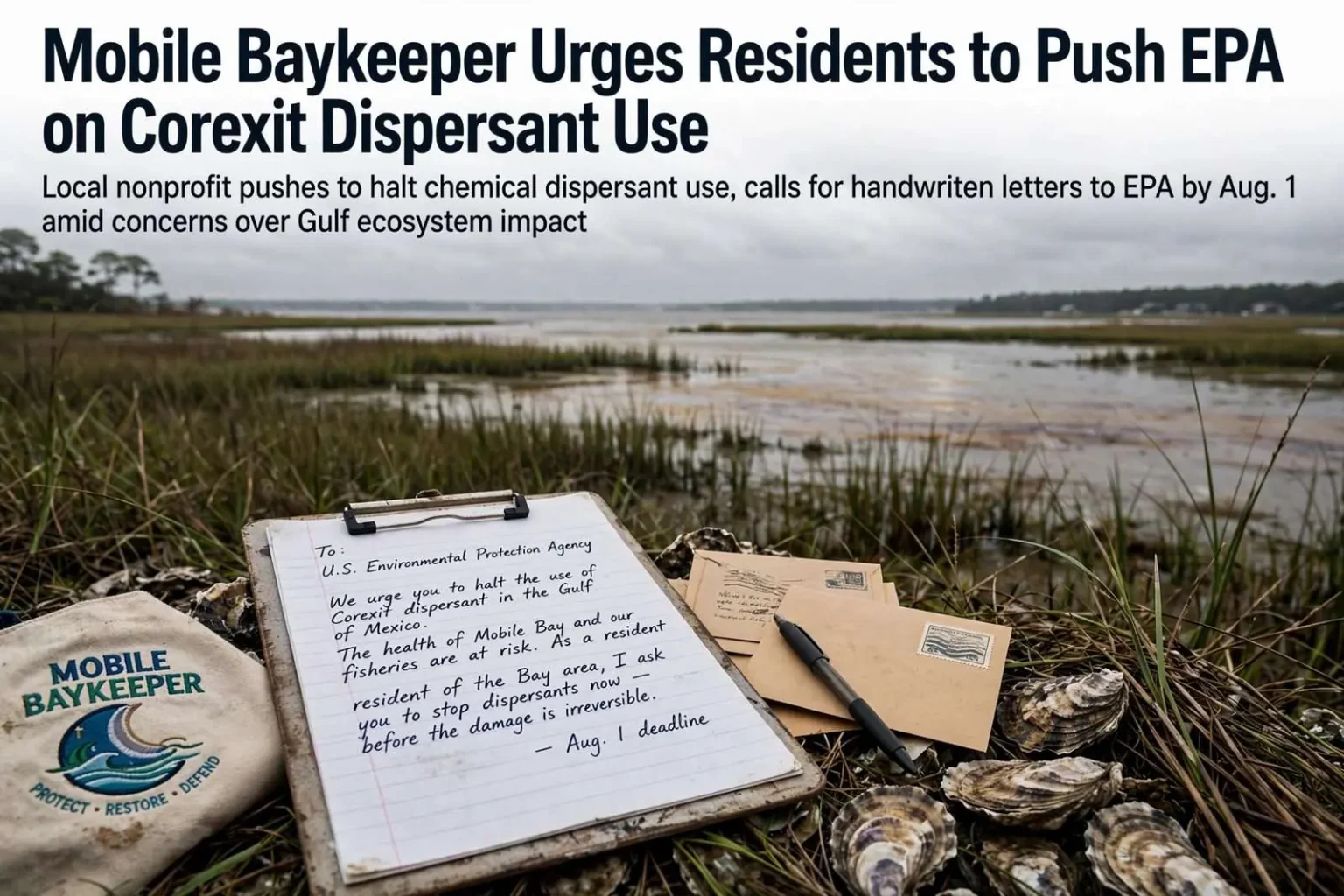
Mobile Baykeeper, the local nonprofit focused on protecting Mobile Bay and its watershed, has come out against the continued use of the chemical dispersant Corexit in the federal response to the Deepwater Horizon oil spill, arguing regulators moved too fast without fully understanding the product’s environmental effects. The group’s position inserts the Mobile Bay region’s most prominent environmental watchdog into one of the spill response’s fiercest controversies — whether the cure is proving worse than the disease.
The organization’s core objection centers on how dispersants work. Rather than removing oil from the Gulf, Corexit breaks it into smaller droplets that spread through the water column instead of concentrating at the surface. Mobile Baykeeper contends that approach can make both shoreline protection and on-water oil recovery more difficult, even as it keeps oil from washing ashore in the most visible, photographed slicks.
In the group’s view, the tradeoff amounts to hiding the damage rather than preventing it. Oil that stays near the surface can be skimmed, burned or corralled by boom before it reaches land; oil dispersed into the water column instead rides the currents that eventually feed Mobile Bay, the estuaries of the Alabama coast and the marshlands that serve as nurseries for the region’s fisheries.
The stakes for the Mobile area are direct. The bay and its surrounding watershed support commercial seafood harvests, recreational fishing, tourism and a fragile balance of fresh and salt water that sustains oyster reefs, grass beds and the Delta’s wetlands. Any contamination that enters the bay’s food web threatens the economies and communities built around it.
A Process Without an Exit
Mobile Baykeeper has also criticized the federal system for approving dispersants for use during spill response, saying the process that allows a chemical like Corexit onto an approved list has no corresponding mechanism to remove it if new evidence of harm emerges. In the group’s view, that one-way approval structure leaves regulators with limited options if the environmental costs of a dispersant turn out to outweigh its benefits.
The approval system operates under the National Contingency Plan, the federal framework that governs how the nation responds to oil spills. Products listed for use have undergone testing, but critics note the testing predates scenarios like the Deepwater Horizon response, where dispersants were being applied at sea in unprecedented volumes, including directly onto the wellhead more than a mile beneath the surface.
That deepwater application was itself novel, and scientists along the Gulf Coast — including researchers at universities in Alabama, Mississippi and Louisiana — have been scrambling to study what happens to dispersed oil in the deep ocean, where sunlight and microbes behave differently than at the surface.
Mobile Baykeeper’s argument is essentially precautionary: until the science catches up with the practice, regulators should stop adding dispersant to the Gulf. The group points out that the spill response is not a laboratory experiment, yet the Gulf’s ecosystem has effectively become the test case.
Call to Action
The organization urged Mobile Bay-area residents to send handwritten letters to the Environmental Protection Agency by Aug. 1, calling on the agency to halt the use of Corexit in the ongoing spill response. The handwritten format was a deliberate choice: mailed letters carry more weight with federal agencies than mass emails or form petitions, each one representing a constituent who took the time to write.
Baykeeper also encouraged residents to contact their members of Congress directly, pressing for closer scrutiny of dispersant use along the Gulf Coast. The two-track approach — regulators on one side, legislators on the other — reflects the group’s recognition that both agencies and their congressional overseers shape what happens in a spill response.
For Alabama’s congressional delegation, the spill has become a defining regional issue. The state’s coastal communities watched the response effort unfold from the north shore of an oil-threatened Gulf, and constituents’ concerns about dispersants, seafood safety and long-term damage have been flowing to Washington since the first weeks after the explosion.
The Aug. 1 deadline gave the campaign urgency and gave residents a concrete way to participate. Environmental groups have long understood that public comment periods and letter campaigns do more than influence agencies — they build the engaged membership that sustains watchdog organizations over the years a spill’s aftermath will require.
The Spill’s Reach Into Alabama Waters
Although the Deepwater Horizon rig failed far offshore, the spill’s consequences have been moving steadily toward the northern Gulf coast, where currents and winds determine whether weathered oil arrives as tar balls, sheens or heavier patches. Alabama’s beaches — the economic engine of the state’s coastal tourism — have been among the areas monitored for impacts as the response continues.
The Mobile Bay area’s exposure is filtered through the bay itself. The bay’s outlets to the Gulf, its oyster reefs and its Delta marshes all depend on timing: how much oil arrives, when it arrives and what form it takes. Dispersed oil — the oil that no longer shows up as a slick — complicates every assessment of that threat because it cannot be seen or easily sampled from the surface.
Fishermen, seafood processors and tourism operators along the Alabama coast have been pressing for answers about seafood testing and water quality, questions that become harder to answer when dispersants have pushed oil below the surface where routine observation cannot track it.
The Broader Gulf Coast Debate
The push reflected broader unease among Gulf Coast environmental groups during the months following the Deepwater Horizon explosion, as communities from Louisiana to the Florida Panhandle weighed the tradeoffs between visible oil on beaches and the less understood, underwater effects of the chemicals used to break it up.
Environmental organizations across the region have raised variations on the same question: who is responsible for deciding how much chemical dispersant enters the Gulf, and on what evidence? The EPA’s authority over dispersant use exists within a response structure in which the responsible party carries out much of the work under federal supervision, an arrangement that has left some critics questioning the independence of the decisions being made.
The uncertainty has public health dimensions as well. Cleanup workers, fishermen assisting with response operations and coastal residents all ask what exposure to dispersed oil and dispersant mixtures means for the people working on and near the water — a question that grew louder after concerns emerged about illnesses reported among response workers in past spills.
For Mobile Baykeeper, the Corexit campaign extends the organization’s core mission. The group, known for its water monitoring programs and its advocacy on issues ranging from stormwater pollution to industrial permits around the bay, treats the spill response as a watershed-scale issue: what happens in the Gulf does not stay offshore when currents, tides and storms connect the open water to the bay’s marshes and tributaries.
What Residents Can Expect Next
The letters campaign’s results will be measured first in the agency’s response — whether the EPA changes course on dispersant use or defends its approach publicly. Federal agencies under sustained pressure from coastal constituents have, at various points in the spill response, adjusted practices, increased testing and expanded public information about what is being applied to Gulf waters.
Congressional attention is the second measure. Gulf Coast legislators have called for hearings and oversight of the spill response, and constituent letters contribute to the record that shapes which questions get asked and which policies get reviewed.
The longer-term stakes involve the spill’s aftermath: years of monitoring, scientific study and restoration planning that will follow the emergency phase. The decisions made now — about dispersants, about seafood testing, about who pays for damage — become the baseline for that future.
Mobile Baykeeper’s message to residents of the bay area is that participation now matters. Handwritten letters by Aug. 1 and calls to congressional offices are, in the organization’s framing, the practical tools available to people whose bay, beaches and livelihoods hang on choices being made far from Mobile — choices about chemicals applied to Gulf waters that eventually touch every shore and estuary on the northern Gulf Coast.
Understanding Dispersant Science
The scientific question at the heart of the dispute is deceptively simple: is oil that is dispersed into the water column less harmful than oil that stays on the surface? Surface oil threatens birds, sea turtles, beaches and marshes — the most visible casualties of a spill — but it is also the oil that responders can see, track and recover.
Dispersed oil behaves differently. The tiny droplets mix downward, exposing fish larvae, plankton, coral communities and the organisms of the open water column to chemical compounds that would otherwise remain at the surface. Whether those organisms can metabolize the dispersed oil, and what the dispersant itself adds to the toxicity, remain open scientific questions — the crux of Mobile Baykeeper’s complaint that regulators acted without fully understanding the effects.
Gulf Coast universities mobilized research vessels and grants to study exactly those questions as the response continued, and the resulting studies will shape how the nation handles dispersants in future spills. Scientists involved in that work have cautioned that the deep Gulf is a poorly sampled environment even in calm conditions, making a fast-moving spill response an especially difficult place to gather clean data.
That gap between action and understanding is what the bay area’s environmental community wants closed. Mobile Baykeeper’s position is not that the spill should go untreated, but that treatment decisions should rest on evidence gathered before — not after — the chemicals enter the water.
The Bay’s Economy in the Balance
Mobile Bay’s commercial and recreational fisheries, its seafood restaurants and processing houses, and the coastal tourism economy that stretches down the highway to the beaches all depend on the same water the spill threatens. Oystermen, shrimp boat captains and charter operators form an industry chain in which a single weak link — consumer confidence in Gulf seafood — can idle an entire fleet.
That is why the dispersant debate resonates locally even though the spill is far offshore. Residents of Bayou La Batre, Coden and the shore communities around the bay lived through earlier oil spill scares and know how quickly rumor can empty docks and restaurants. Clear answers about what is in the water are the region’s best protection.
Mobile Baykeeper’s letters campaign asks residents to make those answers a federal priority — one handwritten letter at a time, before the Aug. 1 deadline, to the agency that controls whether Corexit continues to be poured into the Gulf.