Mobile Bike Polo Team the Dauphins Earn Spot at Continental Championships
Mobile's hardcourt bike polo team the Dauphins earned a third-place finish at the Southeast Qualifier, securing a spot at nationals.
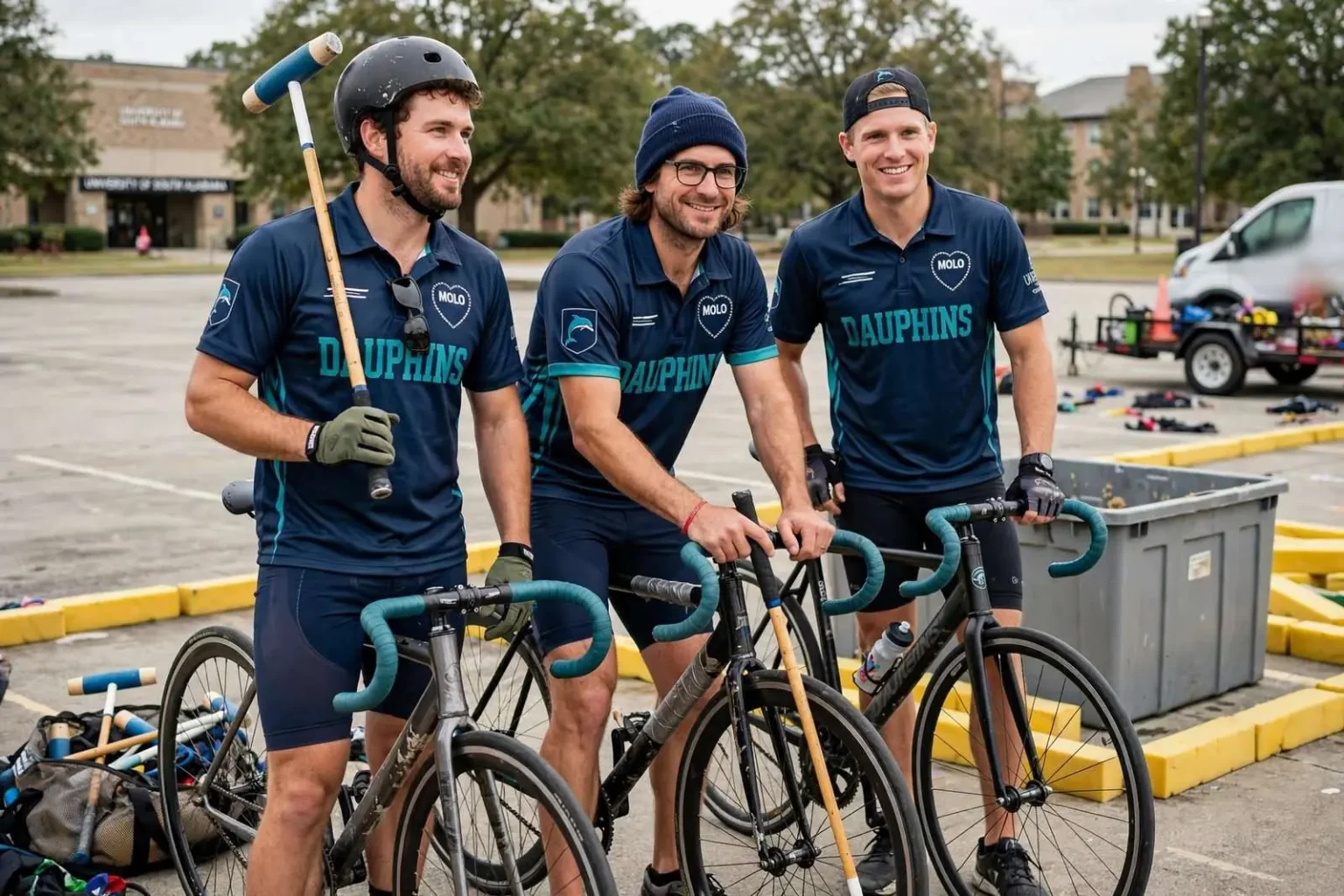
A small but determined group of cyclists from Mobile has earned their way onto one of the biggest stages in hardcourt bike polo. The Dauphins, the competitive team representing Mobile’s co-ed bike polo club known as MOLO, placed third at the Southeast Qualifier in Atlanta and secured a berth at the North American Hardcourt Bike Polo Championships in Minneapolis. For a club that plays on a makeshift court in a university parking lot, the finish represents a leap from regional pickup games to the continent’s most competitive tournament.
From Parking Lot Pickup Games to National Competition
MOLO was founded in June 2009 as a way for local cycling enthusiasts to exercise, compete, and build community. The club has grown to include about 15 regular members, though as many as 30 players have participated over the years, a roster that has turned over as players have moved to Mobile for school or work and moved away again. The club’s name — shorthand for the city’s cycling crowd — reflects the loose, do-it-yourself spirit that has defined bike polo scenes everywhere the sport has taken root.
Twice a week on average, members load more than $5,000 worth of equipment into a van and trailer and haul it to a parking lot at the University of South Alabama, where they spend roughly half an hour setting up a makeshift court using large foam border pieces, a storage container, and a curb to create an enclosed playing area. The setup is not regulation size, and the club does not have enough border pieces to fully enclose the court on their own. None of that has stopped the Dauphins from competing at a high level — and the improvisation is itself part of hardcourt bike polo’s heritage, a sport that grew up in parking lots rather than arenas.
The club’s routine gives some sense of what the sport demands. Players ride stripped-down bikes fitted with fork-mounted mallets, defend goals measured out at each end of the court, and play games that reward bike handling, quick passes and the willingness to throw a shoulder — body contact is legal, and players joke that the biggest expense in the sport is replacing front wheels bent in collision. Regulars often bring spare bikes to the lot, since a single evening can claim more than one to the rigors of the game.
The weeknight sessions have become a fixture of Mobile’s cycling community, overlapping with the same crowd that turns out for group rides and the city’s cycling advocacy efforts. Players say the game’s appeal is its low barrier to entry — anyone who can ride a bike can learn to swing a mallet within an evening — combined with a skill ceiling that keeps longtime players honing their shot-making and positioning for years. The club’s co-ed makeup is also standard for the sport, which has emphasized mixed rosters since its earliest tournaments and remains one of the few team games where beginners and veterans regularly share the same court.
A Strong Showing in Atlanta
Earlier in 2014, three MOLO members — Bernard Hickman, Jacques Chouinard, and Kevin Greene — entered the Southeast Qualifier, an open tournament that drew 34 teams from seven states including Alabama, Mississippi, Tennessee, North Carolina, South Carolina, Georgia, and Florida. Despite facing seasoned competitors from across the region, the Dauphins came away with a third-place finish, good enough to punch their ticket to the continental championship. Qualifier tournaments across North America run through the spring and summer, with the top finishers at each earning seats at the season’s championship event.
The Atlanta finish is notable not only for the placement but for the field it came against. Thirty-four teams in a single regional qualifier is a sign of how deeply the sport has penetrated the Southeast, with established scenes in college towns and big cities alike. The Dauphins’ run through the bracket — as a three-player squad from a club of fifteen — turned heads among players who had written off the Mobile contingent before the first whistle.
The three teammates will now carry the Gulf Coast banner to Minneapolis, where the North American championships gather qualifiers from across the continent for a multi-day tournament. Continental championships typically draw dozens of squads in a bracket that runs from morning to night over a weekend, with local crowds, vendors and pickup courts filling the gaps between rounds. For MOLO, it will be the club’s first appearance on that stage.
The Rise of Hardcourt Bike Polo
While polo played from bicycles has existed for roughly a century, the hardcourt variant is a relatively recent development. The modern version of the sport traces its origins to Seattle in 1999, where bike messengers began organizing informal competitions on concrete surfaces. What started as a side attraction at existing cycling events called Alley Cats quickly spread to cities across North America. The messenger culture that incubated the sport — riders who already spent their days weaving through traffic on fixed-gear bikes — supplied both the athletic template and the subculture’s mix of grit and humor.
By the mid-2000s, the sport had grown enough to warrant a large-scale championship tournament in Chicago, and in the years that followed, the North American Hardcourt Bike Polo Association was formed with 21 elected representatives from across the continent. The organization now oversees ten regions spanning Mexico, the United States, and Canada, standardizing rules, sanctioning qualifying tournaments and organizing the annual championship circuit that the Dauphins have now qualified for. MOLO joined the association in 2010, formally plugging Mobile into the network of clubs that keeps the sport’s calendar running from Vancouver to Miami.
The sport’s spread followed a pattern familiar to anyone who has watched pickup-oriented games grow: a handful of players in one city, a court in a parking lot, a set of homemade mallets, and eventually intercity tournaments that force the rules to standardize. Hardcourt bike polo’s governing documents remain refreshingly brief by the standards of organized sport, and its clubs remain almost entirely volunteer-run, funded by entry fees, local sponsors and the kind of small fundraisers MOLO itself has now launched.
Mobile’s club has lived that evolution firsthand. Founded by riders who discovered the game through out-of-town tournaments and internet videos, MOLO spent its early years recruiting on word of mouth, building its mallet stash from salvaged ski poles and piping, and lobbying for space to play. Joining the continental association in 2010 gave the club a rulebook, a ranking path and, eventually, a realistic road to a championship bracket — a road that ran through Atlanta this spring.
Supporting the Dauphins
The team launched a fundraiser to help cover the costs of traveling to Minneapolis for the championship, including plane tickets, lodging, and equipment. Shipping bikes and mallets, booking rooms and covering entry fees adds up quickly for a club with no revenue beyond its own members’ pockets, and the fundraiser doubles as the club’s introduction to a wider Mobile audience that may not know bike polo exists in the city. Support from local donors would ease the burden on the three qualifiers and signal that the community is behind the club’s biggest moment yet.
The trip also carries implications for the club’s future. A strong showing at the continental championship would raise MOLO’s profile in the regional polo network, making it easier to attract visiting tournaments, recruit new members and eventually build the kind of permanent court the club currently has to assemble and take down by hand. Clubs in other mid-sized Southern cities have followed exactly that arc — from parking lot regulars to hosts of their own qualifier events — and MOLO’s leadership has watched those examples closely.
MOLO remains an open club and welcomes anyone interested in trying the sport. Newcomers do not need tournament experience; the club’s regular sessions in the USA parking lot are structured so that beginners can learn court positioning and mallet handling in low-stakes pickup games, and loaner bikes and mallets are typically available for anyone who shows up curious. The club’s members span a wide range of ages and day jobs, united mainly by time on two wheels.
For now, the Dauphins’ focus shifts to Minneapolis, where a third-place finisher from a Mobile parking lot will line up against the best clubs on the continent. Whatever the bracket holds, the team has already secured the club’s greatest result — and given the cyclists of the Gulf Coast a national stage to call their own.
Residents who want to follow the team or support the travel fund can find MOLO through the club’s social media pages, where it posts session times, tournament results and fundraiser updates. And anyone passing a university parking lot on a weeknight and seeing foam borders, goals and bicycles circling at speed now knows what they are watching: the training ground of a continental championship contender.