Mobile-Born Musician Sam Taylor Left an Indelible Mark on American Music
Sam Taylor, born in Mobile, became a legendary guitarist and songwriter who worked with Otis Redding, Jimi Hendrix and the Beach Boys.
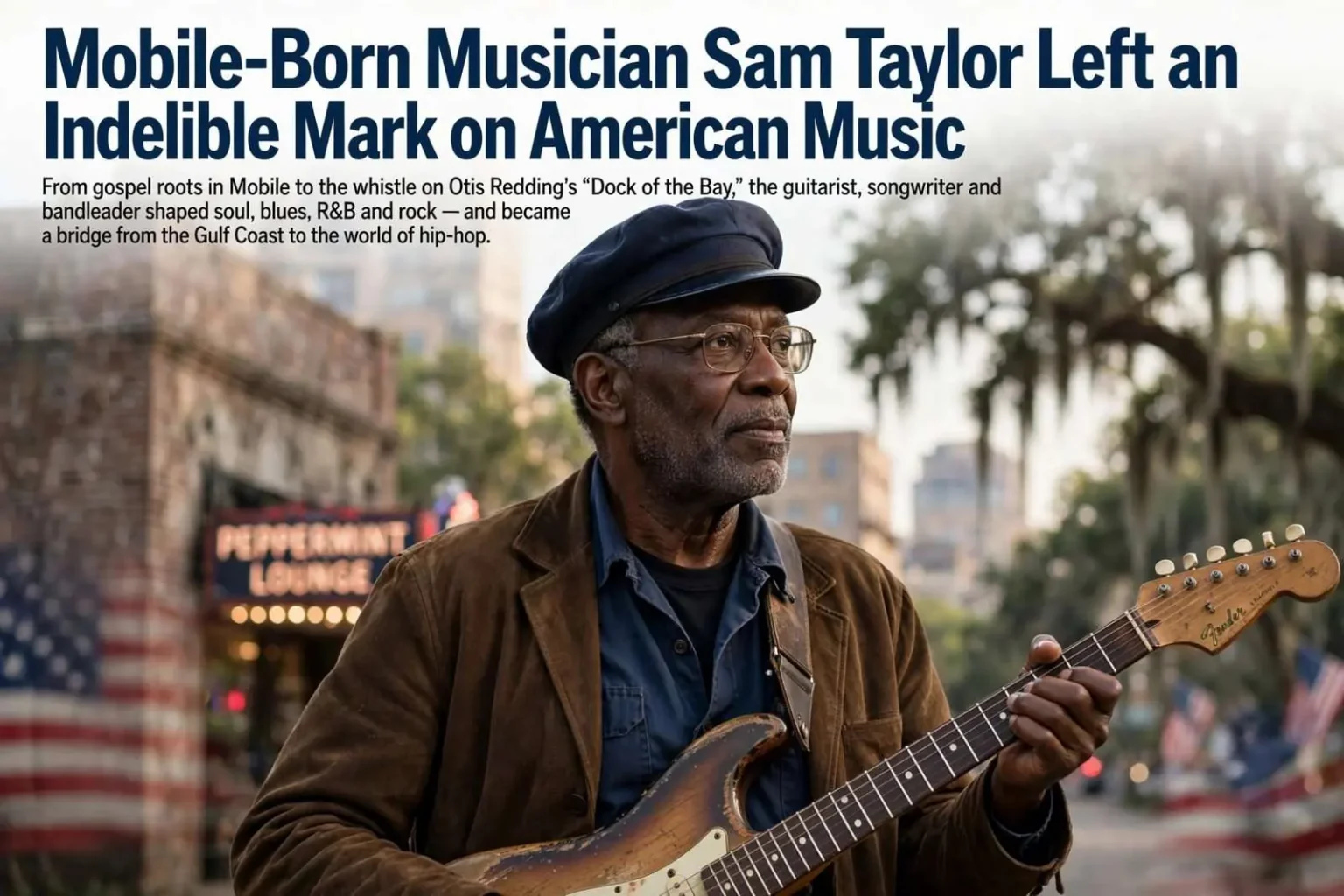
Sam Taylor, born in Mobile, Alabama, built a remarkable career as a guitarist, songwriter and bandleader whose influence stretched across some of the most important chapters of American popular music. From his earliest days singing gospel at the age of three in Mobile to his work alongside legends like Otis Redding, Jimi Hendrix and the Beach Boys, Taylor’s contributions to soul, blues and rock and roll were both wide-ranging and deeply significant. Few musicians touched so many corners of the business — gospel, R&B, blues, early rock and roll and even hip-hop, which would sample his work decades after he recorded it — and fewer still could trace all of them back to a childhood in Mobile.
The Gulf Coast has long been a conduit for American music. Mobile’s port connected the city to New Orleans and the wider South, its churches trained generations of singers, and its clubs and union halls gave working musicians a place to learn their craft. Taylor was a product of that world, and when he left it, he carried its sound with him.
From Mobile gospel roots to the New York music scene
After completing his military service in 1959, Taylor relocated to Long Island, New York. Though he showed promise as a boxer, he ultimately chose to devote himself to music. That decision proved transformative. Taylor scored his first number-one R&B hit with the single “Funny” and went on to record for several labels, including Capitol Records. The move from the service to the New York area placed him at the edge of the most concentrated music market in the world, within reach of the Harlem and Long Island club circuits where touring acts needed reliable local musicians and session work rewarded versatility.
As a songwriter, Taylor penned hits that were performed by an impressive roster of artists. His composition “Peace Pipe” became a hit for B.T. Express, and his songs were recorded by Freddie King, Chubby Checker, Son Seals, Jimmy Witherspoon, Brook Benton, Jay and the Americans, Joey Dee, Maxine Brown and Joe Tex. That list alone spans blues, pop, soul and the bubblegum era of early rock — a range few writers ever cover, and a measure of how adaptable Taylor’s craft was. A song that suits Freddie King’s blues does not usually fit Chubby Checker’s dance-floor pop, and vice versa; Taylor wrote for both.
He also served as bandleader or guitarist for Big Joe Turner, the Isley Brothers, Tracy Nelson, Otis Redding and the duo Sam and Dave. Bandleading for acts of that caliber demanded more than technical skill: it required reading a room, holding a show together and delivering whatever a frontman needed on a given night, from a shuffle behind Big Joe Turner to the church-inflected arrangements the Isleys and Redding built their sounds on.
The whistle on ‘Dock of the Bay’
Among Taylor’s most notable contributions was performing the iconic whistling on Otis Redding’s “(Sittin’ On) The Dock of the Bay.” The track, which was completed and mixed by Steve Cropper following Redding’s death in a 1967 plane crash, became one of the most beloved songs in American music history. Taylor’s whistling remains one of its most recognizable elements. The two-note figure that opens the song and returns throughout it — casual, almost tossed off — became inseparable from the record’s mood of quiet contemplation, and it has been imitated by everyone who has ever hummed the song’s opening bars.
“Dock of the Bay” marked a turn in Redding’s music toward something softer and more personal than the horn-driven soul that made him famous, and the finished record, assembled after his death from materials he and Cropper had begun in Memphis, became the first posthumous number-one pop hit in history. That a Mobile-born guitarist’s whistle sits at the front of it is one of the record’s quiet footnotes, and one of Taylor’s proudest.
Mentoring Sam and Dave, and playing with Joey Dee
Taylor and his longtime songwriting partner, Bennie Earl, mentored the young Florida duo Sam and Dave early in their career, writing two of their first hits — “People in Love” and “Listening for My Name” — during the duo’s time recording for Roulette Records, before their later success with Stax/Volt. The mentorship mattered more than the chart positions. Before Sam Moore and Dave Prater became the most celebrated soul duo of the 1960s with “Soul Man” and “Hold On, I’m Comin’,” they were a young act finding their way, and the guidance of a working bandleader and a writing partner helped shape the call-and-response style that would later define them.
Taylor was also an original member and guitarist of Joey Dee and the Starliters, one of the first racially integrated bands in the United States. The Starliters rose to national fame with “Peppermint Twist” out of the Peppermint Lounge in New York, and their integrated lineup was notable at a time when American bands, North or South, were often segregated by custom if not by law. Fellow members included Charles Neville of the Neville Brothers and actor Joe Pesci — a remarkable roster for a dance band, and evidence of the circle of talent the group attracted and launched.
Together with fellow Starliter Dave Brigati, Taylor had a formative influence on the Rascals, which included Brigati’s younger brother Eddie. The Rascals would become one of the defining blue-eyed soul bands of the 1960s, with hits like “Good Lovin’,” and the connections formed in and around the Starliters’ orbit fed directly into that success. Taylor also wrote some of the earliest material for the Vagrants, the band that featured Leslie West before he went on to form Mountain, where West’s massive guitar sound would help define early heavy rock.
The pattern in Taylor’s early career is easy to see in hindsight: he kept landing in bands and circles just before they became historically important. The Starliters, the Rascals’ principals, the Vagrants, Sam and Dave — each connection placed him at the hinge of a career that mattered, usually before the world knew it mattered.
A connection to Jimi Hendrix
In a colorful chapter of rock history, Taylor reportedly brought his younger associate Jimi Hendrix to meet Joey Dee, hoping to have the young guitarist take his place in the Starliters. At the time, Hendrix had been performing with artists like Little Richard and the Isley Brothers but had a reputation for drawing more attention than the headliners he backed. The story is the kind that could only happen in the early 1960s, when a restless sideman could be recommended from one band to another on the strength of word of mouth — and when the recommendation in question was, in effect, passing the world’s greatest guitar talent along to a twist band.
It also captures Hendrix’s predicament in those years. As a sideman he kept upstaging the stars he was hired to support, a liability on the chitlin circuit and in package shows where the headliner’s ego mattered. Taylor’s instinct — that Hendrix deserved his own spotlight, starting with his own chair in the Starliters — reflected both generosity and a bandleader’s eye for talent. History took the young guitarist in a different direction, to London and to a fame that made the Starliters’ story a footnote in his, but the encounter remains one of the stranger intersections in rock’s genealogy.
Later career and legacy
In the early 1970s, Taylor and Earl were hired as staff songwriters for Brother Records, the Beach Boys’ label. The appointment put the Mobile-born guitarist inside one of the most storied catalogs in American pop, at a label created by the band that had defined the California sound. Taylor later released his debut solo album, “Tunnels of My Mind,” to critical acclaim. He went on to work for Roadshow Records as a songwriter and A&R representative, the dual role of writer and talent scout that keeps a small label’s pipeline full.
Taylor eventually settled in Tucson, Arizona, where he hosted his own music television program, “Down to Earth.” The desert Southwest became the final stage of a career that had run through Mobile, Long Island and New York City, and the television show made him a local institution there — a working musician with a lifetime of stories, handing them to a new audience weekly.
Over the course of his career, he released five albums, including “Blue Tears,” “Voice of the Blues,” “Bluzman Back Home” and “Portrait: The Funk Side of Sam.” The titles trace the identity he settled into in his later decades: a bluesman first, with funk on the side. His work was sampled by hip-hop artists including EPMD, Ma$e and DMX, extending his reach into a genre he never worked in directly. In hip-hop, a sample is the highest form of citation — a producer choosing a break or a riff and stamping it into a new record — and Taylor’s grooves kept finding their way into the music of a generation that had never heard his name.
Taylor was inducted into the Long Island Music Hall of Fame in 2006 and the Arizona Blues Hall of Fame in 1997. The two honors bookend the geography of his life: the New York suburb where he first hit his stride, and the Southwestern state where he finished it. He also hosted the popular blues radio show “Blues with a Feeling” on WUSB-FM, the Long Island university station, keeping the music in front of listeners even as the industry around it changed.
Known for his trademark sailor’s cap, Taylor published his autobiography, “Caught in the Jaws of the Blues,” shortly before his death on January 5, 2009, at his home in Islandia, New York. The title suited a life lived at the center of an industry that chewed through musicians, and the book arrived in time to preserve the stories in his own voice.
Mobile claims many musical sons, but few carried the city’s sound as far, or left it in as many places, as Sam Taylor. The whistle on “Dock of the Bay” still plays in movies, commercials and generations of playlists; the songs he wrote for others still surface on oldies radio; and the hip-hop tracks built on his grooves still introduce his playing to listeners born long after he left Long Island for the last time. It is a career that began with a three-year-old singing gospel in Mobile and ended, fifty-some years later, with an autobiography on the shelf and two hall of fame plaques on the wall — an arc few American musicians have ever matched.