
Mobile Car Wash Fundraiser Keeps Search for Danniella Vian in the Public Eye
A Mobile car wash fundraiser raised over $2,300 for the family of missing mother Danniella Vian while urging the public to keep her case in mind.
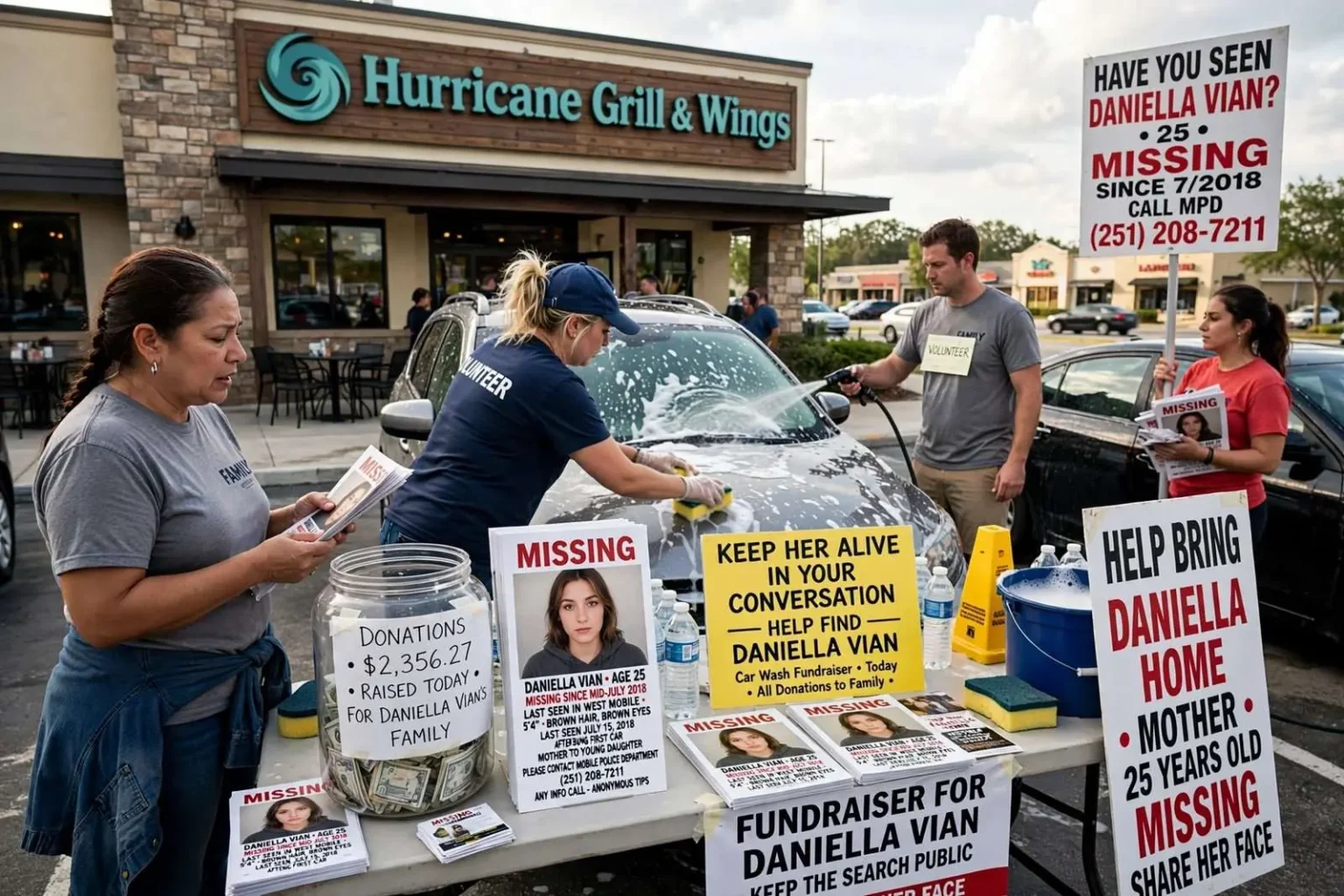
Volunteers spent a Sunday outside a west Mobile restaurant washing cars and passing out flyers, all to keep attention fixed on a missing Mobile mother whose disappearance had stretched on for weeks. The fundraiser ran through the day outside Hurricane Grill and Wings, where organizers set up the car wash as both a money-raiser for Danniella Vian’s family and a reminder that she was still missing. Donations from the car wash alone reached $2,356.27 by Sunday evening, before the restaurant added a share of its dinner sales from a benefit held later that night.
The scene along the restaurant’s parking lot was deliberately hard to ignore. Volunteers with buckets, hoses and sponges waved down drivers passing through the busy west Mobile corridor, while others stood near the road holding flyers bearing Vian’s photograph and description. Every vehicle that pulled in represented a two-fold exchange: a clean windshield in return for a conversation about a missing woman whose family says she cannot be allowed to fade from public memory.
For the family members who organized the event, the arithmetic of the day mattered less than the message. A missing persons case competes for attention in a crowded news environment, and after the first few weeks pass, coverage naturally drops off while the search does not. Community fundraisers like this one are a way for families to push their loved one’s name and face back in front of hundreds of neighbors in a single afternoon, people who might otherwise never hear about the case at all.
Hurricane Grill and Wings, which sits along one of west Mobile’s heavily traveled commercial corridors, offered its lot for the event and later added a percentage of its dinner sales from a benefit held that evening, stretching the fundraiser’s reach into the night. The combination of daytime car wash and evening dinner benefit is a familiar formula for Gulf Coast charity events, and it allowed supporters who could not stop by during the day to contribute over dinner.
‘Keep Her Alive in Your Conversation’
Family members said the goal was as much about awareness as it was about funds. Julie Thomas, Vian’s mother-in-law, urged everyone who stopped by to learn her face and keep talking about her case.
“Know who she is, know her face, share her face and her information, anyone you talk to, talk about her, keep her alive in your conversation so that if someone sees her somewhere they’ll know and they can let us know,” Thomas said.
That appeal captures how families of the missing describe their role once an investigation moves past its early days. Detectives follow leads, but relatives become the case’s public advocates, distributing flyers, maintaining social media pages and showing up at intersections and storefronts with yard signs. Each new person who can recognize Vian on sight is, in the family’s framing, another set of eyes working the case. In a metro area the size of Mobile, where residents cross the same commercial corridors daily, recognition is a practical asset rather than an abstract hope.
The phrase Thomas used — keeping Vian alive in conversation — has become a refrain for families across the country who stage events like this one. Missing persons advocates note that cases are frequently resolved when someone who saw a flyer or a news report later recognizes the person in an unexpected place, which is precisely why families work to keep the image circulating long after headlines move on. The car wash format puts that recognition campaign at eye level, on a roadside where thousands of drivers pass each weekend.
Vian, 25, was last seen in mid-July 2018 after buying her first car that evening. Her family filed a missing persons report after she failed to come home to her young daughter, and volunteers have since plastered billboards and handed out flyers across the area. Anyone with information is asked to contact Mobile police.
The circumstances of her final known outing have weighed on the family from the start. She had just purchased her first car — a milestone she had been working toward — and was last seen on the same day. When she did not return home to her young daughter that night, relatives contacted police and a formal missing persons report followed, opening the investigative process that continues today.
In the weeks since, the family’s visibility campaign has grown steadily. Billboards bearing Vian’s photograph have gone up around the area, and flyers have been distributed at businesses, intersections and public gatherings. The strategy is straightforward: the more places her face appears, the better the odds that someone who has seen something — perhaps without realizing its significance — will connect the image to the case and come forward.
How Missing Persons Cases Work in Alabama
When a report like Vian’s is filed, local officers enter the person’s description into state and national law enforcement databases, which puts the information in front of agencies far beyond Mobile. That step matters because missing people do not always stay within the jurisdiction where they were last seen; a person can surface at a hospital, a business or a traffic stop in another county or another state, and the database entry is what allows officers there to make the connection.
Investigators with the Mobile Police Department typically follow the usual sequence in the early weeks: interviews with family and friends, canvassing of the area where the person was last seen, review of any available camera footage and checks of the person’s financial and phone activity where legally possible. As time passes without answers, cases transition into a longer rhythm of following new leads as they arrive, often generated by tips from the public — which is exactly why awareness campaigns matter to investigators as much as to families.
Under Alabama law, there is no waiting period required to report an adult missing. That surprises many residents, who assume they must wait 24 or 48 hours before police will act. In practice, the sooner a report is filed, the fresher the trail, and families of missing adults in Mobile County are encouraged to contact police immediately when a loved one’s absence is out of character.
Adult cases differ from those involving children in important ways. Because most adults are legally free to leave, police cannot compel anyone to be “found,” and some missing adults are later located safely having left voluntarily. But families of people like Vian — a mother who failed to come home to a young child, with no contact and no explanation — describe a different reality, one in which every day without information deepens the uncertainty. That is the situation Vian’s relatives say they have been living through as the weeks have stretched on.
The Role of the Community in the Search
Law enforcement officials across Alabama have long said that tips from residents solve more cases than any single investigative technique, and missing persons work is no exception. A waiter who remembers an unfamiliar customer, a neighbor who noticed a car parked oddly, a driver who recalls seeing someone walking along a highway shoulder — these fragments only become useful when someone recognizes their significance and calls. Flyers and billboards are designed to trigger exactly that kind of recognition.
Mobile’s landscape gives that approach room to work. The city stretches across a wide footprint, from downtown’s grid to the suburban commercial corridors of west Mobile, and its roads carry commuters, port workers and travelers moving between Florida and Mississippi along the Gulf Coast. A missing person from one neighborhood may be seen in another, or in Pascagoula, Pensacola or along Interstate 10, and the family’s goal is for the photograph to be familiar wherever that happens.
Fundraising events also serve a practical financial purpose that families rarely discuss publicly. Searches generate costs — printing, billboard rentals, gas, time away from work — and in some cases reward funds, which investigators say can coax hesitant witnesses into calling. Money raised at events like Sunday’s car wash goes toward keeping the campaign itself running, so that the search does not stall for lack of resources while the family waits for a break in the case.
Community car washes occupy a particular place in Gulf Coast fundraising culture. Low-cost to organize and easy for strangers to join, they turn a Saturday or Sunday errand into a contribution, and they naturally draw the local news cameras and social media posts that extend the event’s reach beyond the parking lot. For a family managing a missing persons case, the event is as much a news cycle as a revenue stream — a scheduled moment when the community is asked, once again, to look at a photograph and remember.
What Residents Can Do
For residents who want to help, the family’s requests are simple. Learn what Vian looks like. Share her photograph and description with friends and family, particularly online, where a single post can reach thousands of local users within hours. And if anyone recalls seeing her — in mid-July 2018 or at any point since — or has any information about her movements around the time of her disappearance, contact the Mobile Police Department directly.
Tips do not need to feel significant to be worth reporting. Investigators emphasize that callers should not self-edit; a detail that seems trivial to a witness — the direction a car was headed, the time of day someone was seen, what a person was wearing — can be the piece that fits into a larger picture. Callers can remain anonymous when reporting information, and departments would rather screen a hundred unhelpful tips than miss the one that matters.
As for the family, they say the plan is to keep going. The car wash, the billboards, the flyers and the conversations are all part of the same effort to make sure that when someone, somewhere, sees Danniella Vian, they recognize her — and make the call that brings her home to her daughter.