Mobile Cat Who Lost All Four Legs Thrives Years After Emergency Amputation
Years after a near-fatal electrical injury, a Mobile-area cat named Kelly Anne is thriving following a rare quadruple limb amputation.
MOBILE, Ala. — A cat named Kelly Anne is defying expectations in Mobile years after veterinarians performed a rare quadruple amputation to save her life.
According to accounts of her case, Kelly Anne was chased up a tree by dogs as a young cat and suffered a severe electrical injury in the process. The trauma to her legs was extensive enough that veterinarians in Mobile determined amputation of all four limbs was the only way to save her.
The circumstances of her injury highlight a hazard familiar to veterinarians and animal-control officers across the Gulf Coast. Utility poles and transformer equipment draw cats that climb to escape dogs and other threats, and contact with energized equipment can cause devastating burn injuries to the paws, mouth and tongue. Electrical injuries are deceptive even to trained eyes: tissue damage from the current continues to progress for days after the initial shock, and limbs that look survivable on the first night can become unsalvageable as circulation fails.
For Kelly Anne, the damage left no middle ground. Her care team in Mobile weighed the alternatives — repeated surgeries with uncertain outcomes, or a single drastic operation — and chose the one that offered a life rather than a prolonged decline.
An Unusual Recovery
Quadruple amputations are uncommon in veterinary medicine, in part because most owners and veterinarians must weigh whether a cat can maintain an acceptable quality of life without any working limbs.
Kelly Anne’s care team nursed her through surgery and recovery, and she was ultimately able to return home.
Today, the orange and white tabby gets around by scooting on what her caretakers describe as her furry “flippers.”
The mobility she developed is a testament to feline adaptability. Cats carry a low center of gravity, remarkable core strength and an instinct for balance that makes them better candidates for radical amputations than almost any other companion animal. Double amputees — front-leg or hind-leg pairs — are seen regularly in veterinary practices; a cat like Kelly Anne, moving by scooting and wriggling on padded stumps, remains rare enough to draw attention from the profession itself.
She cannot scratch or groom herself the way an able-bodied cat can, but by all accounts she has adjusted well and leads a happy, comfortable life.
That limitation is the daily reality behind her story. Grooming is central to a cat’s sense of well-being, and an animal that cannot groom depends on its people for coat care, nail trims and skin checks — a routine that becomes part of the bond. Owners of disabled cats describe the work as manageable but constant, and they credit it with keeping their animals healthy and comfortable for years past what anyone predicted at the time of surgery.
A Broader Trend in Pet Care
Kelly Anne’s story reflects a broader shift in veterinary medicine over the past two decades, as advances in prosthetics, pain management and post-surgical care have made once-unthinkable procedures more viable for companion animals.
The change has several drivers. Modern multimodal pain management — combining opioids, non-steroidal anti-inflammatories, nerve-pain medications and local blocks — makes major surgery and recovery tolerable in a way it was not a generation ago. Surgical technique and anesthesia monitoring have advanced in parallel, lowering the risks for geriatric and trauma patients alike. And owners’ expectations have shifted: pets are family members, and families increasingly ask what can be done rather than what must be endured.
Prosthetics and wheelchairs have grown into a small industry of their own. Veterinary orthotists now fit custom prosthetic limbs for animals who retain enough of a leg to anchor one, and carts designed for front-limb or hind-limb paralysis give dogs and cats mobility that would have been impossible decades ago. Physical rehabilitation — underwater treadmills, laser therapy, range-of-motion work — has followed, with certified rehab practices now operating in most metropolitan areas, including along the Gulf Coast.
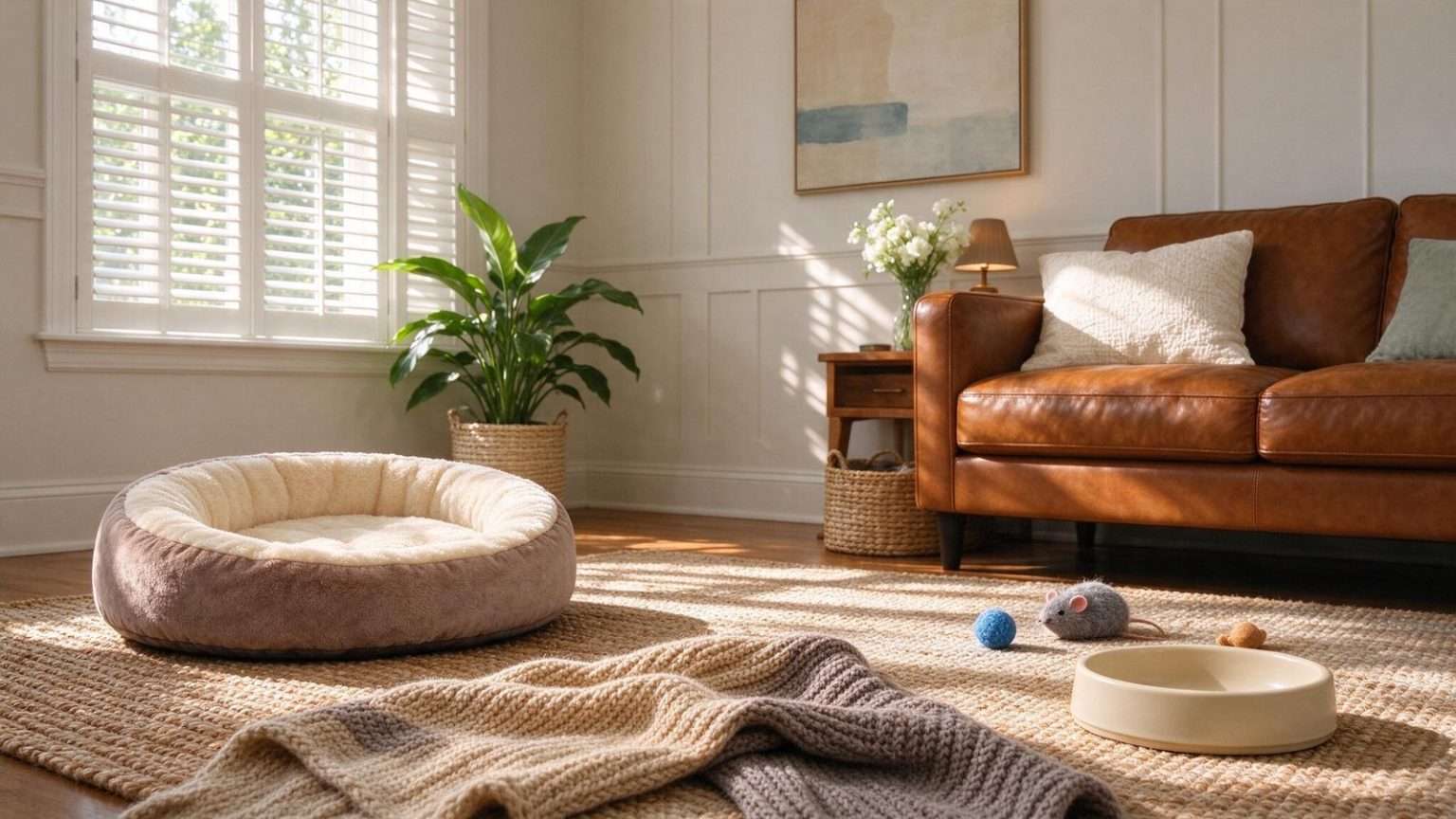
Amputee pets often rely on modified home environments, such as ramps and low-sided litter boxes, along with attentive owners to help with basic grooming.
The modifications sound simple and matter enormously. A low-entry litter box lets a cat with limited mobility use it without climbing; ramps to favorite perches and beds prevent falls; non-slip runners on hard floors give purchase to animals with no digits to grip with. For a cat like Kelly Anne, food and water stations are arranged so she can reach them from her preferred position, and soft bedding protects the skin over her stumps from pressure sores — the most common complication in animals that move by scooting.
What Disabled Cats Teach Veterinarians
Cases like Kelly Anne’s have informed how the profession counsels owners facing similar decisions. The traditional assumption that a quadruple amputee could not have a good life has been tested and, in a small number of documented cases, disproven. Veterinarians still approach such surgeries cautiously — the recovery is demanding and the commitment is lifelong — but the successful outcomes give both vets and families real evidence to weigh rather than instinct alone.
Quality-of-life assessment has become a discipline in its own way. Scoresheets that track appetite, hydration, grooming behavior, interaction and mobility help owners make hard decisions with something better than a gut feeling, and they are equally useful afterward, in confirming that a patient who cannot speak for herself is in fact thriving.
Stories like hers have also helped raise awareness about adaptive pet care and the resilience of animals recovering from traumatic injuries.
For the veterinarians and staff in Mobile who handled her case, a patient like Kelly Anne is the kind that stays with a practice — the animal whose surgery everyone remembered, whose recovery everyone followed, and whose continued presence in the community years later is its own answer to the question that hung over the decision to operate: whether saving her life was saving a life worth living. Her caretakers, by all accounts, have never had any doubt.
The Danger of Outdoor Hazards for Cats
Kelly Anne’s origin story — chased up a tree, injured on electrical equipment — is a reminder of the specific dangers outdoor and semi-outdoor cats face in Mobile and comparable Gulf Coast cities. Animal-welfare groups have long urged owners to keep cats indoors, citing not only traffic and predators but the utility hazards that come with climbing: transformers, guy wires and overhead lines. A cat’s instinct to climb away from danger leads it upward, and in a city laced with poles and lines, upward is not always safe.
Electrical injuries from chewing or touching energized equipment are well documented in cats and dogs, and they range from minor mouth burns to the catastrophic limb damage Kelly Anne suffered. Veterinarians urge owners of any animal found near downed lines or transformer equipment to treat the animal as potentially injured even when it appears fine, because the internal damage can take hours or days to declare itself. Rescue crews and utility workers, meanwhile, ask the public never to attempt to free an animal from energized equipment on their own.
The dogs-chasing-cats dynamic is its own thread in the region’s animal-control work. Loose dogs are among the most common complaints animal services receives in Mobile County, and a chase that ends with a cat in a tree or on a pole puts both animals at risk — the cat from falls and electrical contact, the dog from traffic and from the intervention that follows. Leash ordinances exist throughout the county’s municipalities precisely to prevent scenes like the one that changed Kelly Anne’s life.
Supporting a Special-Needs Pet
For families considering adopting a disabled animal, the practical demands are real but narrower than most people imagine. Beyond the home modifications, the ongoing needs are veterinary follow-ups, weight management — extra weight is punishing for an animal with no limbs to spare — skin care over amputation sites and vigilant attention to urinary and digestive habits, which are early warning signs of illness in any cat but especially one whose mobility limits her ability to reach a box quickly.
The rewards, owners of animals like Kelly Anne consistently report, run in the other direction. Disabled pets adapt with a directness that their humans find humbling: they do not mourn the abilities they lack, they simply find another way to the food bowl, the sunny spot, the lap. The photos and videos that circulate from households like hers — a cat scooting across a kitchen floor at full speed, ears forward, on her furry flippers — have made special-needs pets visible in a way that shelters say has helped them get adopted rather than overlooked.
Rescue groups in the Mobile area and across the country have taken note. Special-needs animals are increasingly featured in dedicated adoption programs, with foster networks that understand their care, and stories like Kelly Anne’s are part of why: every widely shared account of a thriving quadruple amputee makes the next family willing to say yes.