Mobile Chamber Turns to Local Businesses to Shape Its 2027 Legislative Agenda
The Mobile Chamber's annual legislative survey gathers input from area businesses to shape its 2027 advocacy priorities — with tickets to the Jimmy Buffett exhibit up for grabs.
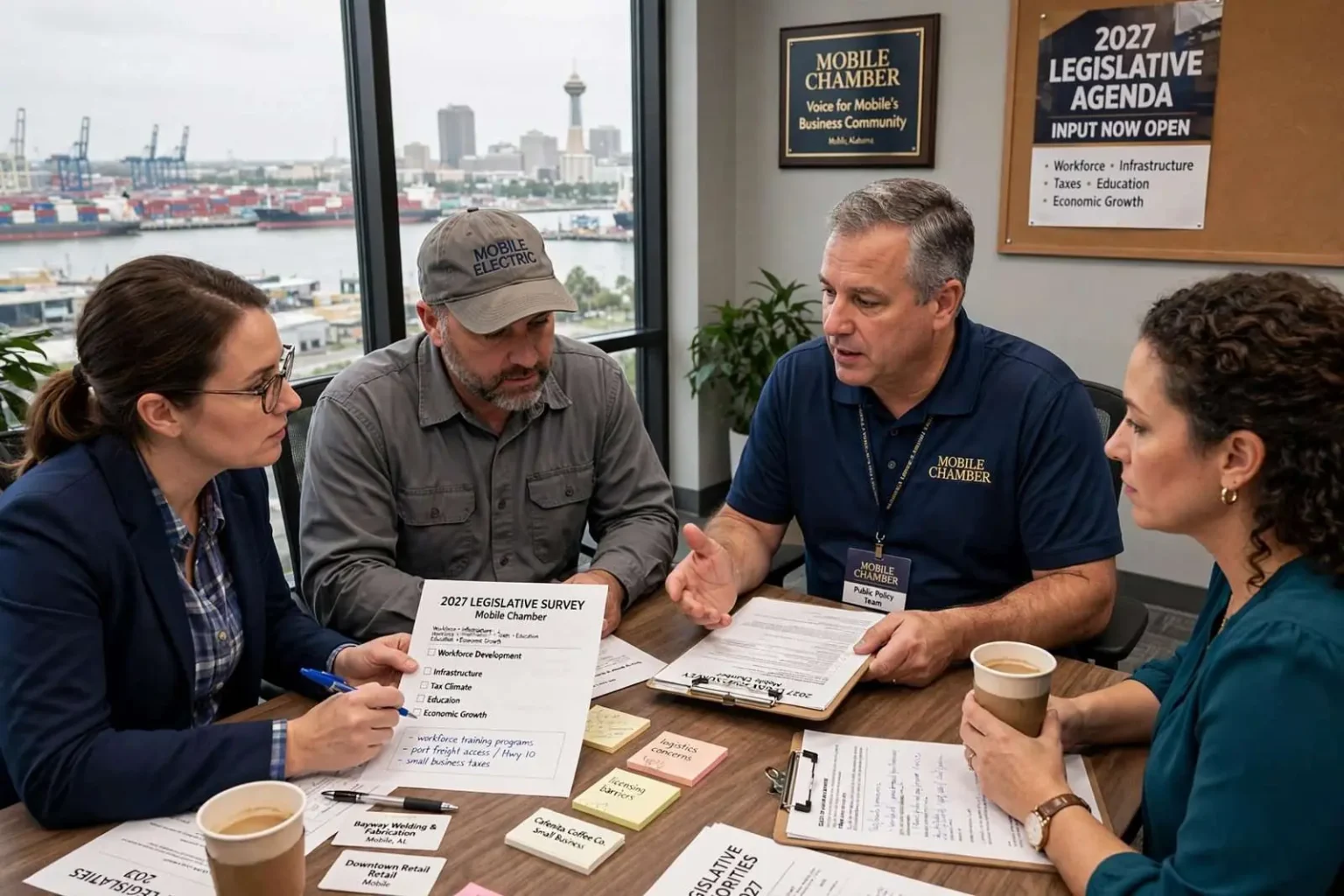
The Mobile Chamber wants to know what is on the minds of the area’s business community — and it is asking directly. The organization has released its annual legislative survey, designed to identify the issues that matter most to Mobile-area employers and translate those answers into the Chamber’s legislative priorities for 2027.
Responses will help guide the Chamber’s advocacy at the local, state and federal levels on key issues such as workforce development, infrastructure, taxes, education and economic growth. The survey is open to businesses of every size, from sole proprietors and small-business owners to larger employers across the region.
A voice for Mobile’s business community
The Chamber’s public policy team serves as the strong, dedicated voice for Mobile’s business community. It works to advocate for policies that support business growth, help employers find and retain skilled talent, and foster a thriving community where businesses and individuals can succeed. Chamber officials emphasize that the effort works best when it is informed by the people it represents — which is exactly where the survey comes in.
Whether a respondent runs a small shop or works within a larger company, the Chamber says, feedback ensures its priorities reflect the real challenges and opportunities facing local businesses rather than assumptions made from a distance.
What the survey covers
Participants are asked for input on the policy areas that most affect day-to-day operations: finding and keeping workers, the condition of local infrastructure, the tax climate, education and the broader pace of economic growth in the Mobile area. The results feed into a focused, effective advocacy agenda the Chamber carries into the coming legislative session and beyond.
Businesses that want a head start can view the Chamber’s most recent legislative agenda online to see how past priorities have shaped the organization’s positions.
A Buffett-themed incentive
There is an added reason to spend a few minutes on the survey: participants will be entered for a chance to win two tickets to the Jimmy Buffett: Son of a Son of a Sailor Experience at the National Maritime Museum of the Gulf. The immersive exhibit opens in September and celebrates the Mobile roots of the legendary singer-songwriter, making the prize a fittingly local one.
How to weigh in
The Chamber says completing the survey takes only a few minutes. Because legislation affects every local employer, the organization’s message is simple: the agenda should reflect the businesses it impacts, and that starts with hearing from them.
How a Chamber Builds Its Legislative Agenda
Local chambers of commerce across the country follow a similar playbook when it comes to setting policy priorities each year: survey the membership, identify the issues that come up most consistently, and translate those findings into a formal agenda that staff and volunteer leaders can carry to statehouses and Capitol Hill. The Mobile Chamber’s approach fits that pattern closely. By opening the survey to businesses of every size — from sole proprietors to the region’s largest employers — the organization is trying to build an agenda that reflects the full range of the local economy rather than the priorities of only its most visible members. That breadth matters because small businesses and large employers do not always agree on what matters most; a small retailer might prioritize commercial property taxes and workforce availability, while a manufacturer with hundreds of employees might care more about industrial infrastructure, freight logistics or specialized workforce training pipelines.
Once the survey closes, chamber policy staff typically compile the results into a ranked or thematic set of priorities, often organized around the same broad categories the Mobile Chamber lists: workforce development, infrastructure, taxes, education and economic growth. That document then becomes the organization’s working script for the coming year — the talking points staff and board members use in meetings with state legislators, congressional delegation staff and local elected officials, and the criteria the Chamber uses to decide which bills to publicly support, oppose or stay neutral on as they move through Montgomery or Washington.
Mobile’s Economic Base Shapes the Stakes
The issues at stake in a Mobile Chamber legislative agenda are not abstract. The Mobile area’s economy rests on a distinctive mix of industries: a deep-water port that ranks among the busiest in the country for certain categories of cargo, an aerospace manufacturing presence built around final assembly work, a shipbuilding and maritime industry with a long history in the region, health care systems that are among the area’s largest employers, and a steel and heavy manufacturing base along the Mobile River corridor. Each of those sectors has its own workforce and infrastructure needs, which is part of why the Chamber casts such a wide net when gathering input — a policy that helps one industry, such as expanded funding for a specific trade certification program, may do little for another that needs improved highway access to move freight, or relief on a particular tax that affects capital-intensive manufacturing differently than it affects a service business.
Workforce development in particular has become a perennial theme for business groups across Alabama and the broader Gulf South. Employers in manufacturing, health care, skilled trades and logistics have for years described difficulty finding enough qualified workers to fill open positions, a challenge that predates and outlasted the disruptions of the pandemic-era labor market. Chambers of commerce have responded by pushing for expanded funding for community college and technical training programs, apprenticeship partnerships between employers and schools, and, in some cases, changes to occupational licensing rules that business groups argue can create unnecessary barriers to entering skilled trades.
Alabama’s Legislative Calendar
The timing of the Mobile Chamber’s survey lines up with the rhythm of Alabama’s part-time legislature. The Alabama Legislature convenes its regular session early in the calendar year, typically in January, and state law limits regular sessions to a set number of legislative meeting days spread across roughly three to four months. That compressed window means organizations hoping to influence legislation need their priorities identified and their advocacy relationships built well before lawmakers gavel in — which is precisely why a chamber survey conducted in late summer or early fall feeds into an agenda for the following year’s session rather than the one already underway. Business groups that wait until a session is in progress to identify their priorities often find themselves reacting to bills already introduced rather than shaping the agenda from the start.
Beyond the state legislature, Mobile’s chamber advocacy extends to the federal level as well, given the region’s reliance on federal spending tied to the port, military installations and infrastructure projects such as the Mobile River bridge and bayway corridor. Chambers in port cities and manufacturing hubs frequently organize trips to Washington, D.C., to meet directly with their congressional delegation, a practice common among metro chambers nationwide that aims to put a human face — actual business owners — behind policy asks that might otherwise arrive only as a lobbyist’s talking points.
Why Business Surveys Matter to Advocacy Groups
Annual membership surveys are a standard tool for chambers and trade associations well beyond Mobile, used by organizations ranging from the U.S. Chamber of Commerce down to small-town merchants associations. The practice serves a dual purpose: it generates the substantive data an advocacy program needs to prioritize its work, and it also gives the broader membership a low-effort way to feel directly involved in shaping the organization’s public voice. For a chamber the size of Mobile’s, which represents businesses across a metro area with widely varying industries and company sizes, that engagement is particularly valuable, since staff cannot realistically have an individual conversation with every member business before setting priorities for the year.
The results also give the Chamber a data-backed answer when a lawmaker or reporter asks why a particular issue made the agenda. Rather than relying solely on anecdote or the preferences of board members, the organization can point to survey results showing that a meaningful share of respondents flagged workforce shortages, infrastructure bottlenecks or tax concerns as priorities, lending the advocacy effort a credibility that is harder to dismiss than a position paper alone.
What Happens After the Agenda Is Set
Once the Chamber finalizes its 2027 priorities, the document typically becomes a living reference point throughout the year rather than a one-time publication. Chamber staff use it to brief candidates and incumbents during election cycles, to prepare testimony or public comments on relevant bills, and to coordinate with statewide business organizations and other regional chambers that may share overlapping priorities on issues like infrastructure funding or workforce training dollars. Coalitions among Alabama’s metro chambers — Mobile, Birmingham, Huntsville, Montgomery and others — have periodically aligned on shared statewide priorities, particularly on transportation funding and education, giving business advocacy from smaller markets more weight in Montgomery than any single chamber could achieve alone.
For individual business owners, the payoff for participating is less about the sweepstakes-style prize and more about influence: a completed survey is, in effect, a vote on what the region’s most visible business advocacy organization spends its political capital fighting for over the next year. As the Mobile Chamber gathers responses ahead of the 2027 legislative session, the organization is betting that a wide, representative sample of the local business community will produce a stronger, more defensible set of priorities than any set drawn up by staff and board members alone.