Mobile Church Repairs Damage After Attempted Murder-Suicide Outside Sanctuary
True Cornerstone Church on Halls Mill Road is rebuilding after an attempted murder-suicide left a woman wounded, with the community rallying to help.
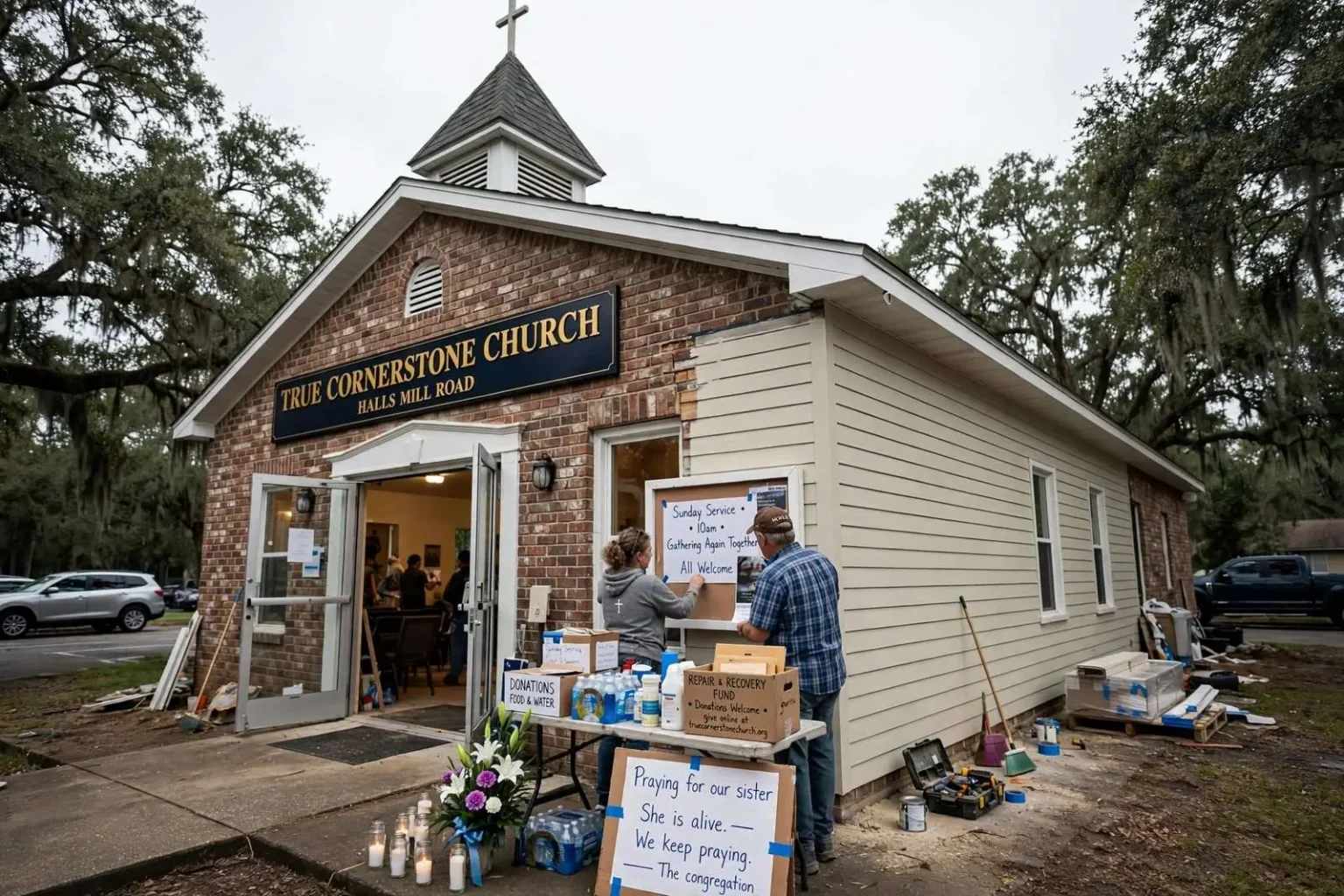
True Cornerstone Church on Halls Mill Road is moving forward with repairs after police say an attempted murder-suicide unfolded at the church, leaving a woman wounded and a man dead.
According to friends of the congregation, the gunman arrived at the church looking for his wife and shot her outside before turning the weapon on himself. Mobile police had not formally released the names of anyone involved, and identities of the couple were being withheld pending official confirmation.
The violence struck at one of the community’s most familiar settings. A church is where a neighborhood expects its safest gatherings — Sunday services, weddings, funerals, the milestones of family life — and violence on church grounds carries a particular shock for the congregation that calls the building home. True Cornerstone’s members spent the days after the shooting grappling with exactly that: the dissonance of a place defined by refuge becoming the scene of an act of violence.
Church members said the wounded woman began praying even as she lay injured, and she survived the attack. That detail spread quickly among members and friends of the congregation, and it became the story’s center of gravity — not the gunfire or the damage, but the survivor’s faith in the moments after she was shot.
Community Rallies Around the Congregation
Pastor Derek Gandy said strangers showed up within a day to help, and a new wall has already gone up where damage occurred as cleanup continued inside the building.
The speed of that response said much about how Mobile’s faith community operates in moments of crisis. Word of the shooting moved through the city’s church networks quickly, and the response — volunteers, materials, and hands arriving before the congregation had asked — reflected the informal network of support that links the city’s congregations. A wall rebuilt within a day is a physical fact, but it is also a message to the congregation that it would not carry the aftermath alone.
Gandy said both the victim and the shooter were friends of his family, and that Sunday’s services went ahead as planned. “I can’t preach faith if I don’t live by faith,” he said.
The decision to hold services on schedule, days after the shooting, was both a pastoral and a practical statement. Congregations that gather immediately after trauma often find the act of worship itself stabilizing — the familiar liturgy, the familiar faces, the sanctuary restored to its ordinary purpose. For True Cornerstone, gathering in the building where the violence occurred, with repairs still under way, amounted to a declaration that the church would define the space rather than cede it to what happened there.
Gandy’s comment about living by faith acknowledged the weight of the moment. Preaching comfort is one task; preaching it while mourning friends, one dead and one wounded, inside a damaged building is another. His dual role — pastor to a shaken congregation and friend to both people involved — placed him in the difficult position of leading grief he shared personally, a burden many small-church pastors know well.
His wife, Kula Gandy, said witnessing the victim’s prayers in the aftermath strengthened her own faith, and noted the outcome could have been far worse had the car crashed into a packed sanctuary or more people been harmed.
That observation pointed to how close the tragedy came to being larger. The shooting unfolded outside the sanctuary rather than within it, and the vehicle involved did not reach a crowded interior. On a day when services were underway or about to be, the difference between an outdoor confrontation and a catastrophe inside the building was a matter of feet and seconds — a reality the congregation processed in the days that followed.
Repairing the Building, Restoring the Congregation
The physical repairs have moved quickly. A new wall already stands where the damage occurred, and cleanup has continued inside the building as the congregation prepares the space for regular use. Church buildings absorb damage differently than other structures — every repair is also a symbolic act, restoring not just walls and fixtures but the sense that the space remains what it has always been.
The church is continuing to raise money to fund building repairs, with donations accepted through its online channels. Like many small congregations, True Cornerstone depends on its members’ giving to cover ordinary operations, and an unplanned repair bill of this size reaches beyond the regular budget. The fundraising effort extends the community support that began with volunteers showing up with tools: those unable to help physically can contribute to the rebuilding instead.
The congregation’s experience with generosity has reportedly exceeded expectations, with contributions and offers of help arriving from beyond its own membership. Mobile’s faith community has a long tradition of mutual aid among churches, particularly in the wake of storms and emergencies, and the response to True Cornerstone followed that pattern — aid flowing to a congregation in need without waiting to be asked.
Domestic Violence Reaches the Church Steps
For advocates who work on domestic violence across Mobile and the Gulf Coast, the circumstances described at the church fit a sobering pattern. Violence between intimate partners frequently spills into public and semi-public spaces — workplaces, family homes, and, in tragic cases, the venues where a couple’s separate lives intersect. A church, where a shooter knows he can find his wife, becomes part of that geography when a relationship turns lethal.
The woman’s survival, and the accounts of her praying as she lay wounded, have given the congregation a narrative of endurance to hold onto. Survivors of such attacks face long recoveries — physical, emotional, and spiritual — and the support of a faith community is consistently cited by victims’ advocates as a meaningful factor in that healing. True Cornerstone’s members have wrapped their prayers around one of their own, and her survival stands at the center of how the church is choosing to tell this story.
Mobile police had not formally released the names of anyone involved, and investigators continued their work in the days after the shooting. The department treats fatal incidents of this kind with a standard sequence — scene processing, witness interviews, and coordination with the Mobile County District Attorney’s Office — though with the shooter dead, the criminal case effectively concludes at the scene. What remains is the work of accounting: establishing exactly what happened, and documenting it for the record and for the family.
For the neighborhood along Halls Mill Road, the shooting and its aftermath have been felt close to home. The corridor of churches, homes, and schools that lines the road knows True Cornerstone as a neighbor, and the sight of repairs rising on the building has become a small, visible marker of the community’s resilience. Within a week of the violence, the wall was rebuilt, services had continued, and the congregation had begun the longer, quieter work of recovery.
The pastor’s framing endures as the church’s public answer to what happened: faith practiced when it costs something, a congregation gathering where the wound is freshest, and a survivor’s prayers — witnessed by her community — offering the congregation its clearest reason to keep moving forward.
A Weekend That Tested the Congregation
The days between the shooting and the following Sunday were the hardest stretch. Congregation members had to absorb the news, check on one another, and decide — with their pastor — whether to gather as usual. That the services went ahead as planned gave members a focal point: a time and place to be together, to pray for the wounded woman’s recovery, and to begin making sense of violence that had arrived at their own doorstep.
Churches in situations like this often lean on outside support as well. Pastors who have guided congregations through trauma frequently call on colleagues, counselors, and denominational resources to help members process grief, and the visits from strangers who arrived with tools and supplies at True Cornerstone suggested the wider community understood that need intuitively. The rebuilding of the wall within a day gave the congregation something rare in such circumstances: visible, immediate evidence of recovery.
The damage itself, while significant enough to require a rebuilt wall and interior cleanup, stopped short of destroying the sanctuary. Kula Gandy’s reflection on how much worse the outcome could have been — a car reaching a packed sanctuary, more people harmed — underscores the thin line the congregation walked. The building can be repaired in days; the knowledge of how close the community came to a far greater loss will take longer to settle.
What Comes Next for True Cornerstone
The fundraising effort for repairs continues through the church’s online channels, and the congregation’s leadership has emphasized gratitude for the outpouring that has already arrived. Every contribution, members say, is both a practical help toward the repair bill and a statement of solidarity with a church that has been through something no congregation should face.
The longer-term work — emotional and spiritual recovery for a congregation that witnessed the aftermath of violence at its own building — will take more than a rebuilt wall. Pastors across the country who have led churches through similar incidents describe a recovery measured in months and years: anniversaries that reawaken the memory, new members who never knew what happened, and the gradual return of the building to being simply a church again. True Cornerstone has already taken the first steps — services held, wall rebuilt, cleanup under way — and the community that rallied to its side in the first days shows every sign of staying for the rest.