
Mobile City Council Weighs $139,000 Contract to Expand Drone Fleet
Mobile's City Council is considering a $139,346 contract with Unmanned Vehicle Technologies for two additional drones to support large public events like.
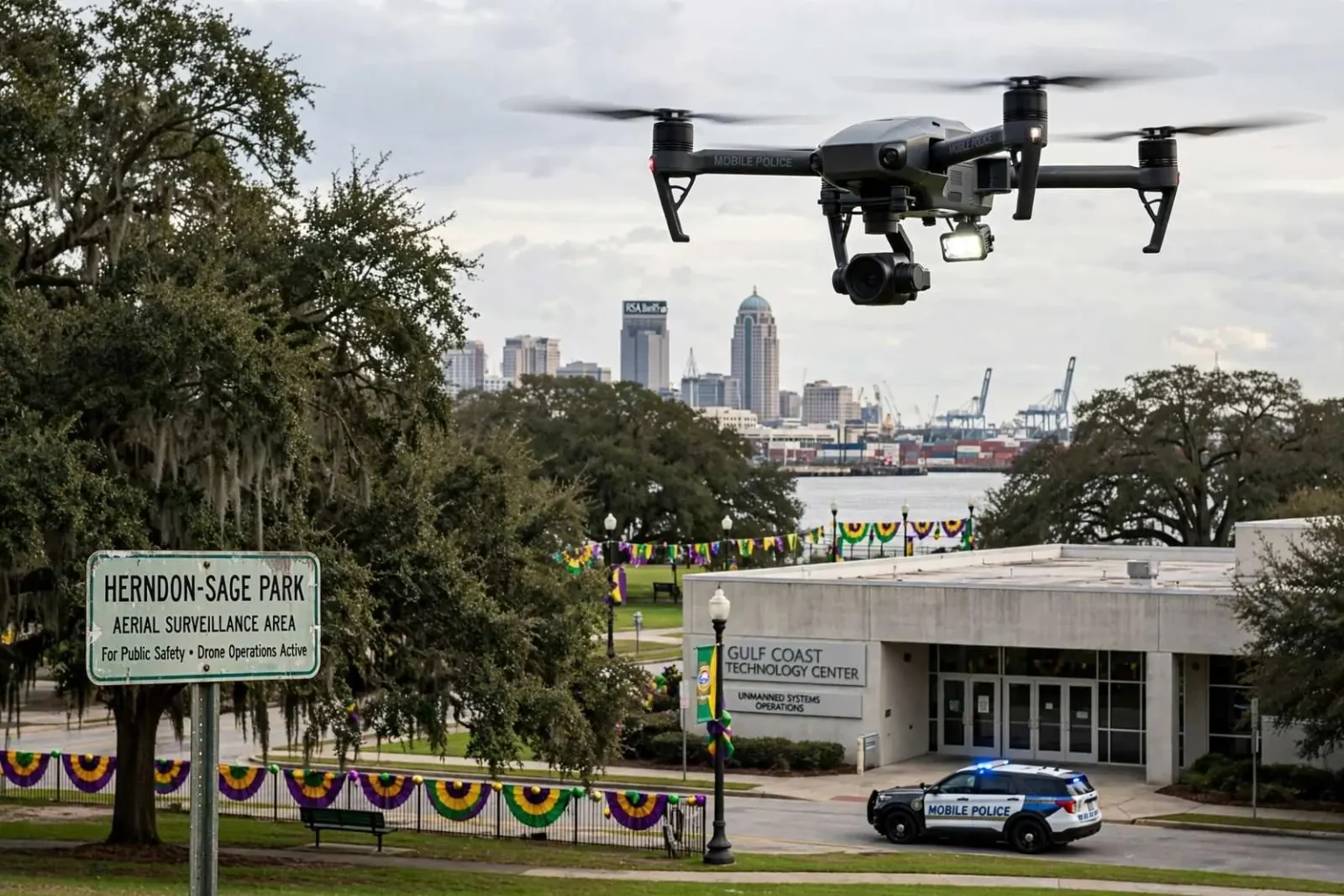
MOBILE, Ala. — The Mobile City Council has approved a $139,346 purchase order with Unmanned Vehicle Technologies, LLC (UVT) for two camera-equipped drones, expanding a fleet that city leaders say will bolster security at Mardi Gras, in parks and during police pursuits.
The council voted Tuesday to approve the measure, which passed unanimously among council members present. Councilman Ben Reynolds did not attend the meeting. The vote came after several residents raised concerns about privacy and surveillance in the days leading up to the meeting.
Councilwoman Gina Gregory said a constituent had contacted her asking that the council not approve the purchase, citing fears about spying and invasion of privacy. On the city’s public safety Facebook page, Mobile resident Brandon Rooney wrote that “‘Aerial Awareness’ is a really creative way to rephrase ‘drone surveillance,’” while resident Byron Overstreet compared the drones to Flock Safety license-plate reading cameras, which have drawn national scrutiny, writing, “This is supposed to be a free country, not a surveillance state.”
Gregory asked Executive Director of Public Safety Curtis Graves to respond to those concerns during the meeting. Graves said the city does not “purchase drones for anything for the purpose of spying on the public” and described the equipment as a way to add “a second layer of security” around parks, public spaces and large events such as Mardi Gras. He noted the Mobile Police Department has more than 500 officers but cannot be everywhere at once.
Council President C.J. Small reiterated that the drones would also be used to follow suspects during police pursuits so officers can avoid sending multiple cruisers into high-speed chases. Gregory said she also supports the drones for helping city officials review building elevations during development projects.
What the city is buying
The contract with UVT covers two drones, a drone-mounted floodlight, two cameras and other equipment. The new drones would supplement the Fotokite tethered drones the city already operates and would be based at the Gulf Coast Technology Center.
Mayor Spiro Cheriogotis said the purchase builds on an aerial situational awareness program the city launched earlier this year to test drone technology at the Gulf Coast Technology Center, and that Mobile already operates drones for its fire department and rescue operations.
“I like these tethered drones because they, you know, you don’t lose ’em,” Cheriogotis said. “They are very effective, and we’re not trying to be secretive about using drones. We’re not going to be invading people’s privacy.”
Cheriogotis said the drones would be an asset for the state high school football championships being held in Mobile this year, as well as annual events like Mardi Gras and the Senior Bowl, and pointed to Tuscaloosa’s investment in drone technology as a model for expanding Mobile’s fleet next fiscal year.
“Drones have proven to be useful tools for agencies around the country, especially where big crowds are present,” Cheriogotis said. “With a number of events throughout our city that draw large crowds, it is imperative that we protect citizens and visitors any way we can. This is a cost-effective way to enhance what we’re already doing to help keep the public safe.”
Public safety officials said the equipment is also expected to help with park security; a sign at Herndon-Sage Park, site of a fatal shooting last year, already advertises the coverage.
Citronelle residents Taylor Roebuck and Ashley Tabone, visiting Medal of Honor Park, said the idea gives them peace of mind, with Tabone saying drones could help “keep the drug activity down.”
Beyond large events, Cheriogotis said he sees potential public safety uses for the drones during high-speed chases. “It’s not gonna be our policy if you run to just let you go. That’s how really bad things happen,” he said. “But if we can do it in a safer way, if we can take those people into custody in a way that puts our citizens at less danger, I’m very interested in it.”
Public Safety Director Curtis Graves reiterated that the drones are meant to be a visible presence rather than a covert one. “These drones will be a highly visible, I hope, deterrent for crime,” Cheriogotis said. “We might put flashing lights on them so people know that they’re there.”
The vendor and the service contract
UVT, the drone vendor, is one of the largest drone and robotics dealers in North America, providing equipment to law enforcement agencies, utilities and construction companies. The company was founded 12 years ago in Arkansas by Christopher Fink and, as of this past May, operates in 13 states.
Alongside the drone purchase, the council introduced a resolution for a $695,000 annual service contract with Protec Video, LLC to handle deployment, management, training and consulting services at the Gulf Coast Technology Center.
Mobile’s embrace of aerial technology puts it in line with a broader shift among Gulf Coast cities. Police departments across Alabama and the Southeast have added drones for search-and-rescue, traffic collision mapping and crowd monitoring in recent years, and university programs along the coast have turned the region into a growing hub for unmanned systems training. The Gulf Coast Technology Center, where Mobile bases and tests its aerial equipment, is intended to serve as that hub for the city’s own operations.
Tethered drones such as the Fotokite units the city already flies are a deliberately conservative choice for municipal use. Because they draw power through a physical tether connected to a vehicle or ground station, they can remain aloft for extended periods without swapping batteries, and they cannot wander off or lose signal the way free-flying drones can. That makes them well suited to fixed observation posts — over a parade route, a park or an incident command scene — though the tether also limits how far they can travel from their anchor point.
The two new camera-equipped drones, which fly untethered, are meant to cover the ground the tethered units cannot: following a fleeing suspect down a grid of streets, sweeping a large festival footprint or moving between parks as conditions change. Pairing the two types gives the city both a persistent eye and a mobile one.
Why Mobile leaders want eyes overhead
The case city officials make for the fleet rests on the geography of Mobile’s public life. Mardi Gras fills downtown streets with hundreds of thousands of visitors over a Carnival season that stretches for weeks; the Senior Bowl draws a national college football audience to the city each January; and the state high school football championships bring crowds to Mobile this year. Those events strain any fixed camera network, which is why city leaders argue that aerial coverage fills gaps ground units cannot.
Parks are the other focus. After a fatal shooting at Herndon-Sage Park last year, the city has leaned on visible security measures — including signage advertising aerial coverage — to reassure residents who use neighborhood parks. Officials have framed the drone program as an extension of that effort: not a replacement for officers, but a way to cover ground between them.
For police pursuits, the pitch is about reducing danger rather than adding force. High-speed chases through residential streets carry obvious risks to bystanders, and leaders from Small on down have argued that an aerial camera following a fleeing vehicle lets ground units back off while still tracking the suspect — a tactic departments elsewhere have adopted after high-profile chase fatalities.
The privacy debate is likely to continue even with the purchase approved. Cities that have expanded drone fleets elsewhere in the country have faced questions about flight logs, data retention and who can access footage, and Mobile’s critics have already signaled they will keep watching how the program is used. City officials, for their part, have repeatedly emphasized visibility over secrecy — down to the idea of flashing lights on the drones themselves.
The $695,000 annual service contract with Protec Video, introduced alongside the purchase, will get its own consideration in the coming weeks and covers the operational side of the program: deployment, management, training and consulting at the Gulf Coast Technology Center. Together, the two measures define the cost of standing up a durable aerial program — hardware from UVT, and the staff expertise to run it.
For now, Mobile joins a growing list of Alabama cities investing in drones as standard public safety equipment. Whether the program expands further next fiscal year, as Cheriogotis has suggested it might, will depend on how the first months of deployment go — and on whether the city can keep persuading residents that eyes in the sky are watching for trouble, not for them.
The council’s unanimous vote also signals how the political calculus has shifted. A measure that once might have drawn a split vote passed without opposition even in the face of organized public criticism, suggesting that most council members view the aerial program as a settled part of the city’s public safety toolkit rather than an experiment. With the equipment purchase now approved and the service contract pending, the Gulf Coast Technology Center is set to become the operating base for one of the region’s more ambitious municipal drone programs.

