
Mobile City Council Approves Five-Year Carnival Contract as Spirit Prepares to Sail
The Mobile City Council approved a five-year Carnival contract as the Carnival Spirit, the port's largest cruise ship yet, readies its first sailings.
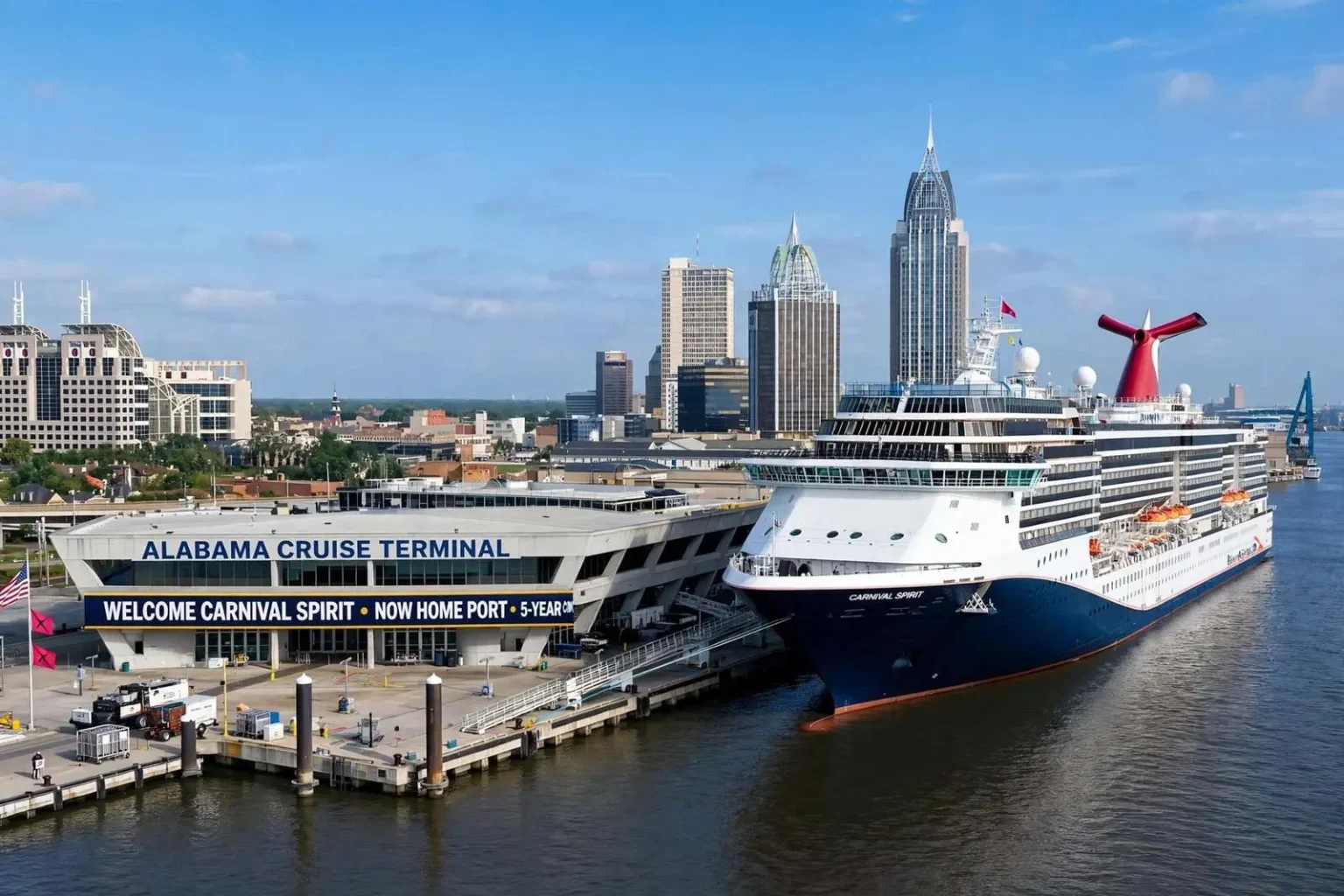
After nearly a year with an empty berth at the Alabama Cruise Terminal, Mobile is locked in with Carnival for the long haul. The Mobile City Council approved a five-year contract with Carnival Cruise Line — the longest agreement the city has ever had with the line — just as a new, larger ship prepares to arrive, ending a stretch of uncertainty that began when Carnival’s previous vessel left Mobile without a replacement.
The nearly year-long gap at the terminal was more than a symbolic loss. The Alabama Cruise Terminal on the Mobile River was built to be an economic engine, funneling cruise passengers and their wallets into downtown hotels, restaurants, and parking operations, and every week without a sailing meant lost revenue for the businesses that cluster around the city’s waterfront. The new agreement commits the line to Mobile through a five-year horizon, giving the city and its tourism partners the stability to plan and invest around cruise traffic rather than wondering each season whether it would continue.
For the Mobile City Council, the five-year term was the headline. Previous agreements with Carnival had been shorter, leaving the city exposed each time the line’s corporate fleet decisions shifted. A longer contract signals a mutual commitment: Carnival is anchoring a vessel here, and Mobile is positioning the terminal as a permanent home port rather than a stopgap berth.
A bigger ship, longer trips
The Carnival Spirit is scheduled to dock Oct. 4 and is the largest cruise ship ever to sail from Mobile. It offers roughly 600 waterfront balconies and itineraries stretching up to 12 days — a big step up from the shorter trips Mobile cruisers are used to. The ship’s arrival changes the profile of Mobile’s cruise product: where previous ships offered mostly short runs to the western Caribbean, the Spirit’s longer itineraries open destinations and sea-day patterns that appeal to a broader cruise market, including travelers who previously drove to New Orleans or Florida ports for longer voyages.
The first departure is set for October 6, and tickets for that sailing are already sold out — an early vote of confidence from the region’s cruising public, who spent the terminal’s dark year watching their options shrink. The next cruise, an October 26 trip to the Western Caribbean, is selling quickly, suggesting the demand that filled the first sailing was no one-time burst of pent-up enthusiasm.
Port officials have long argued that Mobile’s location gives it a natural catchment for cruisers across the central Gulf Coast — from Mobile and Baldwin County north to Jackson and the Florida Panhandle — who are otherwise hours from a cruise terminal. The Spirit’s size and itinerary mix are designed to capture that audience with a product the market has not had here before.
Big boost expected downtown
District 1 Council Member Cory Penn said the constant five-year commitment matters for residents who no longer need to drive to other cities to cruise. The point lands beyond convenience: every sailing that departs from Mobile keeps local dollars local, from terminal parking fees to pre-cruise hotel stays.
Tourism officials expect a substantial economic ripple. David Clark, CEO of Visit Mobile, estimated the ship will bring some 18,000 to 20,000 hotel room-nights as passengers arrive early or stay after their voyages — spending at restaurants and attractions across the city. That projection is the quiet engine of cruise economics: a family flying in for a Saturday departure often arrives Thursday or Friday, eats downtown, visits the USS Alabama or the museums, and books a room near the terminal, then may linger a day after disembarking before the drive or flight home.
For downtown Mobile, the return of a year-round cruise schedule restores one of the waterfront’s steadier rhythms — ships arriving and departing on a fixed calendar, parking lots filling, and a rotating stream of visitors encountering the city for the first time. With the contract signed, the Spirit docking Oct. 4, and the first sold-out sailing leaving Oct. 6, the terminal’s empty-berth era is officially over.
The economics of a home port reach far beyond the terminal gates. Every sailing from Mobile generates demand for parking, ground transportation, hotels, restaurants, and attractions, and the passengers themselves — many of them first-time visitors to the city — become a recurring audience for downtown businesses. Visit Mobile’s projection of 18,000 to 20,000 hotel room-nights translates directly into occupancy for hotels that have spent the past year watching cruise traffic — and the pre- and post-cruise stays that came with it — disappear from their booking patterns.
The pattern holds across home-port cities everywhere: the cruise terminal is less a destination than a generator, pushing waves of visitors into the surrounding district on embarkation and debarkation days. A ship the size of the Carnival Spirit, sailing on a fixed year-round calendar, turns those waves into a predictable rhythm that restaurants can staff for and attractions can market to.
Downtown restaurateurs say they’re ready. At The Noble South, manager Emi Bencsath said the staff can’t wait for more customers and the chance to serve visiting cruisers a taste of Mobile hospitality. That readiness reflects more than optimism — it reflects a downtown dining scene that matured considerably during the years cruise traffic was at its peak, adding restaurants and bars within walking distance of the terminal that did not exist when Mobile’s cruise business was younger.
What the Spirit means for cruisers
For the region’s cruising public, the Spirit’s arrival restores an option that many had resigned to driving for. The ship’s roughly 600 waterfront balconies put it in a class above the vessels Mobile cruisers have boarded in the past, and its itineraries — stretching up to 12 days — mark the first time the port has offered voyages of that length. Longer itineraries change the kind of traveler the port attracts: retirees with flexible schedules, repeat cruisers looking for new routes, and travelers planning around specific Western Caribbean destinations.
The sold-out first sailing on Oct. 6 and the fast-selling Oct. 26 Western Caribbean trip suggest that pent-up demand was real. During the terminal’s dark year, Mobile-area cruisers adjusted by driving to New Orleans, Galveston, or Florida ports — a habit the port now has to win back. The early booking patterns indicate the win-back is already underway, helped along by the appeal of avoiding a long drive before and after a vacation.
The five-year contract also gives the broader tourism economy something it has lacked since the previous ship left: certainty. Hotels can build cruise-dependent packages, the city can plan parking and infrastructure around a known schedule, and Carnival itself has an incentive to invest in marketing a home port it is committed to for years rather than months. Home ports succeed on exactly that kind of mutual investment — the line sells the itinerary, the city sells the stay, and both sides win when the math works.
For now, the sequence is set: the Carnival Spirit docks Oct. 4, the first sailing departs Oct. 6 with a full complement of passengers, and the Oct. 26 Western Caribbean trip is filling fast behind it. After nearly a year of an empty berth at the Alabama Cruise Terminal, Mobile’s cruise era is resuming — bigger, longer, and committed for five years.
The contract’s approval also closes out a period of anxiety for the workers and businesses tied directly to the terminal. Cruise operations support steady employment — terminal staff, security, parking attendants, baggage handlers, shuttle drivers, and the check-in workforce that processes thousands of passengers per sailing. A year without ships meant reduced hours and uncertainty for many of those workers; a five-year agreement converts the question mark back into a schedule.
Council Member Cory Penn’s framing — that residents no longer need to drive to other cities to cruise — carries particular weight in a city that has watched its port argue for years that it can compete with larger Gulf cruise markets. Mobile’s advantages are real: easy highway access from two states, modest parking rates compared with Florida ports, a compact downtown within minutes of the gangway, and a boarding process that locals often describe as far easier than the mega-port experience. With the Spirit, the port now pairs those conveniences with a ship worth staying home for.
The wider Gulf Coast picture
Mobile’s re-entry into year-round cruising also repositions it within the Gulf’s competitive port landscape. New Orleans and Galveston have long dominated the central Gulf home-port market, and both have expanded in recent years. For Mobile, a five-year commitment with Carnival — paired with the largest ship ever based here — is the port’s clearest statement yet that it intends to hold a permanent seat at that table rather than settle for occasional seasonal deployments.
The 12-day itinerary ceiling also hints at where the product could go. Longer voyages mean the ship can reach the Eastern Caribbean and offer more sea-day-heavy schedules that premium cruise travelers seek, while keeping Western Caribbean staples — the ports Mobile cruisers know well — on the calendar. A single vessel can serve several market segments in a year, which is exactly the flexibility a mid-size port needs to keep its sailings full.
For residents planning their first post-contract cruise, the practical details are straightforward: the Spirit docks Oct. 4 at the Alabama Cruise Terminal, the first sailing departs Oct. 6 — already sold out — and the Oct. 26 Western Caribbean voyage is the next chance to board. Bookings beyond those dates continue through Carnival as the ship settles into its home-port rhythm. After a year of watching an empty berth downtown, Mobile finally has its ship back — larger than any before it, committed through a five-year contract, and already proving that the region’s cruisers were waiting for exactly this.


