
Mobile Comedian William Masters Marks BP Oil Spill Anniversary With Satirical Rap Single
Mobile comedian William Masters released a satirical rap single marking the first anniversary of the Deepwater Horizon oil spill.
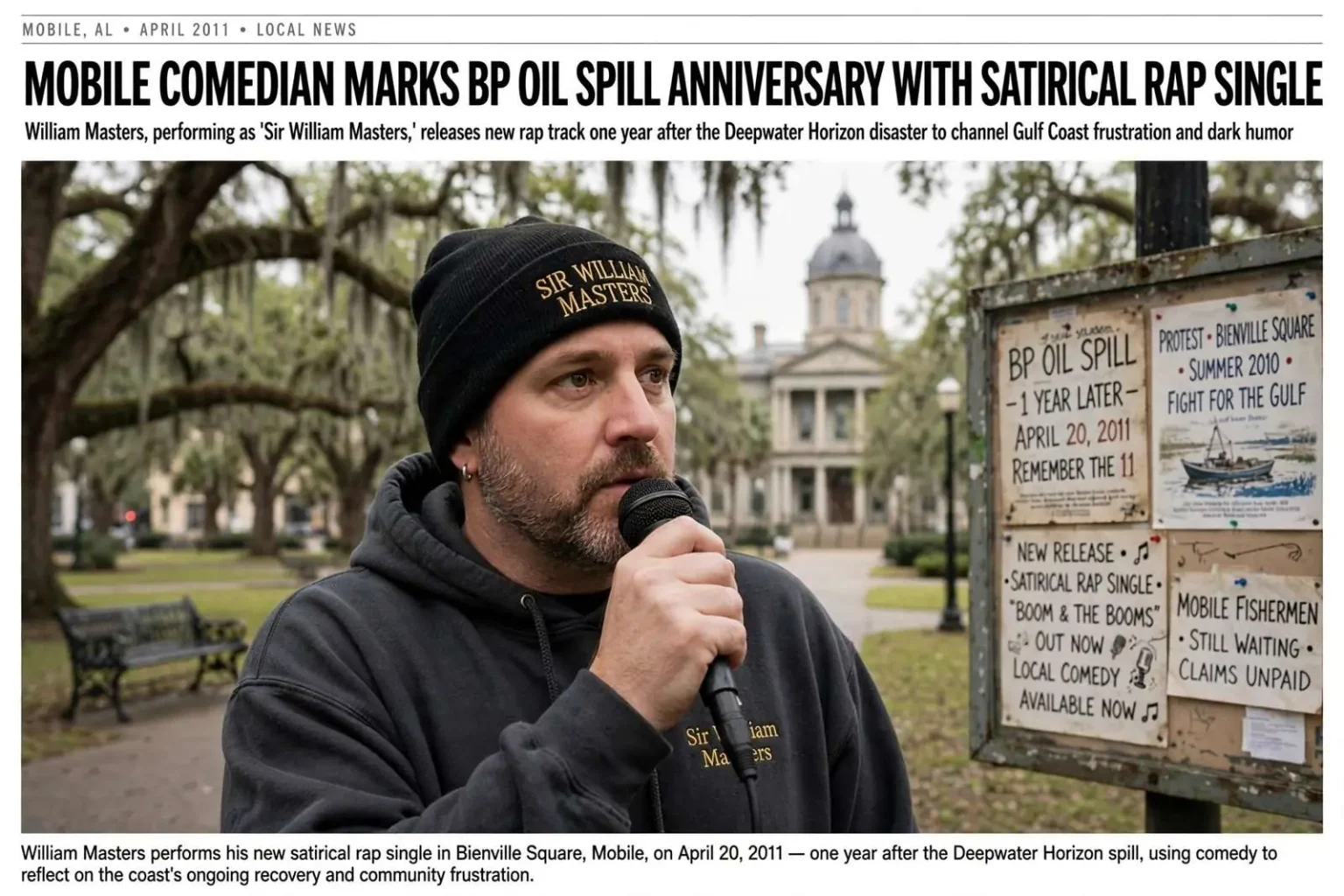
A Mobile-based comedian found a creative way to mark the first anniversary of the nation’s worst offshore oil disaster, releasing a satirical rap single that channeled the frustration and dark humor many Gulf Coast residents felt in the wake of the Deepwater Horizon catastrophe. The single arrived at a moment when the coast was still reckoning with images of oiled marshes and closed fishing grounds, and it gave local audiences a way to laugh at a situation that had offered little else.
William Masters, a local comedian who performs under the stage name Sir William Masters, released the track in April 2011, roughly one year after the explosion aboard the Deepwater Horizon drilling rig killed 11 workers and triggered a massive crude oil gusher in the Gulf of Mexico. Masters had previously covered anti-BP protests held in Mobile’s Bienville Square during the height of the crisis in 2010, making the anniversary single a natural continuation of material he had already been developing for local audiences.
Bienville Square, the downtown Mobile park that hosted the protests, became one of the region’s gathering points during the summer of 2010, when anger at BP ran high across coastal Alabama. Demonstrators there voiced frustration over livelihoods interrupted, beaches threatened and answers delayed. For a comedian covering the scene, the protests supplied both subject matter and an audience already tuned to the emotional register of the disaster, and Masters’ later shift from covering protests to satirizing the whole affair tracked the way many Gulf residents processed the year in between.
A disaster that reshaped the Gulf Coast
The Deepwater Horizon rig, operating on BP’s Macondo Prospect roughly 40 miles off the Louisiana coast, exploded on April 20, 2010. In the three months before the wellhead was capped on July 15, an estimated 4.9 million barrels of crude oil poured into the Gulf of Mexico, making it the largest accidental marine oil spill in the history of the petroleum industry. The scale of the release, and the months it took to stop it, kept the disaster at the center of Gulf Coast life from spring through fall of 2010.
The environmental and economic toll was staggering. Tar balls washed ashore along hundreds of miles of coastline, and by late November 2010, more than 4,200 square miles of Gulf waters had been re-closed to shrimping after contamination was discovered in commercial nets. Along the Louisiana coast alone, more than 320 miles of shoreline were impacted. Wetland marsh grasses were fouled and dying, and researchers found undegraded crude oil on the ocean floor as late as February 2011. Each of those findings kept the spill in the news well after the well itself had been sealed.
South Alabama’s fishing and tourism industries, vital economic engines for communities from Bayou La Batre to Orange Beach, suffered severe disruptions. Skimmer ships, containment booms, and chemical dispersants were deployed across the region in an attempt to limit the damage, while scientists documented massive underwater plumes of dissolved oil and an 80-square-mile dead zone surrounding the blown well. Bayou La Batre, the small boat-building and seafood community south of Mobile, became a recurring image in national coverage, its fleet tied up and its processors waiting on water that no one could certify as clean.
Mobile itself felt the spill’s reach in ways that had nothing to do with oil on its shoreline. The city served as a staging and supply hub for response vessels and cleanup contractors, its port and working waterfront pressed into service for a disaster unfolding offshore. Downtown restaurants and hotels absorbed response workers and journalists through the summer, while residents tracked the spill’s progress through daily briefings and forecasts that determined whether Mobile Bay’s waters would stay open. That proximity to the disaster, even without oiled beaches inside the city limits, is part of why Bienville Square protests drew crowds and why the anniversary resonated a year later.
Orange Beach and Gulf Shores faced a different version of the same problem. The Baldwin County beach towns depend on a summer tourist season, and even where local beaches stayed largely clean, perception of an oil-fouled coast kept visitors away and cancellations high. Rental companies, charter boat captains and restaurateurs spent the season fielding questions about the water rather than booking trips, and the claims process that followed became its own source of frustration for business owners trying to document losses that never stopped accumulating.
Comedy as commentary
Masters’ musical response to the disaster reflected a broader trend along the Gulf Coast, where artists, musicians, and comedians processed the trauma and anger of the spill through creative expression. The satirical approach gave voice to the frustration felt by many coastal residents who watched their livelihoods and environment suffer while BP and federal agencies grappled with the unprecedented cleanup effort. Satire, in that environment, served as a release valve, letting audiences acknowledge anger and absurdity at the same time.
Gulf Coast audiences had a long tradition of turning hard times into material. From hurricane songs to seafood festivals built around recovery, the region’s creative community has repeatedly translated disaster into shared experience, and the oil spill anniversary single fit squarely in that lineage. A satirical rap track about the spill could reach listeners who had stopped reading cleanup reports, and comedy about corporate failures carried a different kind of accountability than a press conference.
The anniversary timing also mattered. By April 2011, the well had been capped for months, but the coast was still living with the aftermath: waters partially closed to shrimping, restoration science just beginning, and claims still being processed. The first anniversary became a natural occasion for reflection across the Gulf, from memorial services for the eleven workers lost on the rig to community events and, in Mobile’s case, a comedian’s musical take on the whole painful year.
The U.S. government ultimately named BP as the responsible party for the disaster, and the company acknowledged mistakes that contributed to the blowout. The lengthy process of environmental restoration and claims settlement would continue for years afterward, reshaping the relationship between the oil industry and Gulf Coast communities. Billions of dollars in penalties and restoration funding eventually flowed back to the Gulf states through settlements negotiated in the years after the spill, money that continues to shape coastal restoration projects in Alabama and its neighboring states.
Mobile’s comedy scene and the spill
For Masters, the BP material sits within a career built on observing Mobile from the inside. Local comedians in mid-sized markets often build their acts around the shared references of their cities, and few references were as universally shared on the Gulf Coast in 2010 and 2011 as the spill. Everyone in the audience had an opinion about the cleanup, the executives and the images on the news, which made the subject both reliable and risky: the material worked only if it matched what people had actually lived through.
The stage name Sir William Masters itself carries the theatrical flourish that defines much of the local comedy scene, where performers move between clubs, festivals and community events across Mobile and Baldwin County. Comedy venues along the Gulf Coast had weathered a difficult stretch during the spill year, as discretionary spending tightened across the region, making a release timed to the disaster’s anniversary both an artistic statement and a bid for an audience ready to laugh again.
The single also documented a specific moment in the coast’s cultural memory. Anniversaries of the spill have since become occasions for measuring recovery: fisheries reopened, tourism campaigns rebuilt, restoration projects funded by settlement money moved from plans to wetlands. A satirical track recorded in April 2011 captured the mood of a coast one year into that journey, still angry, still grieving, and beginning to find its way back to humor.
What the spill left behind
A decade-plus on, the Deepwater Horizon disaster remains the defining environmental event of the modern Gulf. The response effort it triggered, from skimmer fleets to dispersant science to the largest claims process in the region’s history, changed how offshore drilling is regulated and how communities prepare for the next crisis. For south Alabama, the spill also demonstrated both the fragility and the resilience of an economy built on the water, from Bayou La Batre’s shrimp boats to the beaches of Orange Beach.
Artists like Masters play a part in that record that official reports do not. Songs, jokes and performances preserve how a community felt in the moment, complementing the datasets and legal settlements that document what happened. The first-anniversary single from a Mobile comedian belongs to that archive: an artifact of a coast that answered catastrophe with testimony, protest and, eventually, a punchline.
As for the anger that fueled the material, it found its resolution slowly, through the years of restoration funding and the slow rebound of the fishing and tourism industries. But in April 2011, on the disaster’s first anniversary, the mood along the Gulf Coast was still raw, and Masters’ satirical rap single gave Mobile audiences something the cleanup reports never could: the sound of their own frustration, set to a beat.