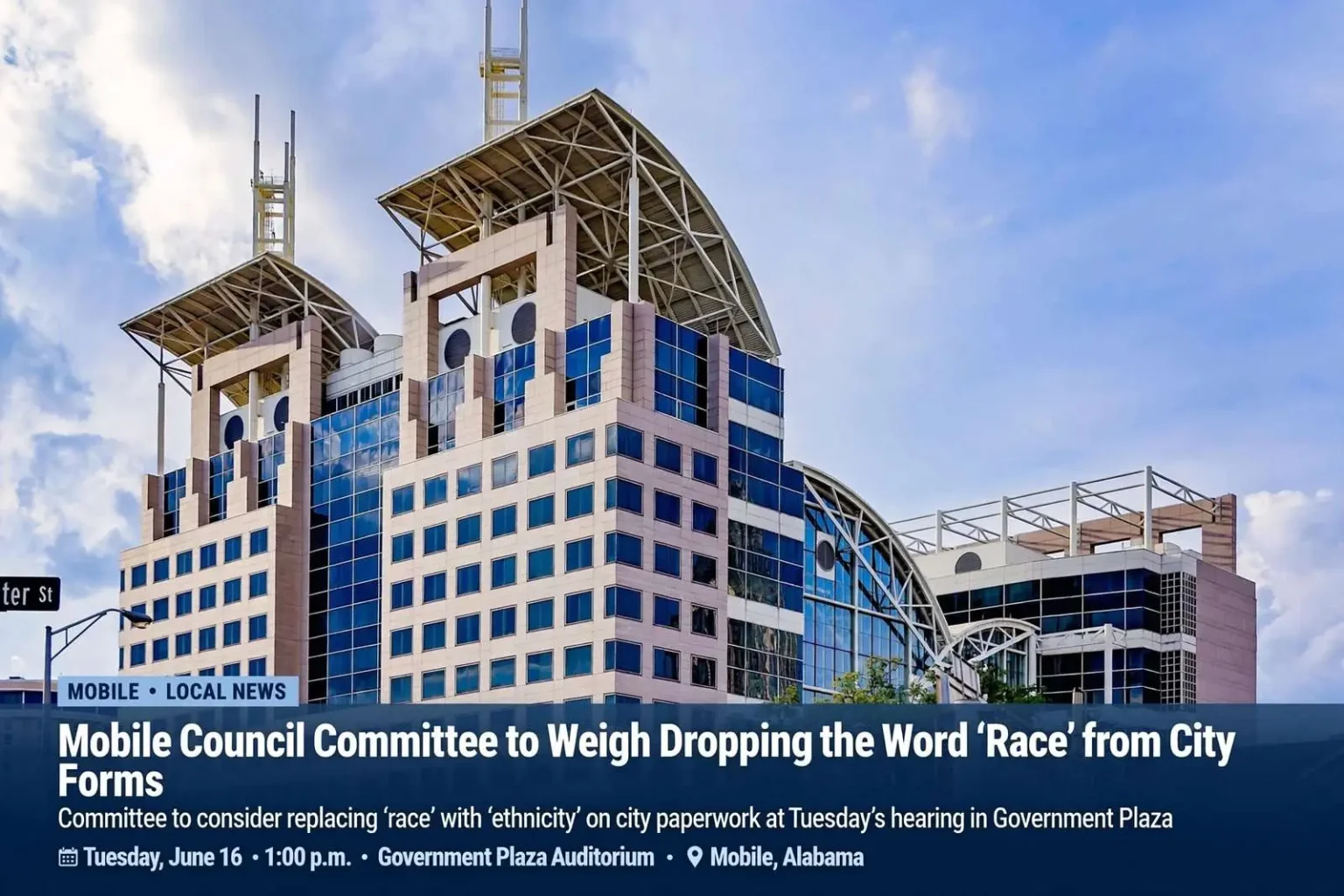
Mobile Council Committee to Weigh Dropping the Word ‘Race’ from City Forms
Councilman Fred Richardson wants Mobile to swap 'race' for 'ethnicity' on city forms; a committee hearing was set at Government Plaza.
A Mobile City Council committee is set to take up a proposal that would scrub the word “race” from the city’s forms and documents, replacing it with “ethnicity” in official paperwork. District 1 Councilman Fred Richardson pitched the idea earlier in the week, arguing that “ethnicity” would be a more accurate and acceptable term on forms that residents fill out when dealing with city government.
The Administrative Services Committee has scheduled a hearing on the measure for Tuesday, June 16 at 1:00 p.m. in the auditorium at Government Plaza. The session is open to the public, and any change the committee endorses would still need to go before the full seven-member council before the city’s paperwork actually changes.
Richardson serves on the Administrative Services Committee alongside Councilwomen Gina Gregory and Bess Rich, giving the three-member panel the first look at the proposal. The committee handles personnel, purchasing, and general administrative matters, which is where questions about the forms the city uses — from job applications to permit paperwork — typically land.
Mobile’s council is made up of seven members, each elected from a single district, with District 1 covering much of the city’s northern neighborhoods. The city has a long history of federal oversight tied to its at-large election structure, which was changed to district-based seats after voting rights litigation decades ago, making questions about how the government categorizes its residents a recurring theme in local politics.
Why the Word Matters
The distinction between “race” and “ethnicity” has been debated for years at the federal level, where the standards that govern data collection treat the two as separate concepts. Under the federal framework used for the census and most government reporting, “ethnicity” is limited to a question about Hispanic or Latino origin, while “race” covers a set of broader categories.
Supporters of Richardson’s approach argue that “ethnicity” better reflects how people identify themselves, blending ancestry, culture, and community rather than sorting people into categories they may not recognize. Critics of such changes typically point to continuity: forms that track race are often tied to federal grant programs, civil rights compliance, and demographic reporting that the city must submit to agencies in Washington.
That tension — between how residents see themselves and what outside agencies require — is likely to surface at Tuesday’s hearing. If the city’s forms feed federal reports, officials will need to determine whether a wording change would disrupt the data the city is obligated to collect and how staff would map responses onto the required categories.
How the Process Works
A change to the city’s standard forms does not happen with a single vote. The proposal will first be discussed in committee, where Richardson, Gregory, and Rich can question city staff about which forms are affected, what the change would cost, and whether outside reporting requirements would be compromised.
If the committee moves the item forward, it goes to the full council, where a majority vote would be needed to direct city departments to revise their documents. Any formal change to city code or policy would follow the council’s standard procedure, including public readings before adoption.
City forms touch a wide range of everyday interactions: applications for city jobs, vendor registrations, permit applications, board and commission appointments, and program sign-ups for everything from summer activities to housing assistance. Each of those documents may collect demographic data for a different reason, and not all of them fall under the same rules.
Employment applications, for example, are typically governed by federal equal employment opportunity requirements, which ask employers to invite applicants to self-identify by race and gender for reporting purposes. Housing and community development programs funded through the federal government carry their own demographic reporting expectations tied to grant dollars.
Because of those overlapping requirements, cities that adjust the wording of demographic questions usually do so carefully, often keeping the underlying data categories intact while changing the labels residents see. Tuesday’s committee hearing is expected to begin sorting out which of Mobile’s documents fall into which category.
The Players at Government Plaza
Richardson has served on the council for decades and is one of its longest-tenured members, known for raising issues that touch on race, representation, and the concerns of his north Mobile district. He has periodically pushed symbolic and practical measures aimed at how city government presents itself to the public.
Gregory and Rich both bring long records on the council as well, with Gregory representing a west Mobile district and Rich having represented areas of the city’s western and southwestern neighborhoods. The committee’s composition means the proposal will be evaluated by members who have handled the city’s administrative machinery — budgets, contracts, personnel policies — for years.
Hearings of the Administrative Services Committee are typically held in the Government Plaza complex downtown, the building that houses both city and county offices. The auditorium setting suggests the committee anticipates public interest, though the hearing itself is a working session rather than a final vote.
What Residents Can Expect
If the committee endorses the change, residents would likely see the new wording roll out gradually as departments reprint forms and update the digital documents posted on the city’s website. Printed stock already in circulation would be used up before replacement, meaning both terms could appear on city paperwork for a transition period.
The cost of such a change is generally modest, since most forms are reprinted on a routine cycle and electronic documents can be updated directly. The larger questions are practical: which forms are covered, how staff record responses for federal reporting, and whether any outside agency sign-off is needed.
Public comment at the committee stage is at the discretion of the chair, and residents who want to weigh in can also contact their district council member directly. Mobile residents can find their district and representative through the city clerk’s office.
The meeting is scheduled for 1:00 p.m. Tuesday, June 16, in the Government Plaza auditorium. Any recommendation that emerges will be forwarded to the full council for action at a later meeting.
The Broader Debate Over Data and Identity
Mobile is far from the first government body to wrestle with the labels on its demographic forms. Other cities and states have debated similar changes in recent years, with some jurisdictions adding write-in options, combining categories, or moving away from older terminology that residents find outdated.
The federal government itself has periodically revised the standards that guide how agencies ask about race and ethnicity. Those standards, last overhauled after a multiyear review in the late 1990s, allow people to select more than one category, a change that recognized the growing number of Americans with mixed heritage and reshaped how demographic data is reported nationwide.
In a city like Mobile — where the population is roughly evenly divided along racial lines and the dynamics of local politics have long tracked questions of representation — the language on official documents carries weight beyond paperwork. Council members have historically been attentive to symbols that signal inclusion or exclusion to different parts of the community.
Richardson’s argument that “ethnicity” is the more accurate term reflects a view held by many scholars and residents that ancestry, culture, and shared history matter more to identity than the older racial classifications. Whether a majority of his colleagues agree — and whether the city’s administrative staff find the change workable — will become clear as the measure moves through the committee process.
The council’s administrative committees meet on a rotating schedule alongside the body’s public safety, public services, and budget panels. Items that clear committee are typically placed on the council’s next regular meeting agenda, which convenes twice monthly at Government Plaza.
For now, the proposal stands as scheduled business for Tuesday afternoon. The outcome of the hearing will determine whether Mobile becomes one of the Alabama cities that has formally retired the word “race” from its paperwork, or whether the idea is refined, delayed, or set aside by the committee.
This story will be updated following Tuesday’s committee hearing.
Background: The Administrative Services Committee
The Administrative Services Committee is one of the standing committees through which the Mobile City Council handles its workload before matters reach the full body. Its portfolio includes the city’s personnel policies, purchasing rules, and internal operations — the day-to-day machinery that determines how departments treat residents, vendors, and employees.
Committee assignments are made by the council president at the start of each term, balancing seniority, district interests, and member expertise. Richardson’s seat on the panel gives him a direct route for bringing administrative proposals like this one forward without needing an outside sponsor.
Items heard in committee rarely arrive as finished legislation. More often, the committee asks staff for information — in this case, likely an inventory of the forms the city uses and the reporting requirements attached to each — before deciding whether to recommend action to the full council.
Residents who follow city government can watch the process unfold in person or through the city’s broadcasts of council and committee meetings. Agendas are published in advance through the city clerk, and minutes of committee actions become part of the public record once approved.
The June 16 hearing marks the first formal step for the proposal. Whatever the committee recommends — approval, further study, or no action — the full council retains the final say over any change to the city’s official documents.