
Mobile Councilmen Struggle to Find Five Votes on New Redistricting Map Ahead of Deadline
Three maps, no five-vote majority: Mobile councilmen raced an Aug. 12 deadline as Stimpson's map loomed as the automatic fallback.
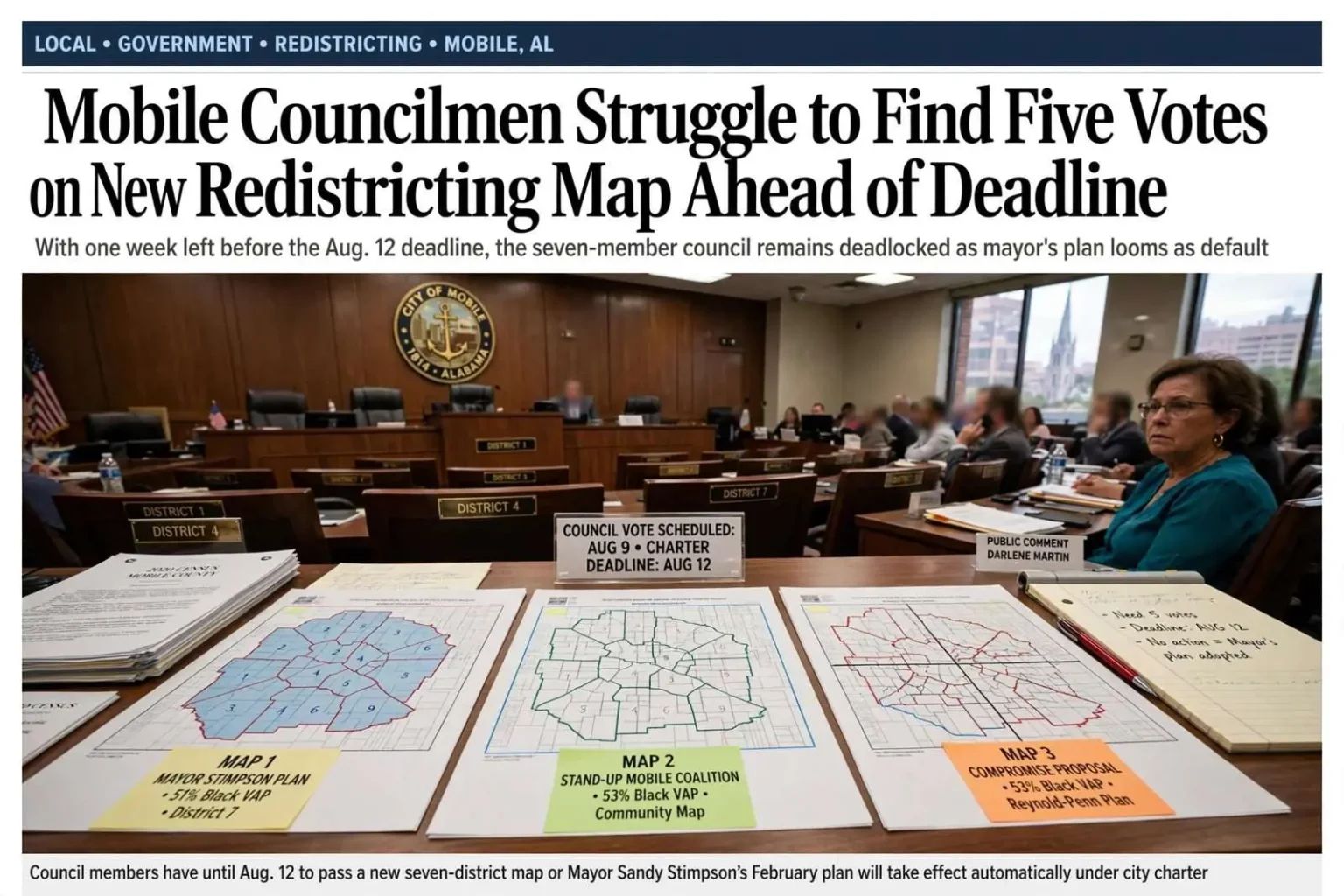
With one week left before the city’s deadline, Mobile City Council members still could not lock down the five votes needed to approve a new redistricting map — and if none passes by August 12, Mayor Sandy Stimpson’s plan takes effect automatically. The deadline is not symbolic: under the city charter, a council that fails to adopt a redrawn district map after each census hands the decision to the mayor’s proposal, whatever the council thinks of it.
Three maps were now before the council, and each had a distinct coalition behind it. The question — how to draw seven council districts for a city that has both grown and shifted since the last census — has split the body along lines of race, neighborhood and political strategy, with the city’s annexation fight looming over every draft.
The first map came from Stimpson in February and would make District 7 the city’s fourth majority-minority district, with close to 51% of its registered voters being Black. The mayor defended it as a collaborative product built from individual meetings with each councilman and public input, meeting all legal requirements. His administration has argued the map complies with the Voting Rights Act and the Constitution as the city’s population lines have shifted westward over the decade.
Community groups and some council members, however, argued the share should be higher, pointing out that 51% of registered voters leaves little room for the district’s Black community to reliably elect the candidate of its choice once turnout, runoff dynamics and district-wide campaigning are accounted for. The difference between 51% and 53% may sound technical; in Mobile’s seventh district, it is the difference between a seat that is competitive and one where a community’s preferred candidate starts with a clear edge.
The coalition’s map
Stand-Up Mobile put forward a second map, raising District 7’s Black voting-age share to 53% without annexation, so the district’s Black community could elect a candidate of its choice. The organization and its allies built the map around the principle that the lines should follow the city’s existing neighborhoods — including areas the city had been contesting in the annexation case — rather than counting new territory before the courts resolved who actually lived inside the city limits.
When that map failed to win a 5-0 majority of the seven-member council, District 4’s Ben Reynolds and District 1’s Cory Penn proposed a third: similar to the community coalition’s 53% target, but shifting certain neighborhoods between districts to bridge Stimpson’s map and Stand-Up Mobile’s. The compromise draft was an attempt to give every faction something — the higher minority share the community groups demanded, and enough of the mayor’s framework to draw support from council members who had backed his version.
Reynolds said consensus around his plan would show the city could move beyond racial division to do what is best for Mobile. The District 4 councilman, whose west-of-I-65 district borders the contested seventh, cast the compromise as a test of whether the council could legislate rather than litigate its way through the once-a-decade process. Co-sponsor William Carroll added that because Mobile is a majority-minority city, residents simply want representation to match population.
Carroll’s point frames the arithmetic that underlies the whole debate: Mobile’s population, per the census, is majority Black and minority combined, and the city’s five existing districts have long concentrated that population into three seats. Redistricting after a decade of westward growth — with white population rising in districts 6 and 7 while older core districts held steady — is what pushed the seventh district into play.
Residents weigh in
Residents weighed in at Tuesday’s meeting as well; one, Darlene Martin, urged passage of the coalition map “with no strings attached” tied to the coming annexation. Her phrasing captured a suspicion that has shadowed the process: that map drawing and the city’s lawsuit over the 2021 annexation vote — in which residents of large unincorporated areas in west Mobile voted to join the city — are being used to influence each other. The annexation, if ultimately upheld, would add tens of thousands of residents and shift every district’s math; mapmakers have fought over whether to count that population at all.
The council chamber’s public comment period has become the season’s recurring civic theater, with pastors, neighborhood association officers and longtime civil-rights figures taking turns at the microphone. The pattern of testimony has been consistent: the community groups want a guaranteed fourth district where Black voters control the outcome, and they want it settled before the annexation question changes the map again.
The council scheduled a vote on the newest map for August 9 — three days before the charter deadline. With five votes needed among seven members, and the mayor’s plan waiting as the automatic default, the arithmetic of the final week leaves little room for abstentions: either the compromise map clears five votes, or the city’s districts for the next decade will be the ones Stimpson drew in February.
The mechanics of the deadline are worth understanding, because they explain the urgency in the chamber. Mobile’s charter requires the council to redraw district boundaries after each federal census, and it puts the mayor’s plan into automatic effect if the council cannot pass its own map by August 12. That structure flips the usual dynamic of city legislation: instead of inaction preserving the status quo, inaction here hands the pen entirely to the administration. Every council member therefore votes knowing that a “no” on the compromise may mean the mayor’s map — the very document some of them object to — becomes law by default.
The legal framework behind the fight is equally technical and just as consequential. Districts must be nearly equal in population, must be contiguous, and must comply with the Voting Rights Act, which prohibits drawing lines that deprive a racial minority community of the ability to elect its preferred candidates. Courts and the Justice Department have applied those rules to cities across the South for decades, and municipalities that guessed wrong have been forced to redraw maps mid-decade at considerable legal expense. Both the mayor’s office and the coalition maps claim compliance; the dispute is over how much margin the law requires.
That is why the number at the center of the debate is voting-age population rather than total population, and why the gap between 51% and 53% matters. Registered-voter and voting-age measures shift with turnout patterns, and a district barely above the majority line can flip in a low-turnout or runoff election. Civil-rights groups in Mobile have argued for a cushion — the 53% figure — precisely because real elections are messier than maps, and because a district that only sometimes elects the community’s candidate does not satisfy the law’s promise.
A district shaped by decades of growth
District 7’s prominence in the dispute is a product of Mobile’s postwar geography. As the city’s population moved west over the past half-century, the Black community’s share of neighborhoods in west Mobile grew with it, and the district that stretches across much of that corridor now sits at the edge of majority status. The 2020 census numbers pushed it over — and made the seventh district the pivot on which the entire map turns: draw it as a fourth minority-opportunity district and the city’s representation matches its population; leave it short and the council’s makeup stays frozen in an earlier decade.
The same growth explains the annexation entanglement. The areas that voted to join the city in 2021 lie along the western edge of the county, adjacent to exactly the neighborhoods District 7 covers, and their tens of thousands of residents would redistribute population across every adjacent district. County and city officials have litigated the election’s validity for years, and the council’s mapmakers have been forced to decide whether to plan for a city that includes the annexed areas or one that does not — with the August 12 deadline refusing to wait for the courts.
The three-map negotiation has also strained relationships inside the council chamber itself. Council members have taken turns defending their preferred drafts in committee, and the weekly meetings have stretched late into the evening as residents parade to the microphone. Behind the scenes, the compromise authors have worked member by member — the same method, notably, that the mayor used to build his February map — looking for the fifth vote that puts a plan over the top.
What happens after August 9 is nearly as consequential as the vote itself. If the compromise passes, the map goes to the mayor’s desk and likely to scrutiny from the same community groups who fought for the higher percentage; if it fails, Stimpson’s map takes effect automatically on the twelfth, and the coalition’s options shrink to litigation or a petition drive to force another vote. Either outcome will shape Mobile’s council elections for the rest of the decade, starting with the next municipal ballot.
For residents, the stakes are concrete: who represents their street, which office fields the call about a pothole or a rezoning, and whether the council’s makeup mirrors the city that elected it. Redistricting happens once every ten years and is invisible until it is not — and Mobile’s fight over three maps, one deadline and one number is the rare moment when the machinery of representation is fully in view.