Mobile County closes government offices after Hurricane Zeta, keeps absentee office open
Mobile County closed Government Plaza, the Plaza Annex and the Courthouse after Hurricane Zeta but kept the Absentee Voting Office open for the ballot.
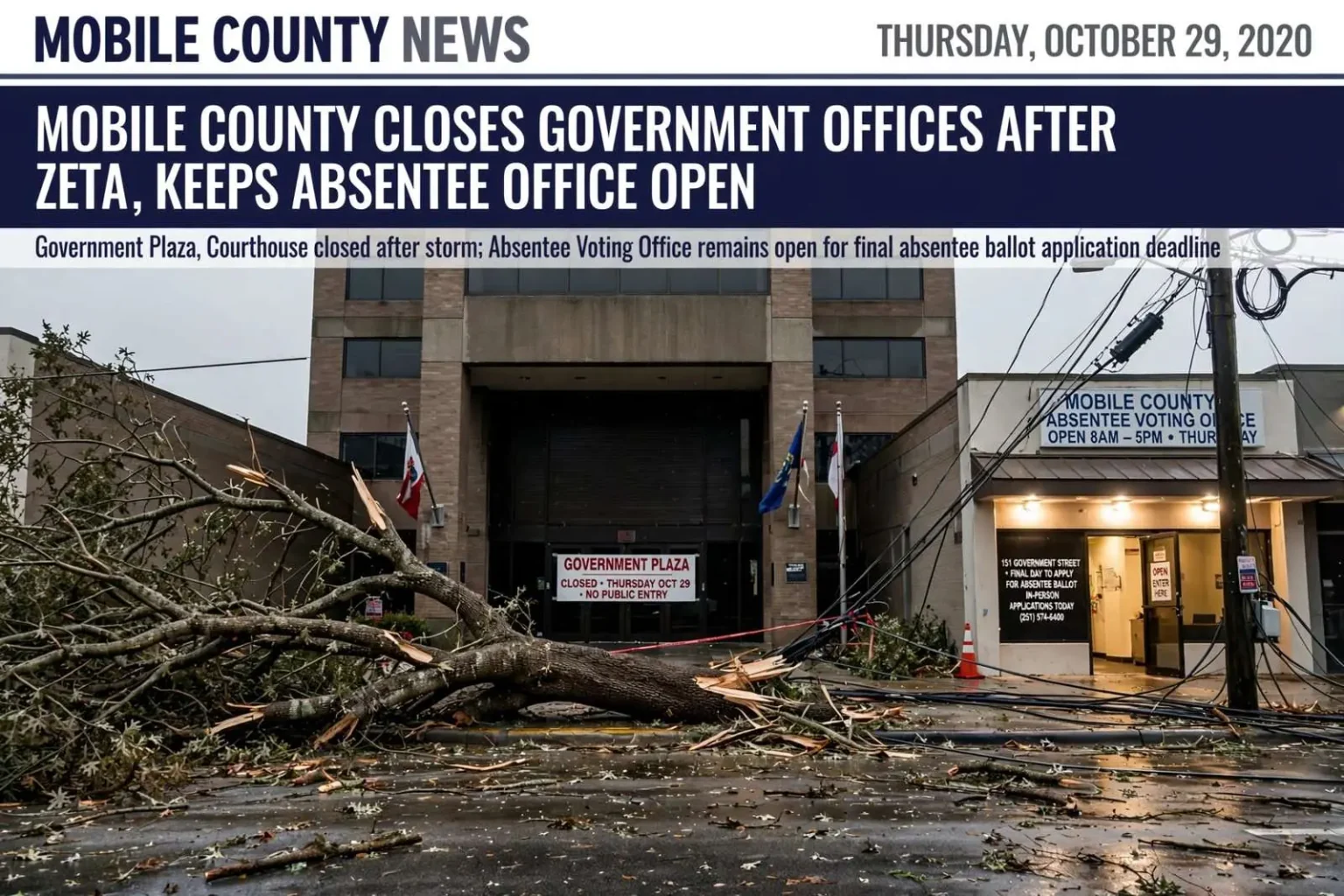
Mobile County shut down its main government buildings the day after Hurricane Zeta swept across the area, but kept one office running on a normal schedule because of a hard election deadline that could not be moved. In an announcement issued the morning after the storm, the Mobile County Commission Office said trees and power lines were down across the county and that work crews were focused on making roads safe and passable.
County offices in Mobile Government Plaza, the Plaza Annex and the Courthouse were closed for Thursday, October 29. The commission said employees were expected to return to their normal work schedules on Friday, October 30. The one-day closure covered the heart of the county’s government operations — the tower that houses the county commission and city offices, the annex that holds additional departments, and the historic courthouse block that anchors the legal district.
The exception was the Mobile County Absentee Voting Office, which remained open from 8 a.m. to 5 p.m. on Thursday. That Thursday was the final day voters could apply for an absentee ballot for the November 3 General Election, leaving the county no room to push the deadline back because of storm damage. The Absentee Voting Office is located at 151 Government Street, within blocks of the closed buildings, and the commission directed questions about in-person absentee voting to the Absentee Election Manager’s Office at (251) 574-6400.
The Storm and the Morning After
Zeta moved through the central Gulf Coast as a hurricane, and Mobile County was among the areas left with widespread tree damage and electrical infrastructure knocked down. The storm came ashore in southeastern Louisiana on the evening of October 28 and rolled northeast across the Gulf Coast, reaching the Mobile area with damaging winds during the night. By daylight, the county’s familiar inventory of century oaks and longleaf pines had left the landscape littered with debris, and thousands of residents were without power.
Crews worked to clear roadways before normal traffic resumed, and county officials said updates on Mobile County’s operating status would be posted to the county’s Facebook and Twitter accounts under the handle MobileCountyAL. The social media channel became the primary notification system for a county workforce spread across more than a thousand square miles — employees waking up to dark traffic signals and blocked roads needed to know whether to stay home, and the commission’s morning announcement served exactly that purpose.
Post-storm closures of courthouse and administrative buildings are standard practice when power is unreliable and debris blocks access, both to keep employees off compromised roads and to free crews to work without commuter traffic. Government plazas double as gathering points and staging areas in the first hours after a storm, and clearing the buildings gives emergency managers flexibility they would not have with a working bureaucracy in place.
An Election Deadline That Would Not Bend
The overlap with an election deadline made the timing unusually awkward for Mobile County, which had to staff a single downtown office while the rest of the government complex sat dark. Alabama’s absentee voting law sets firm windows: applications must be received by the absentee election manager no later than five business days before the election, and no weather event short of an emergency order extends them. The November 3 election — a presidential general election with one of the highest turnouts in state history anticipated — made the Thursday deadline the last realistic chance for many voters to apply.
Absentee voting in Alabama requires a reason, a list that includes being out of the county on election day, illness, work obligations and a handful of other qualifying circumstances, and the application must be signed, witnessed or notarized, and hand-delivered or mailed. Voters planning to apply in person could not simply restart the process next week; the office’s storm-day hours were the difference between voting and not voting for anyone whose paperwork was still pending.
For the absentee office’s staff, the assignment meant navigating the same blocked roads and downed lines their colleagues were told to avoid — with the county’s election calendar as the reason. Election officials across the Gulf Coast had spent 2020 adapting to a pandemic, expanded mail-in interest and a compressed civic calendar; a hurricane five days before a presidential election was simply the next complication in a year that had already rewritten the rules of running an election.
What Comes Back First
The commission’s expectation that employees return Friday, October 30 reflected the county’s rapid-damage assessment in the hours after the storm. Zeta’s fast forward motion — the storm did not linger, but its winds covered a wide swath — meant the cleanup would be measured in days rather than weeks for most of the county, with power restoration and debris removal proceeding on parallel tracks. Courthouse functions that could not wait, including emergency filings and law enforcement operations, continued through arrangements that county departments maintain for storm situations.
Residents with county business that could wait a day were urged to do so, and the county’s online services — property records, tag renewals, payment portals — remained available throughout the closure for anyone with power and connectivity. For those without, the message from the commission was straightforward: the buildings would reopen Friday, the absentee office was open now, and the county’s storm updates would keep coming on MobileCountyAL.
The episode was a small demonstration of how a hurricane tests a county government’s priorities in a single morning. Roads first, employees second, elections always. Mobile County’s answer to Zeta was to close everything except the one office whose deadline the storm could not move — and to tell everyone, through the channels still working, exactly when the rest of it would be back.
Zeta’s path across the central Gulf Coast was the defining storm event of a record-breaking 2020 hurricane season, which had exhausted the National Hurricane Center’s prepared list of names and moved on to the Greek alphabet by late October. The storm intensified rapidly in the central Gulf before landfall, catching some coastal residents who had planned for a weaker system, and its northeast track put metropolitan Mobile squarely in the wind field. County emergency management officials spent the overnight hours taking damage reports while the storm’s backside was still moving through.
The damage pattern Zeta left behind was characteristic of a fast-moving system: widespread tree damage and power line failures rather than catastrophic wind speeds at any single point. For Mobile County, home to one of the densest urban tree canopies on the Gulf Coast, that combination is the familiar one — massive oaks coming down across arterials and neighborhood streets alike, taking power lines with them and leaving crews with months of removal work compressed into days of emergency clearing.
The absentee office’s storm-day service also spotlighted a piece of county government most residents encounter only in election years. The Absentee Election Manager’s Office handles every mailed and in-person absentee ballot in the county, from application through counting, and its staff of permanent professionals swells with temporary workers in general election seasons. Its location at 151 Government Street puts it in the middle of the downtown government district, close enough to Government Plaza that voters could park once and serve both errands on a normal day — and close enough that the closed buildings’ dark windows framed the one lit office on the block.
Alabama’s November 3, 2020 general election proceeded without extension of the absentee deadline despite the storm, and election officials urged voters who had missed the application window to plan for in-person voting on election day. The episode entered the lengthening list of 2020’s election-logistics complications — a year in which elections officials nationwide had become practiced at adapting to circumstances no manual anticipated.
For county employees, the Thursday off was a working day for many of them anyway: sheriff’s deputies, road crews, EMA staff and emergency responders were on the job throughout the closure, and administrative staff returning Friday faced the accumulated backlog of a day away. County government in a hurricane state builds that rhythm into its calendar — the plan for closing is written long before the storm that requires it, and the reopening is just the next step in the recovery.
The commission’s communication through MobileCountyAL reflected a broader shift in how Gulf Coast local governments handle storm messaging. Radio and television remain part of the mix, but social media channels now carry the operational details — which buildings are closed, which offices are open, when crews expect roads clear — because they update in minutes and reach residents wherever they have signal. In a county where a third of households had lost power that morning, the message that the government was closed but the elections office was open cut through exactly as intended.