
Mobile County Elementary Teacher Dies After Battle With COVID-19
MCPSS says Dodge Elementary teacher Misty McKee has died after weeks battling COVID-19, including time in a medically induced coma.
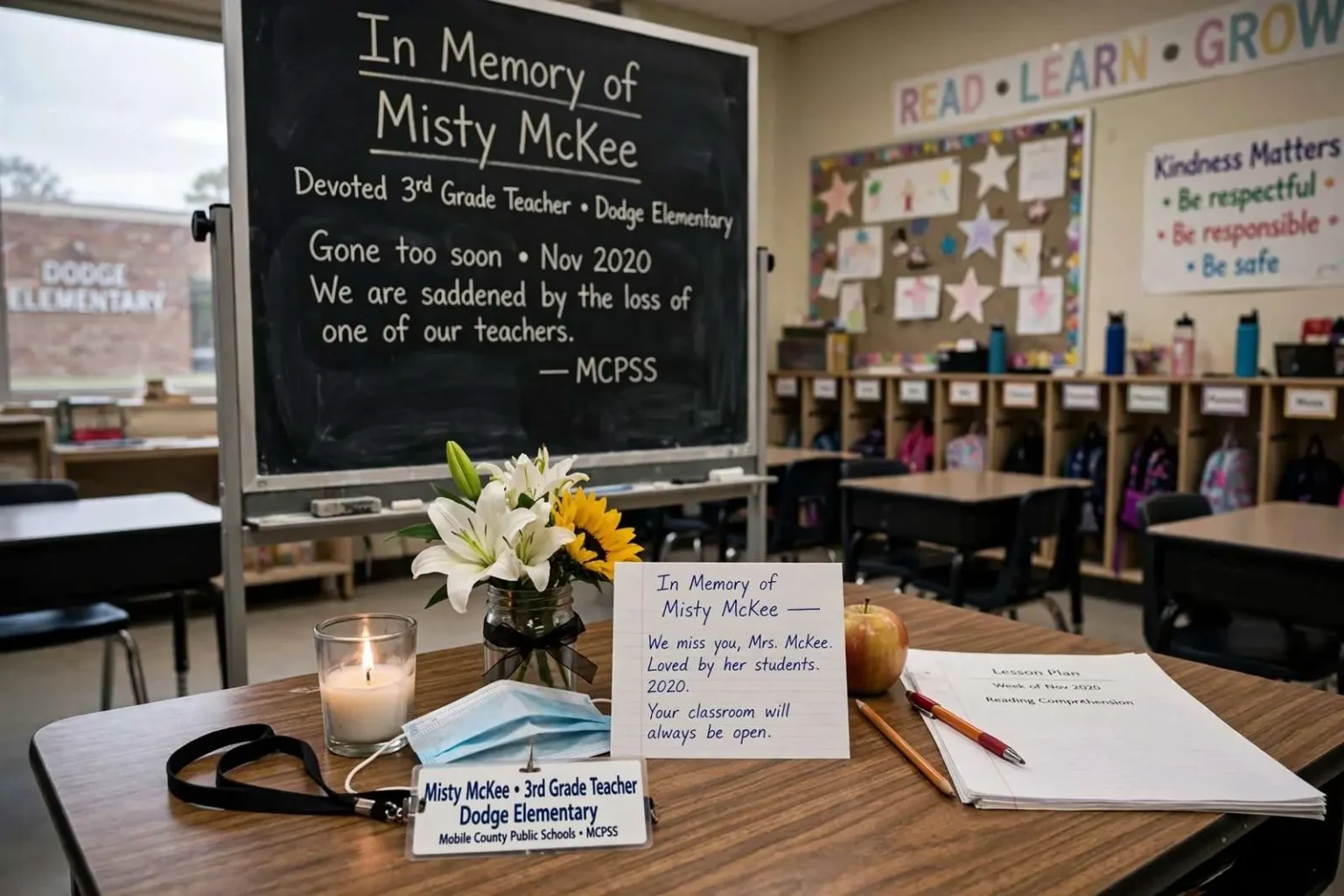
A Dodge Elementary School teacher who spent weeks fighting COVID-19 has died, according to Mobile County Public Schools. Misty McKee was placed in a medically induced coma last month as she battled the illness. A friend said McKee initially believed she was suffering from a sinus infection before testing positive for the coronavirus. In a statement, the school system mourned the loss. “We are saddened by the loss of one of our teachers, Misty McKee,” MCPSS said. “She was well loved by her students and her fellow teachers. Our thoughts are with her family and with Dodge Elementary during this difficult time.”
McKee’s death arrived during the most difficult stretch yet of the pandemic for south Alabama’s schools. COVID-19 cases had surged across Mobile County in the preceding weeks, driven by the wave of infections that swept the Gulf Coast as students returned to campuses under evolving reopening plans. The Mobile County Public School System, the largest school district in Alabama with roughly 58,000 students and more than 7,500 employees spread across some 90 schools, had spent the summer and fall of 2020 juggling remote learning, in-person instruction and quarantine protocols — while teachers like McKee worked in classrooms under rules that changed month to month.
The details of her illness traced a pattern that doctors would come to recognize across thousands of similar cases. What a friend described as what seemed like a sinus infection — congestion, pressure, fatigue — turned into a positive coronavirus test, then a rapid deterioration that landed her in the hospital. When COVID-19 patients struggle to maintain oxygen levels on standard support, physicians sometimes place them in a medically induced coma and onto mechanical ventilation, sedating them so the body can be given rest while machines do the work of breathing. McKee spent weeks in that condition, and her story spread through the Mobile community as friends, fellow teachers and parents shared updates and organized prayers for her recovery.
Dodge Elementary and the Community Around It
Dodge Elementary School serves families in west Mobile, one of the dozens of elementary campuses that anchor neighborhoods across Alabama’s largest district. Elementary schools occupy a particular place in community life: teachers there spend full days with the same group of children, building the reading foundations, classroom habits and small daily rituals that young families remember for years. In a typical year, a Dodge teacher knows not just her students but their siblings, their grandparents at pickup lines, and which families need extra help when the holidays arrive. When a teacher in that setting becomes seriously ill, the entire school community feels it — children ask questions at home, parents message one another, and staff absorb the fear quietly while keeping classrooms running.
The district’s statement reflected that closeness. School leaders said McKee was well loved by her students and her fellow teachers — a phrase that, in school community terms, describes the colleague who covers lunch duties without being asked, who keeps candy in a desk drawer, and whose classroom door stays open. In the weeks that followed her hospitalization, staff at Dodge and across the district shared her story on social media, where posts about her condition drew thousands of reactions and comments from people who had never met her but recognized the situation: a teacher, sick with the virus that had reshaped every school year, fighting for her life in a Mobile hospital.
Her death added a name and a face to the pandemic’s toll on Alabama educators. Teachers across the state had continued reporting to campuses throughout the fall of 2020, some in districts offering only remote options and many, like Mobile County’s, operating hybrid or in-person schedules with masks, distancing and constant screening. Educators’ groups had pressed for protections and priority for school staff, and each reported death of a teacher rippled through Facebook groups and union chapters where educators tracked the risks they faced every day.
COVID-19’s Toll on Mobile County During the Pandemic
By the period of McKee’s hospitalization, Mobile County had become one of Alabama’s hardest-hit areas. The county recorded tens of thousands of confirmed cases during the pandemic, with hospital systems — including USA Health University Hospital, Providence Hospital and Springhill Medical Center — cycling through surges that stretched intensive care capacity. Rural counties along the region faced similar pressure with fewer resources, and health officers repeatedly urged residents toward masking, distancing and, once available, vaccination. The virus’s trajectory in south Alabama followed national patterns: spring surges, a summer peak, a fall resurgence and then the devastating winter wave that followed the holiday season of 2020.
Schools sat at the center of the public health debate throughout. Mobile County’s system moved between remote and in-person models as case numbers shifted, implemented quarantine protocols that sent entire classrooms home, and eventually navigated the arrival of vaccines, which educators received in early priority groups after the initial rollout. Teachers taught through masks and plexiglass, ate lunch in shifts, and learned to read emotions over eyes above a face covering. Through it all, the risk was never abstract — it was a colleague on a ventilator, a friend telling coworkers about a positive test, a family arranging childcare during a quarantine.
Remembering an Educator’s Contribution
When a teacher dies, the grief in a school community takes forms outsiders rarely see. Elementary classrooms carry routines built around a particular person — the morning greeting, the read-aloud voice, the way a teacher calms a frightened child — and those absences are felt in small moments across every school day. Districts typically respond with counseling support for students and staff, guidance for parents on talking with children about loss, and memorial gestures that give the school community a way to grieve together. For colleagues, the loss is compounded by the environment in which it happened: teachers who had spent months worrying about their own exposure now mourned a friend who caught the virus doing the work they shared.
The pandemic reshaped Alabama’s education workforce in ways still being measured. Teachers retired early, changed careers or moved to districts with remote options, and schools across the Gulf Coast continue to work through staffing shortages that trace their acceleration to the pandemic years. Stories like McKee’s are part of why. Teaching was already a demanding profession before a novel virus made every classroom a potential exposure site; the educators who stayed did so while carrying both the academic catch-up their students needed and the quiet awareness that the job now carried a risk it never had before.
The loss of Misty McKee remains one of the human stories inside those statistics. She was a teacher who thought she had a sinus infection and went about her life; weeks later, she was gone. The district’s message — that she was well loved, and that the thoughts of the entire system were with her family and with Dodge Elementary — was the kind of statement no school system wants to compose. For the students she taught, the colleagues who knew her, and the wider Mobile community that followed her fight, her death stands as a reminder of what the pandemic cost in classrooms like hers, one teacher, one school, one community at a time.
How COVID-19 Attacks the Body
The course of McKee’s illness — mild early symptoms, then a sudden collapse — matched the clinical picture that made COVID-19 so dangerous in its first years. The virus enters through the respiratory tract and, in severe cases, triggers an immune overreaction that floods the lungs with inflammation and fluid. Patients can feel moderately ill for days while oxygen levels quietly fall, a phenomenon doctors called “silent hypoxia,” and then deteriorate within hours. That progression is why hospitals urged people with COVID-19 to watch for shortness of breath and low oxygen readings, and why many families first understood the seriousness of a case only when an ambulance was already on the way.
Intensive care teams across Mobile and the nation developed treatment protocols in real time during 2020, learning as they went which interventions helped: prone positioning, which has patients lie on their stomachs to open lung tissue; steroids and antiviral therapies as evidence emerged; and careful ventilation strategies that minimized lung damage. A medically induced coma, like the one McKee endured, is among the most serious steps in that sequence, reserved for patients whose lungs cannot sustain them while awake. Weeks on a ventilator take a toll even on survivors, and families keep vigil through it all with limited visits, phone calls and updates delivered by masked care teams.
The risk profile of the disease also put middle-aged adults like McKee squarely in harm’s way. While older Alabamians suffered the highest death rates, a substantial share of severe cases and deaths fell on people in their 30s, 40s and 50s — the same age range that staffs the state’s classrooms, drives its ambulances and runs its small businesses. Underlying conditions such as asthma, diabetes, obesity and hypertension raised the odds of severe disease, but doctors repeatedly emphasized that previously healthy adults were also hospitalized and dying. That unpredictability was part of what made the pandemic so psychologically punishing for workers who could not stay home.
The School Year That Changed Everything
The 2020-2021 school year that framed McKee’s illness was unlike any in the history of the Mobile County system. The district’s reopening plans shifted with infection data, offering families remote options and reconfiguring campuses with staggered schedules, redesigned classrooms and new cleaning regimens. Teachers became improvisers overnight — converting lessons for simultaneous in-person and virtual audiences, mailing packets home, and troubleshooting Chromebooks for families without reliable internet across the county’s sprawling geography, from inner-city Mobile neighborhoods to rural communities near the Mississippi line.
Elementary teachers faced the steepest challenge of all. Young children learn through proximity and touch — teachers kneeling beside desks, guiding pencils, wiping tears — and pandemic rules stripped most of that away. Educators rewired their craft on the fly, and many did it while separated from their own children, who were learning remotely elsewhere. The exhaustion of that year was documented in surveys showing historic levels of teacher stress, and it is the backdrop against which McKee’s death hit her colleagues: people already stretched to their limits lost one of their own to the disease they had been guarding against since August.
McKee’s name joined a growing list of Alabama educators lost to the pandemic, a list that education organizations compiled with a heavy recognition that the count would grow before vaccines arrived. In the years since, the story of that period has often been told in percentages and policy debates, but the school communities that lived it remember specific classrooms, specific laughs, and specific losses. At Dodge Elementary, Misty McKee was not a statistic; she was a teacher her students loved and her coworkers trusted, and the statement her district issued — promising that the thoughts of nearly 8,000 employees were with her family — measured in institutional terms what her community felt in personal ones.