Mobile County sheriff’s deputy shoots suspect during Chunchula domestic call
A Mobile County sheriff’s deputy shot and killed a suspect during a domestic call in Chunchula. The Mobile County DA’s Office will review the investigation.
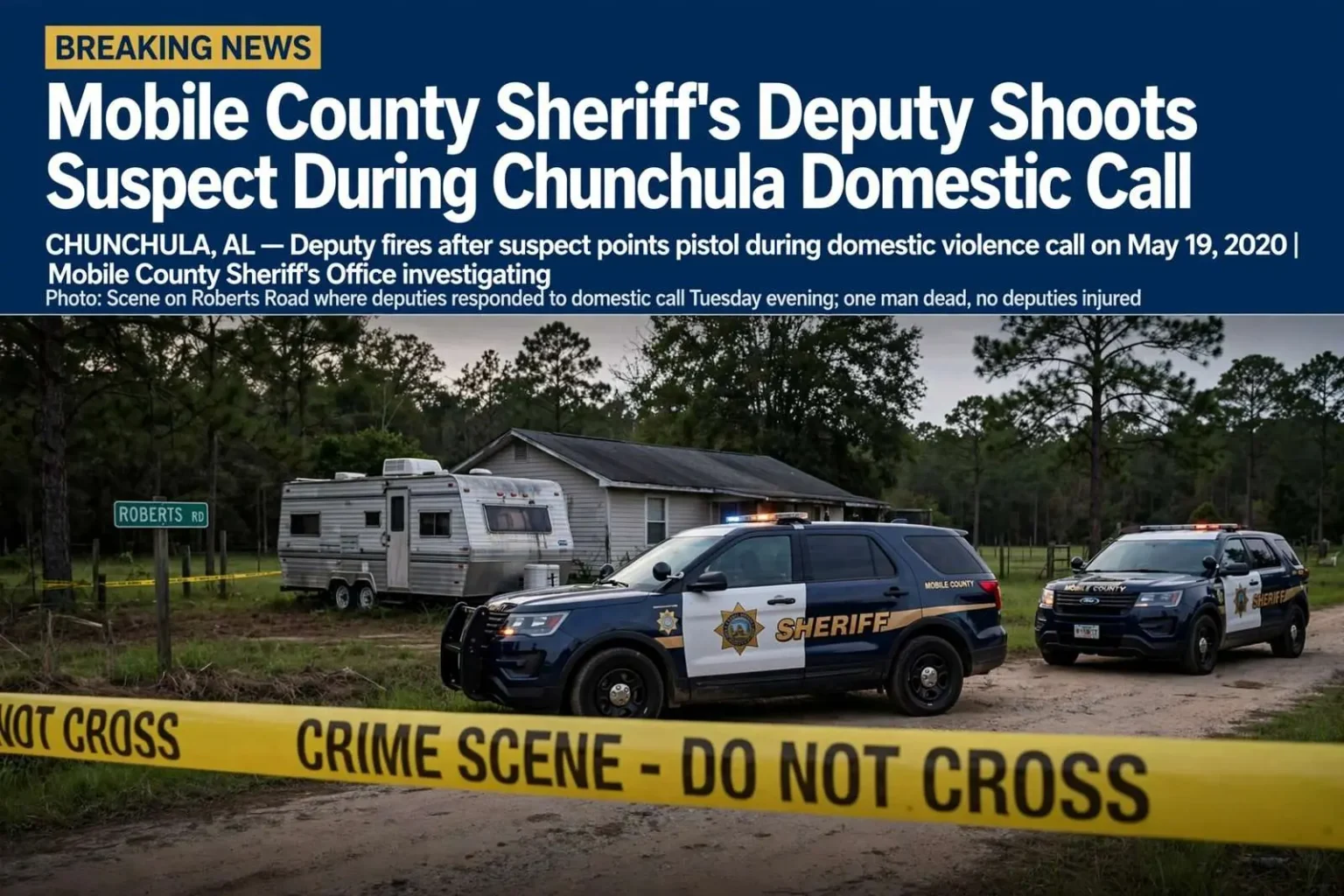
CHUNCHULA, Ala. — A Mobile County sheriff’s deputy shot and killed a man Tuesday evening after responding to a domestic violence call in Chunchula, according to the Mobile County Sheriff’s Office. Deputies were called around 5:15 p.m. on May 19, 2020, to 12500 Roberts Road, where 32-year-old Levi Morse was reported to have assaulted his parents, the sheriff’s office said.
After the assault, Morse retreated to a camper trailer on the same property. When deputies approached and ordered him to come out, Morse refused and pointed a pistol at them, authorities said. A deputy fired a single shot, striking Morse in the upper torso. He was pronounced dead at the scene. No deputies were injured.
What deputies encountered on Roberts Road
The call drew deputies to a rural stretch of Roberts Road in Chunchula, an unincorporated community in northern Mobile County where properties sit on acreage and law enforcement response depends on the sheriff’s office rather than a municipal department. Dispatchers relayed a report that Morse had assaulted his parents at the home, and by the time deputies arrived he had withdrawn to the camper trailer behind the residence — a structure close enough to the house that any approach placed officers in open view of the trailer’s door and windows.
Deputies issued commands for Morse to come out of the camper. According to the sheriff’s office account, he refused and instead pointed a pistol at the deputies gathered outside. A single shot was fired, striking Morse in the upper torso. Deputies and emergency responders could not revive him, and he was pronounced dead at the scene. The parents who had been assaulted in the initial report survived the evening; the sheriff’s office did not describe their injuries in detail.
A history the department already knew
Capt. Paul Burch of the Mobile County Sheriff’s Office said Morse had a history of domestic violence and that deputies had previously been called to the property. Burch said Morse had prior arrests for domestic violence, resisting arrest and theft of property — a record that meant the deputies driving out to Roberts Road that evening were not approaching the address cold.
Repeat domestic calls are among the most dangerous assignments in rural law enforcement. In unincorporated Mobile County, the sheriff’s office covers vast territories with limited patrol staffing, and deputies responding to a familiar address know the calls tend to escalate over time. Statistics kept by law enforcement agencies nationwide consistently identify domestic disturbance responses as among the highest-risk calls an officer can take, precisely because the parties are emotionally invested, weapons are often present and the encounter happens inside or near a home. In this case the risk materialized when a man with a documented history of violence armed himself inside a structure and aimed a firearm at deputies who had no cover between themselves and the trailer.
The deputy who fired
The sheriff’s office said the deputy who fired the shot is a 40-year veteran of law enforcement who has spent 14 years with the Mobile County Sheriff’s Office and previously worked for the Mobile Police Department. That career span means the deputy’s service predates both his Mobile County tenure and much of the modern reform era in American policing, and it places him among the most experienced officers on the force. The department did not release the deputy’s name, and he will presumably remain in a standard administrative status while the investigation proceeds.
Under standard procedure in deputy-involved shootings, the deputy involved is typically placed on paid administrative leave pending the outcome of the investigation, and the agency conducts an internal review of the response separate from the criminal investigation of the shooting itself. The sheriff’s office did not announce disciplinary measures, and none would be expected until the investigative file is complete and reviewed.
How the case will be reviewed
The sheriff’s office said the case is being investigated by its Major Crimes Unit and that the complete investigation will be turned over to the Mobile County District Attorney’s Office. District Attorney Ashley Rich said the investigation is ongoing. That handoff is the standard path for officer-involved shootings in Alabama: the investigating agency assembles the evidence — scene photographs, ballistics, witness statements from deputies and civilians, and the autopsy from the Alabama Department of Forensic Sciences — and the district attorney then reviews the file to determine whether the use of deadly force was legally justified under state law.
An Alabama law enforcement officer is justified in using deadly force when he or she reasonably believes it necessary to protect himself or another person from death or serious physical injury. A determination that the shooting was justified typically ends the criminal inquiry, though the district attorney may also present the case to a grand jury. The review can take weeks or months, and the sheriff’s office committed to delivering the full file rather than a summary.
Chunchula and rural policing in north Mobile County
Chunchula sits in the rural northern reaches of Mobile County, an unincorporated community along U.S. 45 north of Prichard and Chickasaw. Because it has no police force of its own, the Mobile County Sheriff’s Office provides all law enforcement, backed by volunteer fire departments and county emergency services. Response distances are long, properties are spread out, and deputies regularly handle calls involving firearms in areas where shooting is a part of rural life. The camper trailer where Tuesday’s encounter ended is a fixture of such properties, often serving as extra living space or storage a short walk from the main house.
The geography of the call mattered operationally. With no city backup units nearby, the deputies on Roberts Road managed the encounter largely on their own, and the distance to hospitals in downtown Mobile or Saraland shaped the reality that Morse was pronounced dead at the scene rather than transported. Rural calls offer no crowd of witnesses and little cover — the deputies and the armed man in the trailer faced each other across open ground.
The domestic violence pattern
The case follows a pattern that domestic violence advocates and law enforcement researchers have documented for decades: repeated calls to the same address, escalating behavior, prior arrests, and a fatal ending. Prior domestic violence arrests in Morse’s record meant the county had already engaged with the family through its courts and deputies, and each prior call is, in hindsight, an intervention point that did not stop the escalation. Mobile County’s court system offers protective orders, batterer intervention programs and specialized handling of domestic cases, but those tools depend on victims pursuing them and defendants complying — neither of which can be forced from outside the household.
For the family on Roberts Road, the outcome means the parents who were assaulted Tuesday lost a son the same evening. For the sheriff’s office, the case adds to the agency’s record of deputy-involved shootings, each of which draws the same sequence: a Major Crimes investigation, a district attorney review, and a public accounting of the evidence. The Major Crimes Unit is expected to gather statements from every deputy on the scene, preserve all physical evidence for independent review, and document the scene before the property is returned to the family, a process that typically keeps an investigation of this kind active for several weeks. The sheriff’s office said it will release more information as the investigation permits, and the complete file will move to the Mobile County District Attorney’s Office once the Major Crimes Unit finishes its work — the process that will ultimately determine whether the single shot fired on Roberts Road was, in the eyes of the law, justified.
Deputy-involved shootings are investigated with a level of scrutiny that ordinary cases never receive, and the Mobile County Sheriff’s Office has handled past incidents with the same two-track approach announced here: an internal administrative review running alongside the criminal investigation, with the criminal file ultimately leaving the agency’s hands entirely. The Major Crimes Unit’s work on Roberts Road will include canvassing for any witnesses beyond the family, documenting the scene inside and around the camper trailer, recovering the pistol Morse pointed and tracing its ownership, and obtaining the formal autopsy. Deputies’ body-worn camera footage, if any exists from the call, becomes central evidence in the review.
The district attorney’s findings will be a matter of public record, and past reviews of this kind in Mobile County have concluded with detailed public statements walking through the evidence when the use of force is deemed justified. Whatever the outcome, the sequence that ended on Roberts Road — a domestic assault report, a refusal to surrender, a firearm aimed at officers — will be reconstructed step by step before any official judgment is reached, and the sheriff’s office has said it will await that process before commenting further on the deputy’s actions.