
Mobile County’s Bryant Career Technical Center Hands High Schoolers a Head Start on Skilled Trades
Mobile County's Bryant Career Technical Center offers 12 trade programs, with grads landing jobs at Airbus and Alabama Power right out of high school.
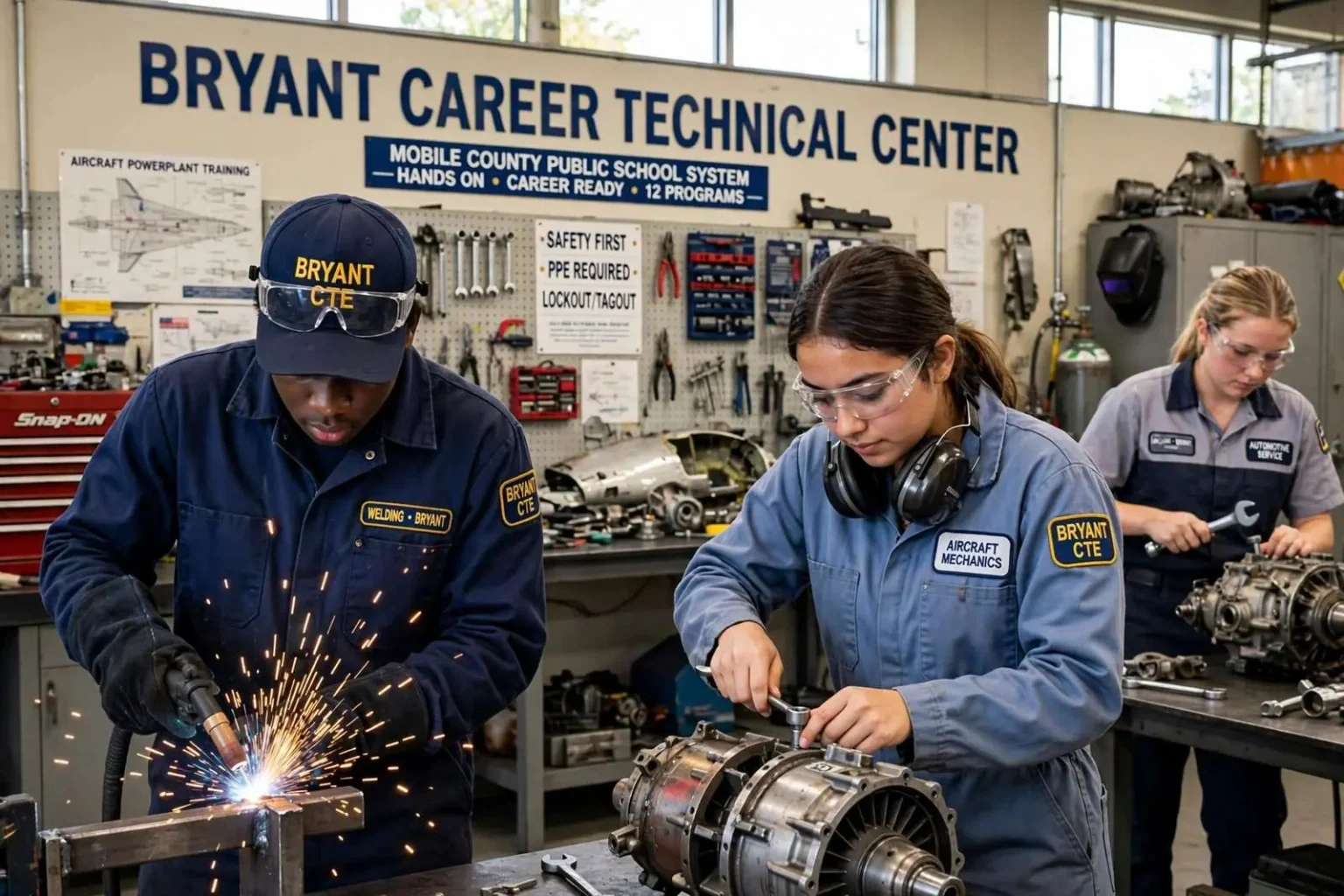
Not every high school student is headed to a four-year campus, and one Mobile County school is making sure that path doesn’t leave them behind. The Bryant Career Technical Center trains students in hands-on trades while they’re still working toward their diplomas.
The center operates as part of the Mobile County Public School System, giving high schoolers from across the district access to professional-grade training most comprehensive campuses cannot offer on their own. Students split their time between home high schools and the career center, graduating with both a diploma and a marketable skill set built in shop classrooms that look less like school and more like the worksites they are preparing to join.
That model reflects a broader shift in Alabama education. Career and technical education has moved from an afterthought to a priority as state leaders, employers and school systems confront a labor market where skilled trades vacancies outnumber qualified applicants, and where the earnings gap between credentialed tradespeople and many bachelor’s degree holders has narrowed or closed entirely.
Twelve Programs, From Welding to Aircraft Mechanics
The center runs 12 career programs covering fields such as welding, cosmetology, automotive service, and aircraft mechanics. Principal Bill Meredith puts the mission plainly: walking across the graduation stage without a marketable skill makes it hard to earn a living, and the center’s daily focus is answering what a student can actually do that an employer will pay for.
The program list is a cross-section of the Gulf Coast economy. Welding feeds the region’s shipyards, fabrication shops and industrial contractors. Aircraft mechanics align directly with Mobile’s rise as an aviation manufacturing city. Automotive service supports the transportation sector every community depends on, and cosmetology offers a licensed trade with immediate employment prospects and an entrepreneurial path for graduates who eventually build their own client bases.
Instruction in programs like these follows industry standards rather than classroom abstractions. Students work with the tools, equipment and safety practices used on real job sites, and many of the center’s courses connect to certification exams that employers recognize statewide. By the time students complete a program, they have handled the same machines and passed the same benchmarks as entry-level workers in their fields.
For families weighing the cost of education, the economics are straightforward. Students who train at the career center do so as part of their free public high school education, graduating without the tuition debt that often accompanies private trade schools — and entering the workforce years ahead of peers who discover their career interests after high school.
Employers Are Calling First
The results speak through graduates’ paychecks. Meredith said students have landed jobs straight out of high school with major employers including Airbus and Alabama Power, and he described employers regularly contacting the school looking to hire its students as demand for skilled workers stays hot across the Mobile area.
That demand is no accident of the business cycle. Mobile’s economy is stacked with industries that hire skilled trades: the Airbus final assembly line and its supplier network, shipbuilding and repair yards along the Mobile River, chemical and industrial plants along the corridor, and the construction booms that follow each major announcement. Every one of those employers needs welders, mechanics, electricians and technicians — and needs them in numbers the local labor market has struggled to supply.
When employers reach out to a school before students even graduate, the usual hiring funnel runs in reverse. Companies that once waited for applicants now court them, and career tech programs with strong industry reputations find their seniors booked before spring. For students, that leverage translates into starting wages, benefits and advancement ladders that were uncommon for 18-year-olds a generation ago.
The scale of the pipeline is significant. Last spring, 280 Mobile County students completed the program. Across the district, the Class of 2022 earned roughly 7,500 career credentials — certifications that give graduates a running start in the workforce the moment they leave high school.
Those credentials matter to employers because they verify skill. Industry-recognized certifications in fields like welding, automotive service and patient care tell a hiring manager that a graduate has been tested against a standard, not merely seated in a class. The credential counts also feed into the state’s college and career readiness measures, which now require graduates to demonstrate readiness through credentials, work experience, college credit or military enlistment benchmarks.
How the Center Fits the District
Bryant is one piece of Mobile County’s career and technical education system, one of the largest in Alabama. The district’s high schools feed students into centralized career tech campuses, a structure that lets the system concentrate expensive equipment — welding bays, automotive lifts, cosmetology labs, aircraft maintenance training tools — in facilities no single high school could justify on its own.
Students typically attend the center for part of the school day, busing from their home campuses and returning for core academics and activities. The arrangement preserves the full high school experience — sports, bands, prom — while adding a professional training track that ends with certifications and, in many cases, internships and apprenticeships arranged through employer partnerships.
The center’s aircraft mechanics program is a signature example of that alignment. With commercial aviation manufacturing now a defining industry in Mobile, training students on airframe and powerplant concepts while they are still in high school creates a direct on-ramp into apprenticeships, aviation maintenance programs and employer pipelines that once drew exclusively from out-of-state talent.
The Statewide Push for Skills
Mobile County’s investment mirrors a statewide commitment. Alabama has spent the past decade rebuilding career tech education, directing funding toward equipment, certifications and regional partnerships after years in which vocational training had been treated as a relic. The state’s workforce development agencies now coordinate with school systems and employers through sector partnerships aimed at filling the gaps that keep companies from expanding.
The stakes are visible in the numbers employers cite. Skilled trades positions across Alabama — welders, machinists, aircraft mechanics, automotive technicians — routinely post among the state’s hardest-to-fill jobs, with aging workforces retiring faster than new workers enter. Programs like Bryant’s are the primary mechanism by which that gap gets closed, and school leaders describe their role in the state’s economy as foundational rather than supplemental.
For students, the trades also offer something the degree path cannot always promise: a career that starts earning immediately. Apprenticeships and entry-level positions in skilled trades pay while workers learn, and experienced tradespeople in the region earn wages that rival or exceed many professions requiring four-year degrees — without the accompanying student debt.
Changing the Conversation About Success
Meredith’s blunt framing — that a diploma without a marketable skill is a hard way to start adult life — cuts against decades of messaging that steered every student toward a university. Educators across Alabama have worked to reframe career tech not as a fallback for students who struggle academically, but as a rigorous, deliberate pathway chosen on its own merits.
The rebranding has been helped by the employers themselves. When companies like Airbus and Alabama Power recruit directly from high school programs and pay accordingly, students and parents see concrete evidence that the trades pathway leads somewhere. Counselors now present career tech alongside the college-prep track, and the credential counts on district transcripts have become a point of pride rather than a footnote. Community leaders have joined the effort as well, pointing out that a region’s ability to attract major employers increasingly depends on whether local schools can supply the workforce those employers need.
The 280 completers from last spring’s class are the most visible measure of that shift. Behind them stands a larger cohort of students who sampled programs, discovered aptitudes and left the center with direction — whether they continued in their trade, advanced to a community college technical program or combined both routes into a longer career plan.
A Head Start That Compounds
What the center offers, in the end, is time. A student who leaves high school with a welding certification, an automotive credential or a year of aircraft mechanics training is not starting a career at graduation — the career has already begun. The head start compounds: earlier earnings, earlier experience and earlier professional networks that college-bound peers will not build for another four to six years.
For Mobile County, the return shows up in the same places it does for the students — a local workforce that meets employer demand, graduates who stay and build lives in the region, and a school system that can point to 7,500 credentials a year as proof that the diploma means something an employer can use. The Bryant Career Technical Center’s 12 programs stand at the center of that promise, one skilled graduate at a time.


