
Mobile Extends Garbage and Trash Service to Newly Annexed Neighborhoods
Mobile starts free weekly garbage and twice-monthly trash pickup for 19,000 new residents in annexed areas; north of Grelot Road begins Oct. 9.
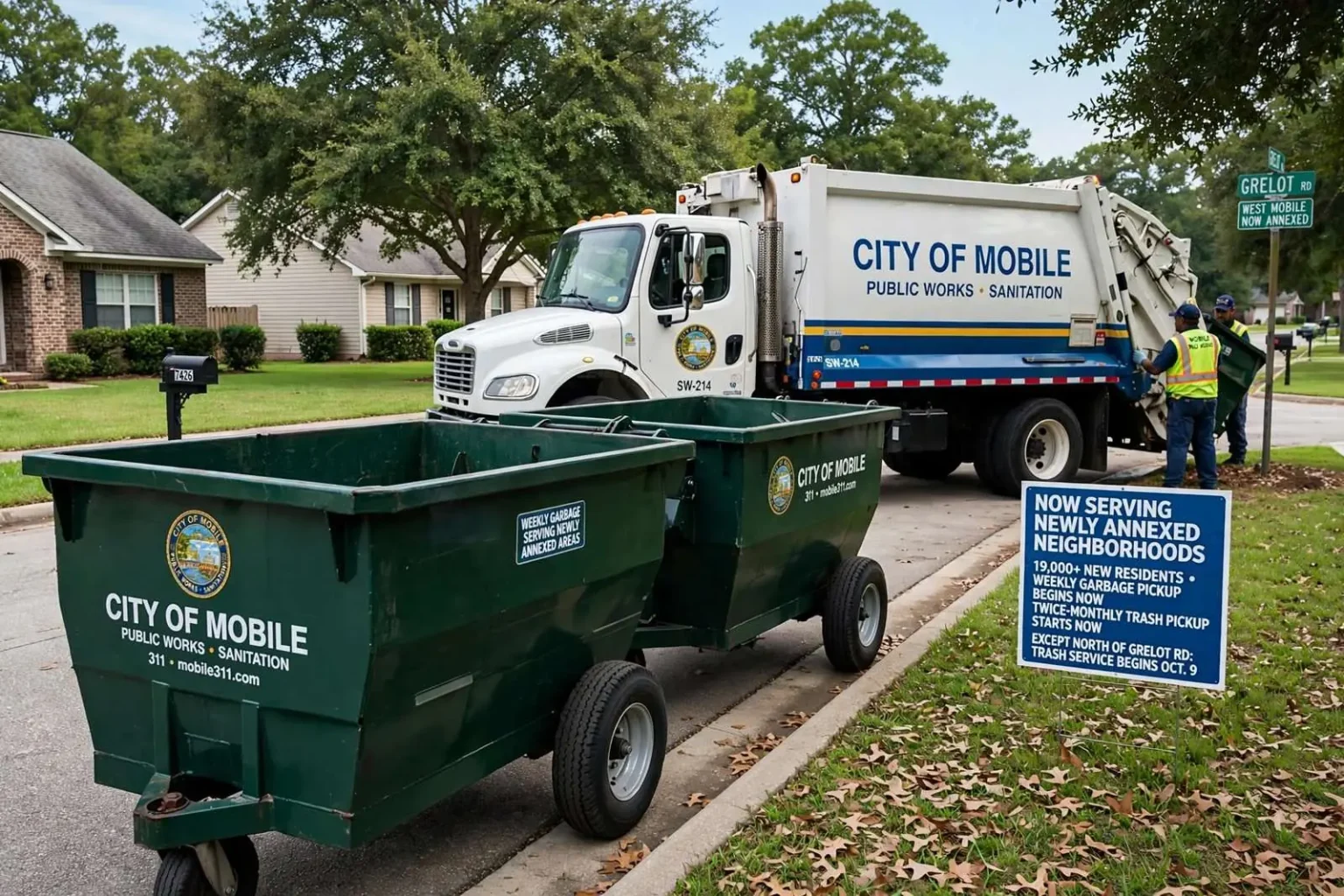
The City of Mobile has started household garbage and trash collection in the areas annexed into the city, extending full municipal services to the roughly 19,000 residents who joined Mobile in July.
Most newly annexed households now receive free weekly garbage pickup plus free trash pickup twice a month. One exception: residents living north of Grelot Road will wait until Oct. 9 for their trash collection to begin.
“We were incredibly excited to welcome more than 19,000 new residents to Mobile in July, and we are just as excited to begin providing full city services to those residents,” Mayor Sandy Stimpson said. “Our goal is to make sure these Mobilians look back and view joining our city as a positive.”
Garbage carts have been rolling out to annexed households for the past month. Anyone who has not received a cart — or who wants an additional one — can submit a request through Mobile 311, which is also the contact point for questions about the new services.
A major expansion of city services
The rollout of garbage and trash collection marks one of the most visible steps yet in folding the annexed neighborhoods into Mobile’s municipal operations. City services are, for most residents, the practical meaning of annexation — police response, fire protection and sanitation pickup are the things people notice week to week, and sanitation sits at the top of that list because it happens at every driveway.
Under the service model now extending to the new areas, households receive weekly curbside garbage collection and twice-monthly trash pickup, both provided at no additional charge as part of city residency. That arrangement replaces whatever private hauler or do-it-yourself arrangement annexed households previously relied on in the unincorporated county, and it is one of the concrete financial benefits the city points to when making its case for annexation.
The transition has been staged. Garbage carts have been distributed across the annexed areas over the past month, giving households the containers they need for weekly pickup, while trash collection — the twice-monthly service for bulk items and yard debris — begins on the schedule the city has announced, with the north-of-Grelot area waiting until Oct. 9.
City officials have treated the extension of services as a milestone in the annexation process, and the mayor’s statement emphasized that the work of integration is measured by how residents experience it: the goal, in Stimpson’s words, is for new Mobilians to look back on joining the city as a positive.
What the new service looks like week to week
For a newly annexed household, the weekly rhythm now includes a garbage collection day each week, with carts wheeled to the curb and returned after pickup. The twice-monthly trash service handles the bigger, bulkier debris that does not fit a cart — furniture, appliances, large yard trimmings — the category of waste that unincorporated residents have often had to haul themselves or pay to dispose of.
The city’s sanitation operation runs on established routes across Mobile’s districts, and extending those routes into the annexed areas required planning on the scale of a mid-sized town: roughly 19,000 new residents represent thousands of additional households, each needing a cart, a route assignment and a schedule.
Residents north of Grelot Road — the one area with a delayed trash start — should note the Oct. 9 date for the beginning of their twice-monthly trash collection. Garbage service in that area follows the same weekly rollout as elsewhere in the annexed zone, with the trash service lagging only because of how the city has phased its routes.
Questions about days, carts and scheduling go through Mobile 311, the city’s customer service line and online portal, which functions as the single point of contact for municipal service requests. The 311 system handles everything from missed pickups to cart requests, and city officials have directed new residents there rather than to individual departments.
The annexation that brought 19,000 residents
The neighborhoods receiving service were part of the large annexation approved by voters that added roughly 19,000 residents to the city in July, one of the biggest municipal boundary expansions in Mobile’s modern history. The annexed territory lies largely in West Mobile — suburban, fast-growing areas between the city’s traditional limits and the county’s unincorporated stretches.
Annexation votes of this scale are unusual in Alabama, where municipal boundaries tend to creep outward in small increments. The campaign for the West Mobile annexation centered on exactly the services now arriving: city police and fire coverage, garbage and trash collection, and a seat in Mobile’s city government, weighed against the property tax considerations that always dominate the debate in Mobile County.
For the city, the annexation brought population growth that ripples through everything from census figures to federal funding formulas. For the new residents, the practical change arrives in installments — a cart at the curb, a route on a schedule, a different set of blue uniforms answering calls — and the sanitation rollout is the installment most visible from the driveway.
The Stimpson administration has framed the extension of services as keeping the city’s side of the bargain struck during the annexation campaign. The mayor’s remarks about wanting new residents to view joining the city positively reflect the political reality that annexations are judged, years later, by service delivery rather than by election-day margins.
How Mobile’s sanitation system works
The services arriving in the annexed areas are the same ones longtime Mobilians receive. Household garbage is collected weekly from city-issued carts, with residents following route-day schedules published by the city. Trash — the bulk and yard debris category — is collected twice monthly on alternating routes, with items curbside on scheduled days.
The city’s Public Works Department operates the routes, and the fleet and crew requirements of absorbing an area the size of the annexation are substantial. Route planning has to balance the new households into existing geographic patterns so that trucks cover contiguous areas rather than zigzagging across the city, which is why phased start dates like the one north of Grelot Road appear in the rollout.
Mobile 311 anchors the customer-service side of the system. The line and its online counterpart log service requests, track them to resolution and route them to the appropriate department. For the annexed households, 311 is the channel for a missing cart, an extra cart, a missed pickup or a question about which days apply to a particular street.
City officials encourage residents to report problems rather than wait, since missed-collection reports feed the operational data the department uses to adjust routes as the new areas settle into the system.
What residents should do now
The practical checklist for newly annexed households is short. First, if a garbage cart has not arrived, submit a request through Mobile 311 — distribution has been underway for a month, and gaps are the kind of issue 311 exists to catch. Second, residents who want an additional cart can request one through the same channel.
Third, note the trash schedule: twice-monthly pickup for most of the annexed area, beginning immediately, with the Oct. 9 start for households north of Grelot Road. Bulk items should be placed curbside according to the schedule the city publishes for each route.
Finally, keep questions in the 311 system rather than calling departments directly. The 311 staff can answer schedule questions, log cart issues and escalate problems, and using the system creates the record that helps the city spot and fix gaps in the new routes.
Why sanitation is the first thing people notice
Municipal experts often note that residents judge their city governments less by grand projects than by the services that show up on schedule — and nothing shows up more often than the garbage truck. For the 19,000 residents who joined Mobile in July, the weekly arrival of city sanitation is the moment annexation becomes real.
The economics reinforce the point. In unincorporated Mobile County, households typically pay private haulers for garbage collection, and trash disposal — the bulk items and yard debris — is often an added cost or a self-service chore. Inside the city, both services come without a separate bill, a difference that accumulates month after month and that city officials cite as a tangible benefit of residency.
The twice-monthly trash schedule is also a service quality marker. Bulk collection is where service failures are most visible — piles that sit for weeks when routes are missed — and the city’s phased approach is designed to build the routes carefully enough to avoid exactly that problem in the annexed areas.
The road ahead for the annexed areas
Sanitation is the beginning of the service integration, not the end. New residents are also absorbing city police beats, fire station coverage, street maintenance schedules and the other layers of municipal operation that come with city limits. Each arrives on its own timeline, and city departments have been working through the transition since the annexation took effect in July.
The Grelot Road area’s Oct. 9 trash start date illustrates how the city is managing that timeline: services arrive everywhere eventually, but the sequence reflects logistics rather than any distinction between neighborhoods. Garbage carts, weekly collection and 311 access are in place across the annexed zone now.
Over time, the measure of the annexation will be ordinary: routes that run on schedule, carts that get replaced when they break, pickups that happen on the day they should. The mayor’s goal — that new Mobilians look back on joining the city as a positive — will be decided in exactly those small, recurring transactions.
For now, the city’s message to the roughly 19,000 newest residents is that full municipal service has arrived at their curbs: free weekly garbage pickup, free twice-monthly trash pickup, carts delivered and requests handled through Mobile 311 — with the one exception north of Grelot Road, where trash service joins the rotation on Oct. 9.
Residents with any question about the new services — schedules, carts, bulk items or missed pickups — can reach Mobile 311 by phone or through the city’s online portal, the single doorway into the city’s service system that the newest Mobilians now share with the rest of the city.