
Mobile Fire-Rescue Clears Man Once Sought in Crichton Arson Cases
Mobile Fire-Rescue cleared Demarcus Battles in the Crichton Dairy Queen arsons; investigators arrested Paul Law in the December 2019 fires.
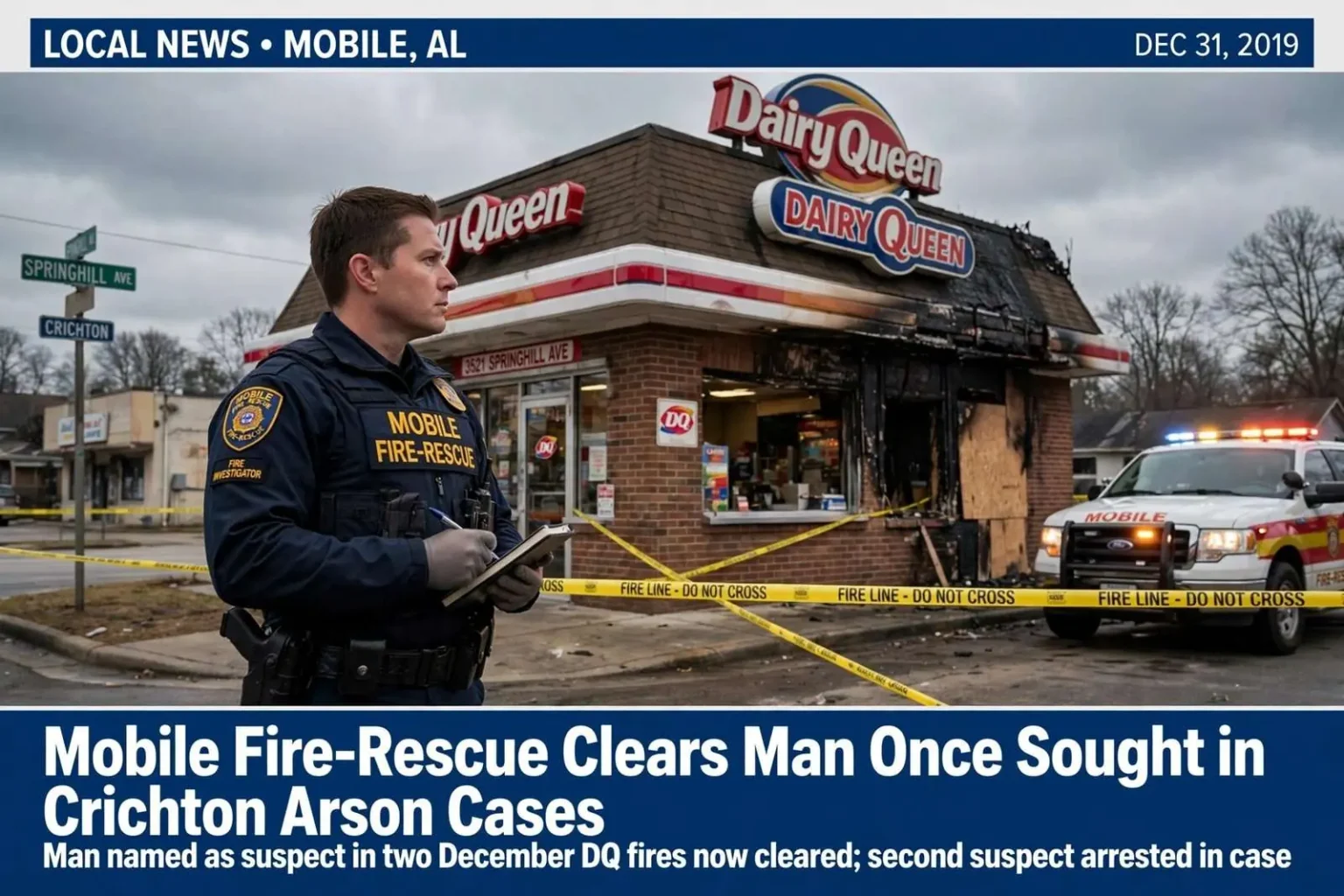
Mobile Fire-Rescue has closed out a case that began with a public appeal for help finding an arson suspect, announcing that the man it had sought in connection with two fires at a Crichton business was cleared of any wrongdoing. The announcement, made on New Year’s Eve, brought an unusual end to a monthlong investigation that had put the department’s request for tips in front of thousands of Mobile residents.
Investigators spent December 2019 looking into two separate fires set at the Dairy Queen on Springhill Avenue in the Crichton community, the first on December 13 and a second exactly one week later. Two fires at the same address within seven days is a pattern that almost always pushes an investigation from an accident file into an arson file, and Mobile Fire-Rescue treated it that way from the start. Fire investigators documented the scenes, collected evidence from both structures, and worked to determine whether the same person was responsible for both blazes.
At the time, investigators identified 36-year-old Demarcus Battles as a suspect and asked the public to call 911 with any information on his whereabouts, describing him as potentially dangerous. The appeal put his name and description into circulation across local news outlets and social media, the standard method a Mobile County law enforcement agency uses when it believes a suspect may be moving through neighborhoods where someone will recognize him. Public appeals like this one depend entirely on residents paying attention, and in Crichton — a close-knit community just north of downtown Mobile — that kind of request tends to travel quickly through churches, corner stores, and family networks.
Mobile Fire-Rescue, the department behind the investigation, provides fire suppression, rescue services, and fire prevention work across the city, operating fire stations spread through every council district. Its investigators are the people who walk through a burned building once the hoses are packed up, reading burn patterns and gathering what the fire itself leaves behind. Crichton sits in the northern part of the city, an area of older neighborhoods and commercial strips along Springhill Avenue where a fire at a well-known business draws immediate attention from the surrounding blocks.
That request ended on December 31, when the department announced that Battles had been cleared in connection with the fires. The reversal was significant. Being named a suspect in a public appeal carries real consequences even before an arrest is ever made, and clearing someone’s name publicly is the corrective step agencies take when the evidence no longer supports the original theory. Mobile Fire-Rescue did not walk back the request quietly; the clearance was announced the same way the appeal had been, so that residents who had seen the first bulletin would also see the resolution.
Investigators have since arrested another man, Paul Law, in the case. The arrest shifted the focus of the investigation entirely, moving the file from a search for a missing suspect to the prosecution of a man already in custody. The department has not released additional details about what led investigators to clear Battles or what evidence tied Law to the fires, which is common while a case moves toward the district attorney’s office, where prosecutors review the findings before formal charges are presented.
The sequence — a public appeal, a name cleared, a different suspect arrested — illustrates how early-stage arson investigations actually work in practice. In the first days after a fire, investigators work from physical evidence at the scene: burn patterns, points of origin, accelerant detection, and witness accounts from people who live or work nearby. A name can surface quickly from those early threads, and departments often publicize it while the picture is still incomplete. As lab results, interviews, and surveillance footage fill in the rest of the picture, the theory of the case can change, and responsible agencies correct course rather than press forward on a bad lead.
Tips from the public feed directly into that process. When a department asks residents to call 911 with information, every call becomes a lead that investigators can chase — a sighting, a timestamp, a detail about a vehicle or a direction of travel. In a case built on two separate fire scenes, tips about one fire often help explain the other, and the accumulation of small details is what eventually separates one suspect from another.
For Battles, the clearance closed a chapter that had made his name public across Mobile in connection with a serious felony. For the Dairy Queen on Springhill Avenue, the arrest offered some assurance to a business corridor that had watched the same building catch fire twice in a single month. Springhill Avenue is one of the main commercial arteries through Crichton, and a repeated fire at a familiar storefront draws attention from everyone who passes it daily.
Within the City of Mobile, fire investigations are handled by Mobile Fire-Rescue’s own fire investigators, who respond to suspicious fires alongside firefighters and take over the scene once the flames are out. Fires outside city limits generally fall to the Mobile County Sheriff’s Office or to volunteer fire departments working with county investigators, which makes the city’s in-house unit one of the busier fire investigation operations on the Gulf Coast. Investigators there routinely split their time between structures, vehicles, and brush fires, and their findings feed directly into criminal prosecutions.
The two December fires also landed during one of the busier stretches of the year for arson work. Late December brings a predictable mix of conditions — cold snaps that push people toward space heaters and improvised heating, holiday vacancies at businesses that close early, and longer nights that give someone setting a fire more hours of darkness to work in. None of those factors determine what happened at the Dairy Queen, but they shape the workload investigators carry when a repeat fire lands on their desk.
The department has not said whether the two fires at the restaurant were set in the same manner or whether the second fire was an attempt to cover up the first, questions that often matter in cases involving repeated fires at the same location. What investigators established, through their month of work, is that the person responsible was not the man they first named. That conclusion, and the arrest of Paul Law, now stand as the public record of the case.
What the case means for Crichton residents
For people who live and work in Crichton, the outcome carries a practical lesson that public safety officials repeat often: a public appeal is a starting point, not a verdict. Residents who saw Battles described as potentially dangerous in December saw the department itself undo that characterization by year’s end. The same attention that helped circulate the appeal also ensured the correction reached the same audience.
The arithmetic of an appeal is worth understanding. A bulletin naming a suspect reaches thousands of people, and among those thousands are usually a handful who recognize the name or the face. What happens next depends on what they do with that recognition. In Mobile, as in any city, some leads turn out to be mistaken — a sighting that places someone somewhere they never were, a resemblance that puts an innocent person’s name in a report. Investigators weigh every tip against the physical evidence, and in this case the weight of that evidence eventually pointed away from Battles altogether. When it did, the department’s obligation was to say so publicly, and it did.
For a business owner, a fire — let alone two — means more than the damage visible from the street. Beyond the burn itself there is smoke intrusion, water damage from suppression, and the time it takes an insurance claim and a contractor to bring the building back. When the fire is ruled arson, the investigation adds another layer, since the scene has to be preserved as evidence before repairs can begin. Neighboring shops along Springhill Avenue watched that process play out through the second half of December, and the arrest in the case gave the corridor at least the assurance that the investigation had produced a result.
The case also shows why fire departments press residents to report what they see, even when it seems minor. A person who noticed a stranger lingering near the restaurant on December 13, or a car that should not have been there on December 20, may hold a detail that means nothing on its own and everything when placed beside the rest of the file. In Mobile County, those calls have closed out countless fire cases over the years, and the Crichton investigation ended the way most of them do — with investigators following the evidence wherever it led, even when that meant abandoning their first theory.
The case remains part of the department’s ongoing fire investigations in Mobile County, and the arrest of Law moves the Dairy Queen fires into the court system, where outcomes are decided on evidence presented to prosecutors and judges rather than on early bulletins. Mobile Fire-Rescue closes out 2019 with the fires solved by an arrest, a cleared man whose name was returned to him, and a reminder that in fire investigation, the first answer is sometimes not the final one.