Mobile Fire-Rescue Contains Woods Fire Threatening Apartment Complex on Sollie Road
Mobile Fire-Rescue crews contained woods fires south of Charleston Apartment Homes on Sollie Road that briefly threatened the apartment complex.
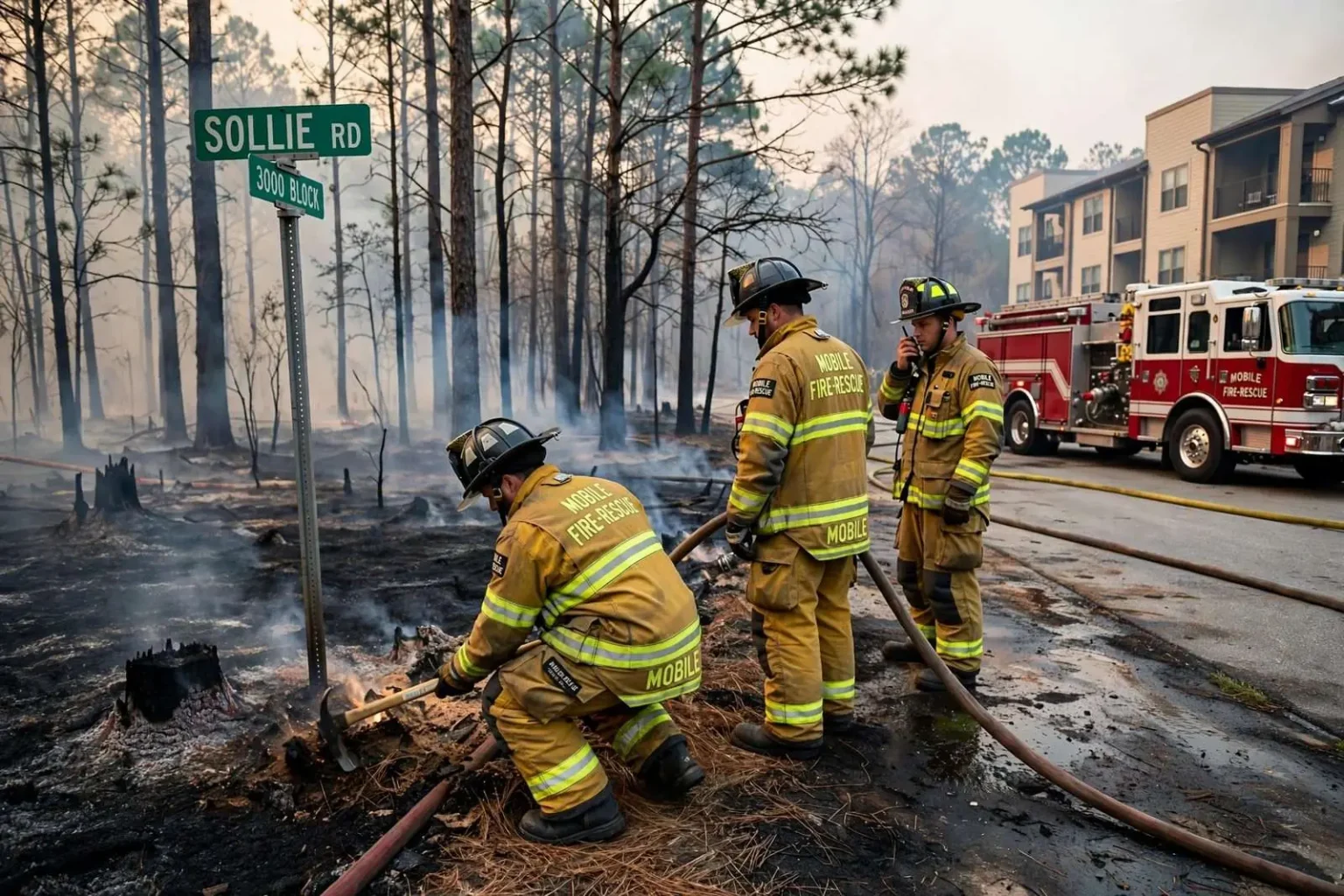
Mobile Fire-Rescue crews responded to two large area wood fires just south of the Charleston Apartment Homes complex, with officials saying the flames posed a threat to the apartments. Multiple crews worked the scene along Sollie Road. By early evening, officials said the fire was small and had been contained. No injuries or damage to the apartment complex were reported in initial updates from the department.
The fires broke out in wooded land just south of the Charleston Apartment Homes community along Sollie Road, in the western part of Mobile. Crews arriving on the scene found two separate areas of burning woods, and officials assessed the spread as a threat to the nearby apartment complex before the response brought the flames under control. Multiple fire companies worked the scene through the afternoon, cutting off the fire’s path toward the buildings and protecting the neighborhood as conditions developed.
By early evening, Mobile Fire-Rescue officials reported that the fire had been reduced to a small area and contained, meaning fire lines held and no further spread was expected. Initial updates from the department confirmed no injuries and no damage to the apartment complex. The response stands as an example of the wildland firefighting work Mobile crews face regularly, particularly during dry stretches when brush and woods fires can move quickly toward developed areas.
Wildland Fire Risk in West Mobile
West Mobile’s mix of subdivisions, apartment communities, and undeveloped wooded tracts creates what fire officials call a wildland-urban interface, where homes and businesses sit directly against land that can burn. Longleaf pine and mixed hardwood stands, dense undergrowth, and frequent Gulf Coast dry spells combine to produce brush fire conditions, especially in late summer and fall when rainfall is uneven and humidity drops behind passing cold fronts. Fires in these conditions can travel through grass and brush faster than residents expect, throwing embers ahead of the main fire front.
Sollie Road runs through this landscape in western Mobile, an area that has seen substantial residential growth over recent decades. Apartment complexes and neighborhoods in the corridor border undeveloped parcels, drainage corridors, and wooded lots where fires can start from a range of causes, including debris burns that escape, equipment sparks, discarded smoking materials, and lightning. The Alabama Forestry Commission supports local departments in the region with burn permit oversight, wildland crews, and firefighting aircraft when conditions warrant.
Mobile Fire-Rescue trains for these incidents alongside its structure fire response, with apparatus carrying wildland tools and crews practicing hose lays, hand line construction, and defensive positioning to protect exposed buildings. When a woods fire threatens an apartment complex, the department’s priority shifts to protecting the structures, which changes how crews deploy resources around the perimeter of the fire.
How the Response Unfolded
Initial crews arriving on a woods fire near apartments follow a standard framework: size up the fire’s direction and rate of spread, identify structures in its path, and establish a plan to cut the fire off. In this incident, multiple crews worked the scene along Sollie Road, positioning apparatus between the flames and the Charleston Apartment Homes complex and attacking the fire along its edges. Water supply in areas without fire hydrants can come from tankers and portable pools, though west Mobile’s street network generally provides hydrant coverage close to developed parcels.
Containment, the milestone officials announced by early evening, means the fire is surrounded by control lines or barriers and is no longer spreading. Crews typically remain on the scene after containment to mop up hot spots, monitor smoldering interior areas, and ensure that wind changes do not push embers across the lines. The department’s initial updates confirmed that no injuries occurred and no damage was done to the apartment complex, a result that reflects both the response and the geography of the fire’s movement.
Officials have not released a cause for the fires or an estimate of acreage burned in the wooded area. Investigations of brush fires focus on points of origin, weather records, and any evidence of ignition sources, and findings are released when the review is complete.
Mobile Fire-Rescue and Its Coverage
Mobile Fire-Rescue, the fire department of the city of Mobile, operates fire stations across the city and provides fire suppression, emergency medical services, and specialized response capabilities to Alabama’s fourth-largest city. The department’s coverage area includes the densely built older sections of the city as well as the expanding residential corridors to the west, where new subdivisions and apartment complexes continue to push development against wooded land. Its crews handle structure fires, medical emergencies, vehicle crashes, hazardous materials incidents, and wildland fires each year.
Apartment complexes present particular challenges in fire response because of the number of residents potentially exposed in a single incident. Departments across the Gulf Coast emphasize early evacuations, clear access lanes for apparatus, and defensible space — cleared buffers between structures and vegetation — for multifamily properties near woods. Fire officials in Mobile regularly encourage property managers to maintain those buffers, keep irrigation working, and ensure that residents know evacuation routes before smoke makes them hard to see.
During the incident along Sollie Road, the threat to the Charleston Apartment Homes complex shaped the deployment, with crews assigned to protect the buildings while others fought the fire in the woods. The outcome — the fire contained by early evening with no injuries and no damage to the complex — matched the department’s objectives for an interface fire of this kind.
What Residents Near Wooded Areas Should Know
Fire officials in south Alabama recommend that residents living near wooded tracts take a handful of practical steps. Keeping a cleared zone of at least thirty feet around a home or building, removing dead vegetation and pine straw accumulations near exterior walls, trimming limbs away from rooflines, and storing firewood away from structures all reduce the chance that embers ignite a building. Cleaning gutters and decks of flammable debris matters during dry periods, when embers from a distant brush fire can reach a neighborhood ahead of the flames.
Residents should also know the rules on outdoor burning. In Mobile, open burning is regulated by city ordinance and by the Alabama Department of Environmental Management, and the Alabama Forestry Commission issues burn permits for larger land-clearing fires in unincorporated areas. During drought conditions, burn bans can prohibit all outdoor burning, and violations carry penalties because of the risk escaped fires pose to neighbors. Most brush fires in the region are traced to escaped debris burns or equipment use rather than natural causes.
Smoke from woods fires also creates hazards beyond the flames, reducing visibility on roads like Sollie Road and aggravating breathing conditions for residents nearby. Officials advise drivers to slow down and use headlights in smoke, and residents with respiratory conditions to stay indoors and run air conditioning on recirculate until the smoke clears.
After the Fire Is Out
Even after containment, crews may return to a burned area for days to monitor for rekindling, since roots, stumps, and deep organic soil can hold heat long after the surface flames are gone. Fire investigators will work to determine what started the two fires near the apartment complex, and property managers will typically assess the burned buffer for hazards such as weakened trees before allowing normal activity near the tree line.
The incident along Sollie Road ended with the outcome Mobile Fire-Rescue trains for: the threat recognized early, multiple crews positioned to protect the apartment community, and the fire held small and contained by early evening. Officials reiterated in their updates that no injuries were reported and the apartment complex escaped damage, closing out the emergency phase while follow-up work continued in the burn area.
A Seasonal Pattern on the Gulf Coast
Fire officials note that brush and woods fires in the Mobile area tend to cluster in predictable conditions: extended dry spells in late summer, the fall fire season when humidity drops, and late winter cold fronts that desiccate vegetation. Days of low rainfall followed by wind are the combination that turns a small fire in the woods into a neighborhood emergency, which is why departments track weather outlooks alongside their daily readiness.
For communities along Sollie Road and throughout west Mobile, the incident serves as a practical reminder of the relationship between development and the wooded land that makes the area attractive. Growth in the corridor continues to bring homes closer to undeveloped tracts, and fire officials encourage builders, managers, and homeowners alike to plan for fire behavior at the interface — not because fires are common, but because the cost of being unprepared is measured in the buildings and lives at the edge of the smoke that follows it. Authorities said the area will be monitored in the coming days for any rekindling, and the department will release the findings of its cause investigation once the review is complete.