Mobile Fire-Rescue Holds Boot Drives to Help Dauphin Island Fire Chief Recovering From Burns
Mobile Fire-Rescue is holding boot drive fundraisers to help Dauphin Island Fire Chief Brad Cox, who suffered severe burns in the line of duty.
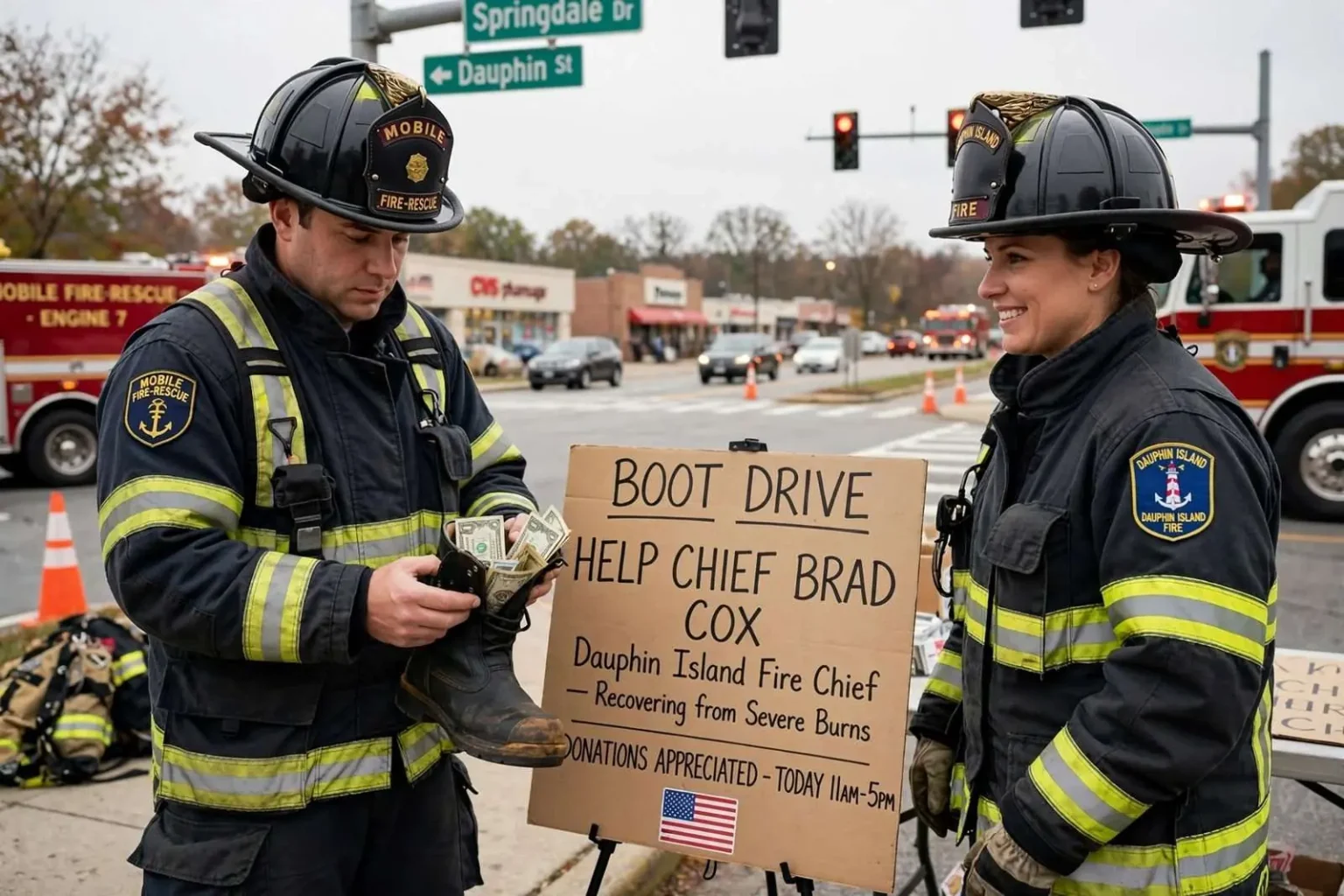
Mobile Fire-Rescue firefighters are collecting donations at intersections across the city this month to help Dauphin Island Fire Chief Brad Cox and his family after he suffered severe burns responding to a fire last month. The fundraising effort brings together firefighters from two separate departments and communities — the state’s second-largest city and a barrier island town at the far southern edge of Mobile County — around a single injury that resonated through the region’s fire service. Burns of the severity Cox suffered are among the most dangerous injuries a firefighter can survive, and the recovery that follows is measured in months of hospital care and rehabilitation rather than days.
Cox was hospitalized at USA Hospital, where he required ventilator support and a tracheostomy because of the severity of his injuries, according to fire department officials. A tracheostomy — a surgically created airway through the neck — is typically required when burns and smoke inhalation compromise a patient’s ability to breathe on their own, and ventilator support in those early weeks marks the most fragile phase of a burn recovery. The University of South Alabama’s medical center is one of the region’s primary destinations for patients with traumatic injuries, and its intensive care units handle exactly the kind of complex, multi-system cases a severe burn injury presents.
Recovery Moves to Long-Term Care
He has since been moved to Infirmary West LTAC, a long-term acute care facility, to continue his recovery. The transition out of intensive care is a milestone in any serious injury, but the move to a long-term acute care hospital signals the reality that follows: weeks or months of wound care, respiratory therapy, physical rehabilitation and monitoring before a patient can return to any version of normal life. For a working fire chief, that timeline also means months away from the department and a family managing both the medical journey and the household strain that comes with it.
Long-term acute care facilities fill a specific gap in the medical system — caring for patients who no longer need a full hospital but are not yet ready for home or outpatient rehabilitation. The daily work there is slow and repetitive by design: dressing changes, breathing treatments, mobility work and the steady effort of rebuilding what injury took away. For burned firefighters, skin graft care and physical therapy can stretch the recovery well past a year, which is why departments and unions so often organize financial support at the beginning of a journey like this one.
Boot Drives Set at Three Intersections
Mobile firefighters are holding “boot drive” fundraisers, standing at busy intersections and collecting cash donations in their turnout boots, at the same three locations on three separate dates. Firefighters will be stationed Sunday, November 14, from 11 a.m. to 5 p.m.; Friday, November 19, from 11 a.m. to 5 p.m.; and Saturday, November 20, from 8 a.m. to 5 p.m., at the following corners: Springdale Drive at Dauphin Street, Schillinger Road at Airport Boulevard, and Highway 90 at Three Notch Road.
The three locations are deliberate picks that spread the collection points across the city’s geography. The Springdale and Dauphin Street corner sits in the heart of west Mobile’s busiest retail and residential corridor, Schillinger Road at Airport Boulevard catches traffic in the fast-growing western suburbs, and the Highway 90 at Three Notch Road intersection serves the Tillman’s Corner area in the southern part of the city. Together they put fundraising firefighters in front of thousands of drivers during morning errands, afternoon traffic and a busy Saturday, and the image of a firefighter holding out a turnout boot at a red light has proved one of the most effective grassroots fundraising formats the fire service has.
Boot drives carry a meaning that goes beyond the money collected in them. The sight of off-duty firefighters volunteering their own hours, standing in the cold or the traffic exhaust, tells the community that the man they are helping is one of their own — and that the fire service takes care of its people. Drivers who drop bills into a boot rarely know the injured firefighter personally, but the transaction builds the kind of bond between departments and neighborhoods that pays dividends long after the drive ends, in support votes, in patience during street closures and in the goodwill that follows fire crews through their careers.
Restaurant Fundraiser Planned for December
Texas Roadhouse at 6150 Airport Boulevard is also organizing a fundraising night for Cox on Tuesday, December 7, from 5 to 8 p.m. The restaurant says it will donate 10 percent of food purchases made during that window to the fundraiser for customers who drop their receipt in a collection box at the restaurant. The mechanics matter for anyone planning to attend: the donation only counts for receipts placed in the box, so diners who want their meal to benefit the chief need to remember the final step on the way out the door.
The format is one of the most common partnership models between national restaurant chains and local causes. A three-hour dinner window on a weekday evening captures the peak dinner rush, the restaurant converts its regular traffic into a fundraiser at essentially no cost to the family, and the community gets a reason to gather that feels like dinner rather than a charity appeal. Families juggling holiday-season schedules in early December often find a dinner-based fundraiser easier to support than another request for direct donations, and restaurants along the Airport Boulevard corridor — one of Mobile’s busiest dining strips — draw from every part of the city.
Flyers with details are available at Mobile fire stations, including the station at Tapia Drive. Fire stations double as information points for campaigns like this one, and residents who miss the boot drives can pick up the details in person, pass them to neighbors or post them at churches, schools and workplaces across their own neighborhoods. The more the flyers circulate, the wider the safety net around the Cox family becomes — and in a fundraising effort built on small donations from many people, circulation is everything.
A Tradition of Mutual Aid Across Two Counties
Mobile Fire-Rescue has organized similar boot drives in the past for firefighters and families facing medical emergencies, drawing on the department’s long tradition of mutual aid among first responders across Mobile and Baldwin counties. Mutual aid in the fire service formally means the agreements that send engines and ladders across jurisdictional lines when a neighboring department needs help, and it runs deep along the Gulf Coast, where a major fire, a hurricane or a major incident on the Causeway or the Bayway can pull resources from a dozen departments at once. But the tradition has always extended beyond apparatus and staffing to the informal network of support that links firefighters’ families across the two counties.
Dauphin Island’s fire department is small by necessity — the island’s year-round population is a fraction of its summer crowd, and its chief and volunteers face the same hazards as their big-city counterparts with a fraction of the staffing. When the island’s fire chief is injured, the department loses its leader and the town loses a public servant whose job covers everything from beach-rescue support to storm response. That is the gap the boot drives and the restaurant night are built to fill, one boot and one receipt box at a time.
For residents who want to help, the paths are straightforward. Show up at any of the three intersections during the boot drive hours and drop a donation in the boot. Dine at the Airport Boulevard Texas Roadhouse on December 7 between 5 and 8 p.m. and drop the receipt in the box. Or make a contribution through the fire stations carrying the flyers. Every format welcomes the small donations that make up most of a boot drive’s total, and organizers consistently stress that the aggregate is what matters — a hundred drivers giving a few dollars each outpaces a handful of large checks.
What the Funds Go Toward
Medical fundraising for an injured firefighter typically covers the costs that insurance and workers’ compensation leave behind: travel between home and the care facility, household expenses that continue while a paycheck is interrupted, modifications and equipment needed during recovery, and the ordinary bills a family cannot pause because its breadwinner is in a hospital bed. In an injury as severe as the burns Cox suffered, the recovery timeline alone — months at a long-term acute care facility, followed by outpatient rehabilitation — creates a long runway of expense that no family budgets for in advance.
The fundraising also sends a message to the injured chief himself, which organizers of these drives often mention first. Recovering patients in long-term care face long stretches of monotony and pain, and the knowledge that their community is actively behind them — that drivers are leaning out of car windows to fill a boot at Springdale and Dauphin — reaches a hospital room in a way nothing else does. Fire service families describe that awareness as part of the treatment, a reminder that the department that sent them into the fire is still standing with them afterward.
The Broader Risk Firefighters Face
The injury that started this campaign is a reminder of what the job costs. Firefighters face burn and smoke-inhalation injuries on calls in every jurisdiction — big city, small town or barrier island — and the protective gear that makes modern firefighting possible still leaves gaps at extreme temperatures and collapse conditions. Burn recovery, as the details of Cox’s hospitalization show, is not a single event but a chain of interventions: intensive care, ventilation, surgical procedures, long-term wound care and rehabilitation. Each link requires specialists, and each takes time that ordinary life does not pause for.
That is why the boot drive model has endured across the fire service for decades. Equipment can be budgeted and apparatus can be financed, but the human cost of the job falls on families who had no way to plan for it, and the community that benefits from the service is the natural source of the cushion. Mobile Fire-Rescue’s decision to organize the drives for a chief from another department is the tradition at its best — the instinct that the fire service is one community across county lines, and that an injury on Dauphin Island is Mobile’s concern too.
The November boot drives and the December restaurant night run through the end of the month, giving the community three weekends of intersections and one dinner rush to fill the fund. From there, the Cox family’s recovery continues on its own long timeline, backed by whatever the boots and the receipt boxes managed to collect — and by a region that has shown, time and again, that it shows up for its firefighters.