
Mobile Fire Rescue puts out fire on towboat at Cochrane Causeway boatworks
Mobile Fire Rescue extinguished a fire on a towboat at Blakely Boatworks on the Cochrane Causeway; no injuries were reported and damage is unknown.
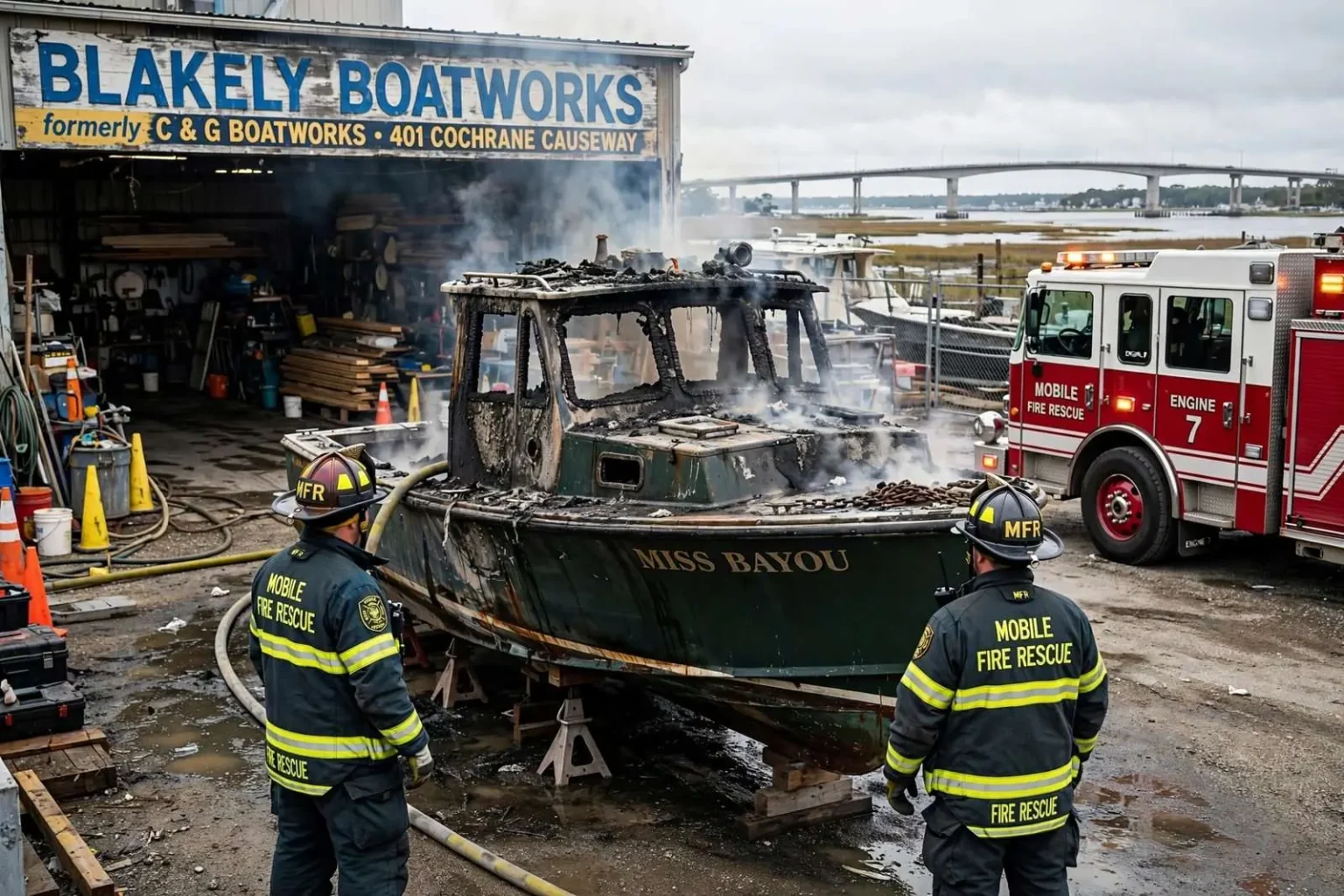
Mobile Fire Rescue crews responded to a fire on a towboat at a business on the Cochrane Causeway. The vessel was on land, not in the water, and no one was on board at the time. No injuries were reported. The fire broke out at Blakely Boatworks, formerly C & G Boatworks, at 401 Cochrane Causeway. Crews extinguished the blaze, and no damage estimate was immediately available.
Mobile Fire Rescue crews responded to a fire aboard a towboat at Blakely Boatworks on the Cochrane Causeway, the stretch of U.S. Highway 90 that runs along the western shore of Mobile Bay. The fire broke out at the boatyard, located at 401 Cochrane Causeway, and involved a vessel that was hauled out on land rather than in the water. No one was on board the towboat at the time, and no injuries were reported in the incident.
Crews brought the blaze under control and extinguished it, working on the yard’s property alongside the bay. Because the vessel sat on land, firefighters did not face the added complications of a vessel fire on the water, which can require marine response, but boatyard fires carry their own hazards, including fiberglass resins, fuels, paints, and welding materials commonly found in working yards. Officials did not immediately release a damage estimate, and the cause of the fire had not been announced in the initial reports.
The Cochrane Causeway and Its Boatbuilding History
The Cochrane Causeway is part of the historic U.S. Highway 90 corridor across Mobile Bay, a road that predates the interstate crossings and remains a working route connecting Mobile with the eastern shore communities. The Causeway has long been home to marine businesses — boatyards, tug and barge operations, bait shops, and seafood houses — that take advantage of direct access to the bay’s western shoreline. Its boatyards have served the region’s working fleet for decades, repairing towboats, tugs, fishing vessels, and pleasure craft.
Blakely Boatworks operates at 401 Cochrane Causeway at the site formerly occupied by C & G Boatworks, a yard known in the region for building and repairing working vessels. The transition from C & G to Blakely Boatworks continued the site’s role in the local marine industry, keeping the Causeway’s tradition of hands-on boat construction and repair alive. Yards like this one depend on skilled trades — hull fabrication, welding, joinery, painting, and mechanical work — performed around vessels that can weigh hundreds of tons when hauled out or under construction.
Towboats, the vessels that push barges on the region’s rivers and harbors, are a familiar product and customer of Causeway yards. Their hulls, house structures, and machinery spaces involve large quantities of flammable and combustible material during construction and repair, which is why fire response at boatyards is treated as a specialized incident rather than a routine structure fire.
Firefighting Challenges at a Boatyard
A fire aboard a vessel on land presents a mix of hazards that falls somewhere between a structure fire and a marine incident. Vessels are built with compartmented spaces, narrow passageways, and limited access points, meaning firefighters must often advance hose lines through confined machinery spaces to reach the seat of a fire. Combustible materials in a working towboat include fuels and lubricants in the engine room, insulation, wiring, and the large amounts of wood, fiberglass, and marine paint present in a yard setting.
Mobile Fire Rescue crews responding to the Causeway worked to contain the blaze to the vessel and prevent extension to nearby yard structures, vessels under repair, and stored materials. The department’s crews train for industrial and marine-response scenarios, and Mobile’s waterfront industry gives them regular experience with fires and rescues involving vessels, docks, and port facilities. No injuries were reported in this fire, either to workers at the yard or to the crews responding.
The fact that the towboat was on land simplified several aspects of the response. There was no risk of the vessel sinking or of a fire spreading across the water, and crews had solid footing and yard equipment available. Hauled-out vessels are also easier for firefighters to access from multiple sides than a vessel moored at a dock, though the elevated hull and superstructure still require ladders and careful hose work.
Mobile Fire Rescue and Industrial Response
Mobile Fire Rescue protects Alabama’s fourth-largest city and one of the Gulf Coast’s major port and industrial corridors. The department’s response area includes the Port of Mobile, refineries and chemical facilities, shipyards, and the Causeway waterfront, giving its crews broad experience with industrial fires. Departments in port cities emphasize pre-incident planning with waterfront businesses, so that responding companies know yard layouts, water supplies, and the hazards stored on each property before an emergency occurs.
In a boatyard fire, early decisions shape the outcome: where to position apparatus, how to protect adjacent vessels and buildings, and whether to attack the fire directly or defend the exposures while it burns out in a confined area. Investigators look closely afterward at the origin of the fire — engine rooms, welding operations, electrical systems, and hot work performed near flammable materials are among the most common sources in yard incidents. The department had not announced a cause or damage estimate in the immediate aftermath of the Causeway fire.
The absence of injuries in this incident reflects both circumstances and standard practice. With no one aboard the vessel, search and rescue demands disappeared, and crews could concentrate on suppression. Boatyard operators also maintain safety requirements for hot work, fuel storage, and fire watches during repair operations, and those practices are designed to catch exactly the kind of incident that occurred at 401 Cochrane Causeway before it can grow beyond control.
The Working Fleet and the Causeway Economy
The towboat involved in the fire belongs to one of the most important segments of the region’s transportation economy. Towboats and tugs move barges carrying grain, petroleum products, aggregates, and containers on the Mobile, Tombigbee, and Alabama rivers and across Mobile Bay, linking the Port of Mobile with the interior of the state and the broader inland river system. Keeping that fleet in service depends on the yards along the Causeway and the city’s waterfront, where vessels undergo repairs, inspections, and overhauls between their working cycles.
A fire aboard a single vessel can therefore ripple through the local industry even when no one is hurt, pulling a boat out of service for repairs and tying up yard space and tradesmen. Insurers and operators move quickly after such incidents to assess damage, and yards coordinate with investigators before repair work can begin on the vessel involved. The absence of an immediate damage estimate in this case is typical, since hull, machinery, and interior damage is documented over days after a fire.
The Causeway itself remains a distinctive part of Mobile’s geography. Lining the road along the bay’s western edge, the businesses there — boatyards among them — operate at the water’s edge in a way few other parts of the city do, and the road’s low profile relative to the bay has made it a focus of periodic flood and storm surge discussions. Through all of that, the marine trades have persisted along the Causeway for generations.
What Happens After a Boatyard Fire
After crews extinguish the blaze, the next steps follow a familiar pattern. Fire investigators examine the vessel and the surrounding yard to determine the origin and cause, documenting the scene with photographs and interviews with yard personnel. The vessel’s operator and the yard’s insurer arrange for an assessment of the damage, and the yard reviews its own procedures and equipment in light of the incident. Officials will typically release cause findings only after that investigation is complete.
For the marine community along the Causeway, incidents like this reinforce the safety practices that govern work around vessels under construction and repair — controlling ignition sources during hot work, managing flammable liquids, and keeping response equipment ready in the yard. Mobile Fire Rescue’s response to the fire at Blakely Boatworks ended with the blaze extinguished, no one hurt, and the working waterfront along the Causeway able to carry on.
Boatyard Fire Prevention Practices
Marine trade associations and fire prevention officials outline a set of standard practices that yards use to reduce fire risk around vessels under construction and repair. Hot work — welding, cutting, and grinding — requires permits and fire watches that continue for a period after the work stops, because smoldering materials can ignite long after the sparks are gone. Flammable paints, solvents, and resins are stored away from work areas in approved cabinets, and fuel systems are drained or monitored whenever repair work involves a vessel’s tanks or engine room.
Electrical systems aboard older working vessels are another frequent concern, since wiring in damp marine environments degrades over years of service. Yard operators coordinate with vessel owners to de-energize systems during work and to inspect temporary power connections used while a boat is hauled out. Housekeeping matters as well: accumulations of sawdust, wood scraps, rags, and packaging give a small fire the fuel it needs to grow before crews can respond.
Response readiness is the final layer. Yards keep portable extinguishers staged near work areas, maintain clear lanes for fire apparatus, and identify the nearest hydrants and water supplies for arriving crews. When an incident does occur, those preparations are what allow the first-arriving fire companies to move directly to suppression, as Mobile Fire Rescue crews did along the Causeway, bringing the towboat fire under control with no injuries to anyone at the yard.